Howard still owns a few properties in LeDroit Park
In reviewing Howard University’s proposed campus plan, we started to take account of all of the property in DC that the university owns. Up until 10 years ago, Howard University was accused of being LeDroit Park’s biggest slumlord, owning numerous properties in the neighborhood and letting them lie vacant, blighted, and decaying.
Under the reign of university president H. Patrick Swygert, Howard made a significant and commendable effort to rehab and sell many of its vacant properties in the neighborhood.
For instance, the university owned all but one house on 400 block of Oakdale Place. It let these houses lie vacant, blighted, and boarded up. Under Pres. Swygert, the university renovated the houses and sold them to employees. Today the 400 block of Oakdale Place is fully occupied and a new condo building is nearing completion on the western end.

531 & 533 U St NW in 2004. Howard University renovated 531 (right) in 2004. Image from the DC government.
In other cases, the university renovated properties but has retained ownership. 531 U Street NW looked terrible in 2004 (right), but now looks very nice. We can’t quite tell if the house is occupied, but it consistently appears to be in good condition.
Elsewhere on the 500 and 600 blocks of U Street, Howard built historic infill houses (below) on vacant lots it owned on the north side of the street. The result is a block with with a continuous wall of housing on the street’s northern face. The houses’ façades are of high quality, with detailed brick work, ornate porches, and a variety of detailing.
The job is not entirely done, however, and Howard University retains ownership of a few properties that raise eyebrows. Let’s look at these three:
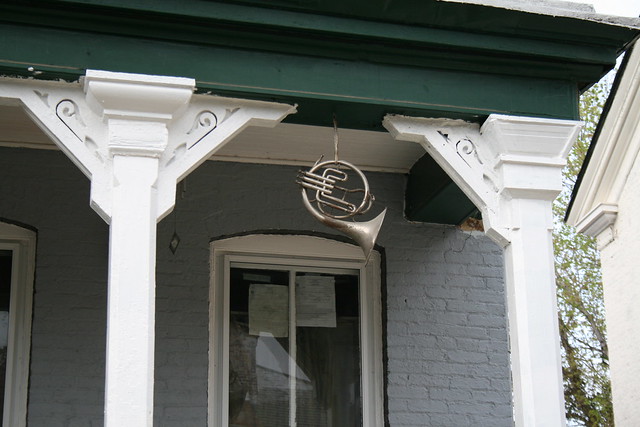
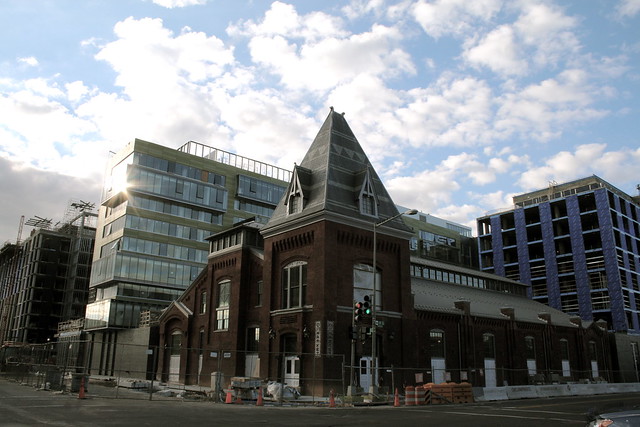
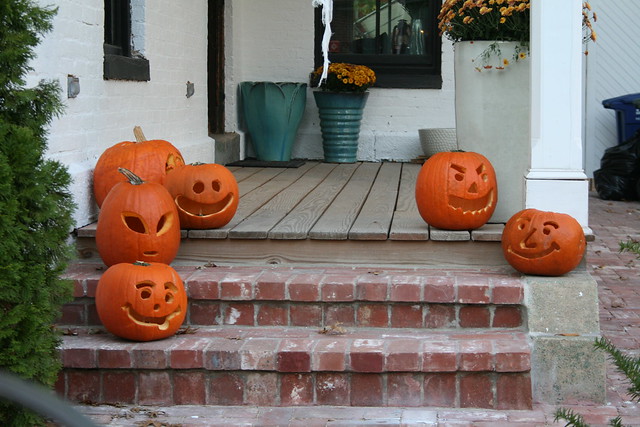
649 Florida Avenue (left) sits as a vacant lot, frequently collecting trash and debris. A university official told us that long ago Howard had considered using the lot to create a delightful pedestrian path to the university from the Shaw Metro. That never happened and now the lot sits vacant.
408-410 T Street (center) was the home of Walter Washington, DC’s first elected mayor. The university owns the property, and though it’s not blighted, it may be vacant. With some renovation work, this would make an excellent rental home for a Howard professor or anyone else for that matter.
326 T Street (right) is the Mary Church Terrell House, future home of the Robert and Mary Church Terrell House & LeDroit Park Museum and Cultural Center. Though it’s vacant and undoubtedly meets the District’s definition of blight, we are willing to cut the university more slack in this case since the eventual outcome will be a wonderful addition to the neighborhood. Unfortunately, the campus plan does not specify any additional Howard funding to restore the site.
In addition to the properties above, Howard owns a few more properties in LeDroit Park:
- Gravel parking lot at the SE corner of 5th and W Streets. (Square 3072, Lot 818). Campus plan does not mention any change to this lot.
- Carver Hall, 211 Elm St NW (Square 3084, Lot 830). Campus plan mentions the dorm’s decommission, but no reuse plans.
- Slowe Hall, 1919 3rd St NW (Square 3088, Lot 835). Campus plan mentions the dorm’s decommission, but no reuse plans.
- Howard University Hospital daycare, 1907-11 5th St NW (Square 3090, Lot 41)
- 420 T St NW – a house that appears to be occupied (Square 3094, Lot 800)
- Howard University Hospital (Square 3075, Lot 807)
- Parking garage bounded by 4th St, Oakdale Pl, 5th St, and V St. (Square 3080, Lot 73)
- Parking garage bounded by 4th St, V St, 5th St, and an alley. (Square 3072, Lot 52)
Though Howard retains a few problematic properties, it’s important to note the great strides the university has made in taking responsibility for its property portfolio in the neighborhood. A plan for these few remaining properties, even one in which the university retains ownership but leases, would put residents at greater ease.
“LE DROIT PARK. What Three Years Have Done.”
We came across this 1876 article documenting the initial improvements to the nascent LeDroit Park.
LE DROIT PARK. What Three Years Have Done.
National Republican
September 4, 1876Mr. James H. McGill, architect, has forwarded to the inspector of buildings, Mr. Thos. M. Plowman, a communication, in which he furnishes interesting information in relation to the improvements made in LeDroit Park within the last two years. He states that the different tracts of land composing the park were purchased at different times from June, 1872, to March, 1873, by Messrs. A.L. Barber & Co., and united by these gentlemen into one tract, which has been carefully surveyed and recorded. This park is in the form of an equilateral triangle, with one side resting on Boundary street [now Florida Avenue] and reaching from Seventh street eastward to Second street, and contains fifty acres. Until its subdivision by the present proprietor the eastern tract had been used for private residences and grounds, and the western portion had laid uninclosed for several years, and had been used as a public common. Improvements were soon commenced on a liberal scale; a handsome pattern of combination wood and iron fence was adopted and built all along the entire front and a board fence all along the rear, making one inclosure. All the interior fences were removed, and the lots thrown in together, affording a continuous sward. Streets were graded, graveled and guttered, brick sidewalks were put down, and gas, water and sewer mains laid.
The erection of buildings was commenced in July, 1873, since which time eight large brick residences have been erected on the north side of Maple avenue [now T Street] and two on the south side, costing from $4,000 to $12,000 each; ten houses on the north side and ten on the south side of Spruce street [now U Street], at an average cost of $3,500; two houses on the north side of Elm street, costing $3,000 each; four houses on east side, and five on the west side of Harewood avenue [now 3rd Street],costing from $4,000 to $10,000 each. A very superior stable and carriage-house has been completed for A. Langdon, esq., and another is in course of erection for A. R. Appleton, esq. Up to this date forty-one superior residences and two handsome stables have been constructed, at a cost of about $200,000. These houses are either built separately or in couples; are nearly all of brick; of varied designs, no two being alike either in size, shape or style of finish, or in the color of exterior. About $4,000 has been expended in the purchase and planting of ornamental shade trees and hedges, and about $50,000 in street improvements. About 4,500 lineal feet of streets have been graded and graveled, 9,000 feet of stone and brick gutters laid, 5,000 feet of brick pavement, 4,000 feet of sewer mains, 3,550 feet of water mains and 3,800 feet of gas mains laid. All of this expense has been by the proprietors of the property without a dollar from the District or authorities, and all the work has been done in the best and most liberal manner, under the direction of Mr. McGill. The plan contemplates the finishing of all its streets and the erection of two hundred tastefully-designed, conveniently-arranged and well-built detached and semi-detached residences, and when completed cannot fail of being a credit to all concerned. During the time stated the value of improvements constructed in other portions of the county amount to upwards of $100,000.
Census data for LeDroit Park
In preparation for redistricting Ward 1′s ANCs, the DC Office of Planning has released block-by-block demographic data for the District. We have combined the data for the blocks that comprise LeDroit Park to create a LeDroit Park census.
Analyzing U.S. Census data for LeDroit Park proves difficult because the of the way census tracts are drawn. Our census tract, 34, combines LeDroit Park and Howard University. Dorms on the northern end of the campus, far away from LeDroit Park, account for 717 of the tract’s 4,347 residents, thus skewing tract data. Furthermore, the tract also inclues several blocks bounded by Rhode Island Avenue NW, Florida Avenue NW, and 2nd Street NW.
Fortunately, the Census Bureau provides data for each block, allowing us to combine the statistics for those blocks in LeDroit Park, while excluding the Howard University campus. In the map below, we have outlined the tract in blue and shaded the blocks for LeDroit Park in red.
View LeDroit Park Census in a larger map
Though LeDroit Park started out as an exclusively white suburban neighborhood, by 1910 the neighborhood was almost entirely black. Today, 100 years later, the neighborhood is 70% black and is continuing to diversify.

However, when looking at the numbers on a block-by-block basis, you see that the neighborhood demography, must like that of the District itself, is unevenly distributed.
The block bounded by 5th Street, T Street, 6th Street, and U Street is 53% white, the highest in the neighborhood. Likewise, the block containing the Kelly Miller public housing is 91% black, the highest percentage in the neighborhood. The block containing the arch and the Florida Avenue Baptist Church comes closest to black-white equilibrium at 44% and 49% for each group respectively.

When looking at total population numbers for each block, you see that the two most populous blocks contain Howard University dorms. The block bounded by 2nd Street, T Street, 3rd Street, and Elm Street has 382 residents and contains Slowe Hall, which houses 299 students.
The second most populous block contains the new park. However, it also contains Carver Hall, which itself houses 173 students. Certainly these blocks are big, but the fact that their population numbers are off the chart has more to do with student dorms than with any inherent difference in housing density.

Finally, when we look at housing vacancy, we see that the block bounded by 5th Street, T Street, 6th Street and U Street has 38% of its housing units vacant. We’re not sure what’s causing this number, but we suspect that the apartment building at 5th and U Streets NW boosted the vacancy rate. The building has since been finished and is fully rented.
The block with the second-highest rate of vacancy contains the now-renovated Ledroit Place condo building at 1907 3rd Street NW.

It would be interesting too look at other data, including household income, car ownership, and age distribution for the neighborhood. However, the Office of Planning’s spreadsheet only covered population numbers, racial distribution, and housing unit numbers, so those are the metrics we graphed.
Ben Taylor chronicles U Street
We’ve been really busy lately and we have a big post reviewing Howard University’s campus plan in the works.
In the meantime, have a look at this Post video of Ben Taylor, a U Street photographer.
U Street’s worst pedestrian hazards will soon disappear
DDOT will begin reconstructing U Street this fall. Stretching from 9th Street to just short of 14th Street NW, the project’s first phase will fix many of the worst pedestrian problems with this street. Sadly, not being a Great Streets project, it isn’t getting some of the decorative touches of other projects like H Street NE.
Most of the details in the plan are the same as they were three years ago. A major theme is that the street will better accommodate pedestrians, especially those in wheelchairs. DDOT is guaranteeing a 4-foot-wide clearance throughout the project, and to do so the agency will eliminate parking spaces and driving lanes and move walls, street poles, and trees where necessary.
On the 1300 block, the staircases of three buildings on the south side currently make for a sliver of a sidewalk. Instead of trying to move or reconfigure the stairs, which are on public space, and instead of looking for an exception to the 4-foot clearance, DDOT will remove parking spaces and extend the sidewalk toward the travel lane.
Additionally, the construction process itself is designed to minimize disruptions to pedestrians. The city will require its contractor to work on only one block at a time and will divert pedestrians to the parking lane when the sidewalks are being replaced.
Phase 1 will start in the fall and construction is expected to last 9 months. Phase 2, which stretches from 14th Street all the way to 18th Street, will start after phase 1 and the 18th Street reconstruction project are both finished.
In phase 1, the roadway will simply be milled down and resurfaced, a process that itself takes about 3 hours per block. The sidewalks will also be replaced except in front of the African-American Civil War Memorial and the Ellington, where they are very new. Phase 2 is more complicated, involving digging up the entire road bed, replacing a century-old water main, and rebuilding the entire roadway. The phase 1 section’s water main was replaced in the late 1980s with the construction of the Green Line, so the road work is less extensive there.
On the 1700 block, the north side’s sidewalk is notoriously narrow, poorly lit, and buckled by tree roots. DDOT will eliminate an eastbound driving lane on this residential block and redistribute the reclaimed area to both sidewalks.
At the intersection with 16th Street and New Hampshire Avenue, the agency will include bulbouts (“B”) to reduce the street-crossing distances for pedestrians.
Just east of the intersection and on the north side of U Street, the agency will remove an existing retaining wall (“A”) on the public right-of-way and rebuild it several feet back. This move will widen this otherwise narrow section of sidewalk.
The elimination of the slip lanes onto New Hampshire Avenue on both sides discourages speeding and creates small pedestrian plazas.
As we have documented before, some transportation departments are prone to neglecting pedestrians or expecting them to take needlessly long detours around construction. This will not be the case on U Street, much to the relief of pedestrians and business owners.
To minimize obstructions along the sidewalks, the city will install multi-space meters. This will be a good time to consider implementing performance parking for the U Street corridor, as parking becomes especially difficult on Friday and Saturday nights. The increased revenue could be used to improve and maintain the street amenities over the coming years, as is being done on Barracks Row.
The city will save street trees where it can and replant new trees in empty boxes and where trees cannot be saved.
While these improvements will enhance the experience for the many pedestrians who traverse the corridor, this reconstruction lacks many of the decorative design touches of some other projects around the city including the Great Streets projects.
U Street will receive the standard blue-gray concrete sidewalks instead of the beige, exposed aggregate concrete sidewalks now on H Street and currently being installed in Adams Morgan. H Street’s sidewalks enjoy pedestrian-scaled street markers etched in granite slabs embedded in the sidewalks. The metal street banners are another nice touch on H Street that won’t come to U Street under the current plan.
We can certainly add some decorative elements later, but the sidewalk pavement is something expected to last decades and must be done right the first time. With such a storied history, U Street deserves some of the qualities of a Great Street.
A Dunbar poem that LeDroit Park inspired
One of LeDroit Park’s notable residents was famed poet Paul Laurence Dunbar. Mr. Dubar lived at 1934 4th St NW with his wife Alice.
After Mr. Dunbar’s death, his widow, Alice, published an article analyzing his poetry. In it she noted that Spruce Street (now LeDroit Park’s segment of U Street NW) inspired the poem “Lover’s Lane”:
The white arc light of the corner lamp, filtering through the arches of the maples on Spruce street, make for the tender suggestion in “Lover’s Lane,” where the lovers walk side by side under the “shadder-mekin’ ”
Below we have reprinted “Lover’s Lane” followed by an old audio recording of Paul Robeson singing a hearty bass-barritone version of the Dunbar poem.
Lover’s Lane
SUMMAH night an’ sighin’ breeze,
’Long de lovah’s lane;
Frien’ly, shadder-mekin’ trees,
’Long de lovah’s lane.
White folks’ wo’k all done up gran’—
Me an’ ’Mandy han’-in-han’
Struttin’ lak we owned de lan’,
’Long de lovah’s lane.Owl a-settin’ ’side de road,
’Long de lovah’s lane,
Lookin’ at us lak he knowed
Dis uz lovah’s lane.
Go on, hoot yo’ Mou’nful tune,
You ain’ nevah loved in June,
An’ come hidin’ f’om de moon
Down in lovah’s lane.Bush it ben’ an’ nod an’ sway,
Down in lovah’s lane,
Try’n’ to hyeah me whut I say
’Long de lovah’s lane.
But I whispahs low lak dis,
An’ my ’Mandy smile huh bliss—
Mistah Bush he shek his fis’,
Down in lovah’s lane.Whut I keer ef day is long,
Down in lovah’s lane.
I kin allus sing a song
’Long de lovah’s lane.
An’ de wo’ds I hyeah an’ say
Meks up fu’ de weary day
Wen I’s strollin’ by de way,
Down in lovah’s lane.An’ dis t’ought will allus rise
Down in lovah’s lane;
Wondah whethah in de skies
Dey’s a lovah’s lane.
Ef dey ain’t, I tell you true,
’Ligion do look mighty blue,
’Cause I do’ know whut I’d do
’Dout a lovah’s lane.
7th & T was always the seedier end of the U Street corridor
This is the second in a series on the Scurlock photo archive. Read the first entry.
During the Jazz Age of the 1920s and later into the 1930s, U Street was dubbed the “black Broadway” as it featured such venues as the Lincoln Colonnade (now the Lincoln Theater), the Howard Theatre, and other clubs and restaurants. In a segregated city in which blacks were excluded from most restaurants, theaters, and stores, U Street served as a refuge to catch a show and enjoy a meal.
This photo from the Scurlock archives was taken looking east at 7th and T Streets NW in 1939.
[Toggling between now and then photos will not work in RSS readers. View the actual post]
We have referred to this area as the block of blight for its dilapidated buildings, copious litter, and frequent police arrests. It turns out that some things never change. Even when this photograph was taken, U Street was not uniform in character and the area around the Howard Theatre was considered downscale compared to the classier venues west on U Street. (For more on U Street’s evolution, see Blair Ruble’s recent book, Washington’s U Street: A Biography.)
Pictured here at the corner is National Grill, which, like Harrison’s Café in LeDroit Park, advertised itself as open all night. The lighted vertical sign attached to the façade appears to read “LUNCH” and the pediment at the cornice bears the building’s name, “Scott’s”. (View a larger version of the photo.)
Just to the right (south) of National Grill is the S.W. Keys Luncheonette, whose vertical sign advertises coffee and waffles. Just south of that is Harlem Cafe, located in a building that has since been replaced.
On T Street, just behind Scott’s Building and just before the Howard Theatre, you will see a sign that reads “BILLIARDS”. That marks Frank Holliday’s pool hall, a popular gathering spot for Howard scholars, jazz musicians, and city laborers alike. Duke Ellington captured the scene at the pool hall:
Guys from all walks of life seemed to converge there: school kids over and under sixteen; college students and graduates, some starting out in law and medicine and science; and lots of Pullman porters and dining-car waiters.
Just beyond the pool hall, you’ll see the Howard Theatre sporting its original Italianate façade. The theater was later covered with plaster, which was only recently removed for the restoration project.
Today the last two buildings on 7th Street are a Chinese take-out and a tiny market. One of the developers of Progression Place, the large development project underway on the block (rendering below), said that the late owner of these two buildings refused to sell to his development. Progression Place will incorporate every building on this block except for these two.
If anyone is looking for a two-building restoration project, here is your chance!
New Condos Coming to Shaw and 14th Street

Florida Avenue elevation for Douglas Development's proposal for 2221 Fourteenth Street NW
The monthly meeting of ANC1B will be on Thursday, December 2 at 7pm in the Reeves Building at Fourteenth and U Streets NW. Here are some of the highlights from the agenda:
Development/Public Space
The commission will likely support the zoning relief application for 2221 14th Street NW (image above). In a rare residential foray, Douglas Development seeks to build a condo building at the southeast corner of Fourteenth Street and Florida Avenue. The company is seeking support for several variances and special exceptions, mostly regarding the roof structure, rear setback, and parking requirements. View the designs and zoning application.
The commission is also likely to lend its support to the Arts District Branding Project, which is developing graphic banners (sample at right) to hang from lights posts along Fourteenth Street and U Street. The banner is part of a $200,000 city-funded branding project to enhance the marketing and identity of the arts district that stretches along Fourteenth Street from Rhode Island Avenue to Florida Avenue and along U Street from Seventeenth Street to Seventh Street.
DDOT prefers that private groups obtain ANC support before the agency permits groups to hang banners on poles for 90 – 180 days. After the 180-day term, the banners remain up until another group wishes to use the poles or until the group removes them.
Also on the agenda is the District-owned Parcel 39 at the southwest corner of Eighth and T Streets in Shaw. The site is currently a parking lot, but Mayor Fenty, in the waning days of his mayoralty, is seeking to sell the lot to a development team with plans to construct a four-unit condo building. The sale price, or proposed sales price, has not yet been disclosed.
Alcohol Licenses
Two licensees are looking to modify their licenses:
Alero Restaurant & Lounge (1301 U Street) looks to amend its Class C license to include a 44-seat sidewalk café serving alcohol from 11:30 am to 1 am Sunday through Saturday.
Nearby, the Islander Caribbean Restaurant & Lounge (1201 U Street) wants to extend its hours and expand to the second floor. Currently their hours are Sunday 10 am- 2 am and Thursday-Saturday 10 am-2 am. They propose these new hours: Sunday through Saturday, 6 am-4 am with alcohol served Sunday 10 am-2 am, Monday-Thursday 8 am-2 am, and Friday – Saturday 8 am-3 am.
The commission will likely renew the following licenses as a formality:
- Duffy’s Irish Restaurant (2106 Vermont Avenue)
- Hominy/Bohemian Caverns (2001 11th Street)
- Dickson Wine (903 U Street)
- Velvet Lounge (915 U Street)
- Indulj (1208 U Street)
- Desperados Pizza (1342 U Street)
- Patty Boom Boom (1359 U Street)
- Marvin (2007 14th Street)
- The Gibson (2009 14th Street)
- Café Collage (1346 T Street)
- Jin (2017 14th Street)
Filming History
Mrs. Lauretta Jackson has lived in LeDroit Park since the 1940s. The Humanities Council of Washington DC, located in the white rowhouse at Vermont Avenue and U Street, sponsored this three-part interview with Mrs. Jackson. It’s truly a fascinating window into the neighborhood’s history. Mrs. Jackson explains the stories behind many of the neighborhood’s notable houses and details the neighborhood’s nineteenth-century birth.
Part 1:
Part 2:
Part 3
New Contraflow Lanes Open on New Hampshire Ave
DDOT just activated the new contraflow bike lanes on the two blocks of New Hampshire Avenue connecting from U Street. Cyclists traveling against the flow of car traffic now have separate lanes in which to travel all the way to the crossroads of U Street, Sixteenth Street, and New Hampshire Avenue.
At the intersection, DDOT has installed special bike traffic lights to allow cyclists to cross into the bike-boxes ahead of the queues of car traffic waiting on Sixteenth Street. (See the green bike-boxes ahead of the stop lines in the diagram above.)
This is a pilot project for DDOT and there are a few kinks to work out. First, the bike signals are not placed in ideal positions. Look carefully at southwest corner of the diagram above. Notice that a cyclist stopped at the stop line on New Hampshire Avenue does not directly face a bike signal. The cyclist must know to look to the right and to look up to heights that are unusual for bike signage. In much of the world, bike signals are placed five to seven feet above the ground. Even if the signals cannot be located to other poles, lowering them on their existing poles could help.
Second, there are induction loops embedded in the pavement to sense a waiting cyclist but there’s no indication that cyclists should wait exactly at the stop line in order to trip the sensor. While filming, we pulled to the curb to stop and failed to trip the sensor.
This is merely the first step in DDOT’s plan to reconfigure the intersection, which suffers a high number of pedestrian injuries. Until now, these two blocks of New Hampshire Avenue have been the missing link between New Hampshire Avenue and Sixteenth Street and the bike lanes on T and V Streets (eastbound and westbound, respectively).


Recent Comments