September 26, 2012 - 10:09 pm

Sunday & Monday events in LeDroit Park

Nellie's at Night by M.V. Jantzen, on Flickr

Photo by M.V. Jantzen on Flickr

There are several upcoming LeDroit park events.

Sunday: LeDroit Park historical walking tour

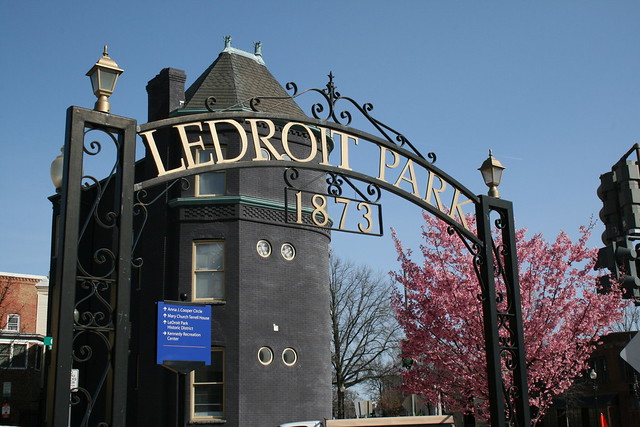
As part of the annual WalkingTown DC event, I will lead two free walking tours of the neighborhood. The tours will be on Sunday, September 30 at 1 pm and again at 3:30 pm. Meet me at the arch at 6th Street and Florida Avenue NW.  The tours are free and open to the public.

Monday: Monthly LeDroit Park happy hour

Come for drinks, free appetizers, and chat with your neighbors Monday, October 1 from 6 to 8 at Nellie’s (9th & U Streets NW).  Nellie’s owner, a LeDroit Park resident, has kindly donated appetizers for the event.

1 Comment »
September 12, 2012 - 7:40 am

Get a free history tour of LeDroit Park on Sept. 30

How was LeDroit Park established and who built all those unique homes on U Street? Why did the neighborhood start as exclusively white but become so important to black history? As part of the annual WalkingTown DC event, I will lead two free walking tours of the neighborhood.

The tours will be on Sunday, September 30 at 1 pm and again at 3:30 pm. Meet me at the arch at 6th Street and Florida Avenue NW.  The tours are free and open to the public.

We’ll cover

  • The neighborhood’s founding
  • Relationship with the Howard Theatre
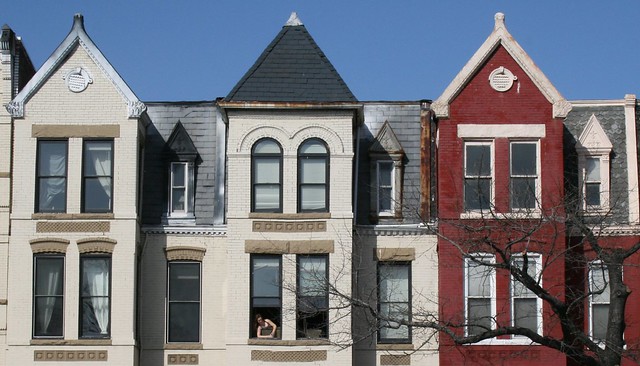
  • Architectural history
  • The Park at LeDroit
  • Walter Washington
  • Ernest Everett Just
  • Robert & Mary Church Terrell
  • Anna Julia Cooper
  • William Birney
  • Edward Brooke
  • Octavius Williams
  • Oscar De Priest
  • Griffith Stadium
2 Comments »
July 11, 2012 - 12:41 am

Storm floods streets and basements of Bloomingdale

During torrential downpours the Bloomingdale neighborhood experiences flooding. Yesterday evening’s storm flooded numerous Bloomindale basements and the intersection of Rhode Island Avenue, T Street, and First Street NW.

The Boundary Stone restaurant (116 Rhode Island Avenue NW) posted a photo of a flooded Rhode Island Avenue NW.

Why did this section of the street flood? DC Water, which runs the water pipes, sewers, and storm drains, blames the lack of pipe capacity in Bloomingdale.

A closer look at the 1861 Boschke map of the District of Columbia reveals that the northern reaches of Tiber Creek flowed right through Bloomingdale. In fact the creek flowed right where Rhode Island Avenue flooded at T Street NW.

Boschke map with modern streets superimposed

Whether the creek still flows underground in this location is something I will leave to experts. However, creeks, like all water, flow to the lowest point on the land. The creek’s former presence at this location suggests that the terrain slopes downward on all sides, directing rainwater to this critical flood point.

Ward 5 Councilmember Kenyan McDuffie (D) was on the scene and DC Water has promised to brief him soon on their Bloomingdale flood solution, which they say is on the way. Though this degree of flooding is rare, Bloomingdale residents will surely welcome and demand a permanent fix.

13 Comments »
June 27, 2012 - 7:58 am

The death of FormStone

FormStone

Formstone, that faux-stone façade that became popular in the 1930s and ’40s, can be removed, but it’s not easy. The old Frazier’s Funeral Home, at 389 Rhode Island Avenue, has been vacant for several years since the District shut it down.  The new owner is renovating the property to convert into 4 or 5 residential units.

Part of the renovation involves removing the Formstone façade and repairing the brick beneath.

Half and half

Brick below Brick and Formstone

5 Comments »
June 20, 2012 - 9:21 am

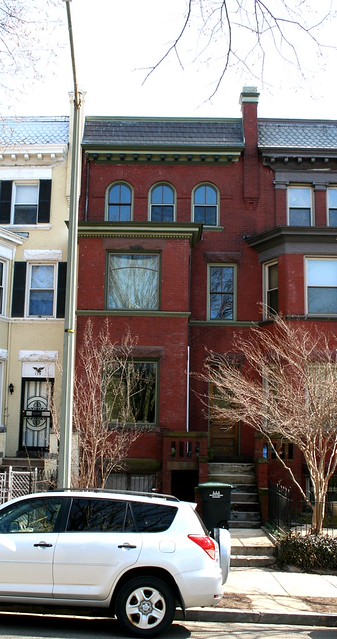
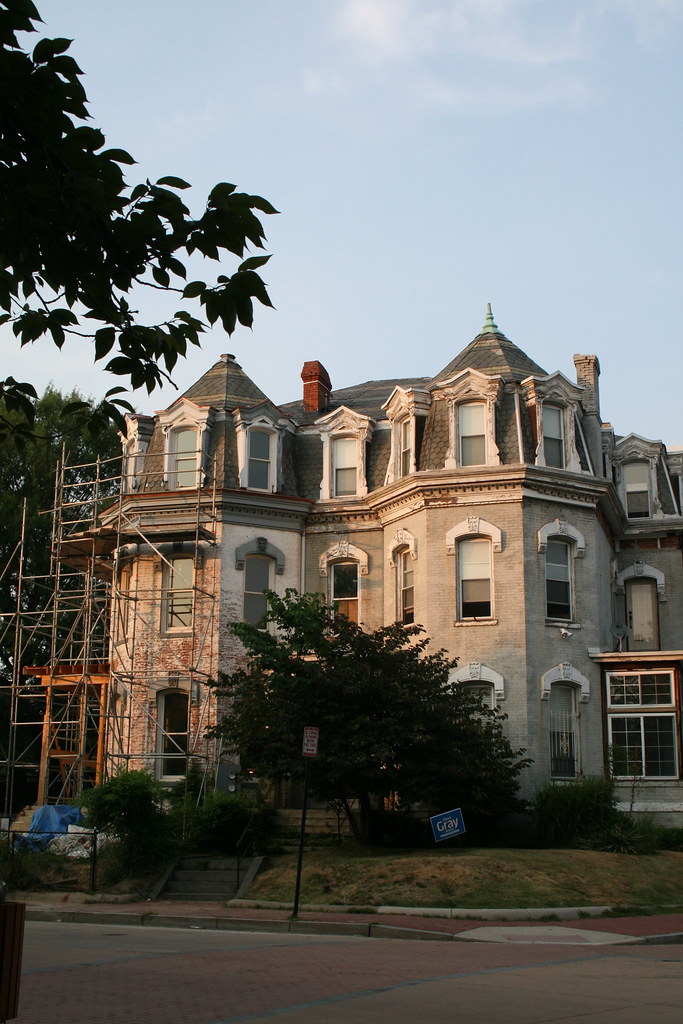
Can you identify LeDroit Park’s 12 distinct architectural styles?

The Washingtoniana Division of the M.L.K. Library contains a great collection of books on the history of Washington. Since all the material in the section is reference material, none of it can be checked out.

The kind librarians, however, permitted me to scan the entire book LeDroit Park Conserved, produced in 1979 for the DC government.

The book covers the historical development of the neighborhood, documents the different architectural styles, and offers suggestions to residents who wish to restore their properties with greatest historical accuracy.

Most surprising to me was the number of architectural styles represented in LeDroit Park.  Let’s review:

Chateauesque

Georgian revival

Italian villa

Italianate

Queen Anne (brick row house)

Queen Anne (frame row house)

Queen Anne (free-standing)

Renaissance revival

Second empire

Spanish revival

Victorian gothic

Washington row house

View the entire book for all the details, photos, diagrams, and maps.

5 Comments »
June 19, 2012 - 9:16 am

Just who was Ernest Everett Just?

An academic’s prestige is usually measured by the degree to which his peers admire his work.  Any job where success depends on reputation is bound to be a difficult and political career.  Howard biologist Ernest Everett Just (1883-1941), who lived at 412 T Street in LeDroit Park, faced a constant struggle for recognition for his groundbreaking work in biology in the early 20th century.

I occasionally give history tours of the neighborhood.  My tour touches on two major themes: the neighborhood’s eclectic architecture and the prominent black Americans who lived in LeDroit Park. I had never heard of Just before moving to LeDroit Park, but in researching topics for my tour I came across a 1995 postage stamp commemorating him. This makes him the first of two LeDroit Park residents featured on postage stamps.

Two months ago, a neighbor who was a researcher at Howard University recommended Kenneth Manning‘s 1983 biography of Just.  He assured me that the book, entitled Black Apollo of Science, detailed all the administrative problems at Howard that still exist to this day.

I picked up the book hoping to read historical accounts of LeDroit Park while Just lived in the neighborhood. Though there was very little about the neighborhood, the book provided interesting stories about Howard University’s administrative and financial troubles during the early 20th century.

The book was light on LeDroit Park and Washington because Just himself increasingly disliked teaching at Howard and the pervasive racism he faced living in the United States. In the 1920s, midway through his career, Just began to spend more time conducting research at research institutes in Berlin; Naples; and Roscoff, France. He deliberately avoided returning to the Marine Biology Laboratory in Woods Hole, Massachusetts, where he felt he was socially isolated because of his race. Just saw Europe as an escape from racism he faced at home.

In Europe Just could finally attend the same operas he had seen advertised in Washington’s whites-only venues and he could travel and book hotels without worrying that his reservations would be rejected due to Jim Crow.

Whether Just was pursuing his PhD at the University of Chicago or conducing research in Massachusetts or Europe, his wife and children remained in LeDroit Park at 412 T Street. But as Just eventually grew apart from the United States, he also grew apart from his wife. Just took several lovers in Europe during his research stints and he eventual filed for divorce from his wife Ethel in the late ’30s.  This was a formality, though, as their love had died many years ago.

Though Just was in France at the time of the 1940 census, the census ledger lists him as the absent head of household at 412 T Street.

The Just family stood out for its educational attainment.  Notice that in column 14, Just is listed as having completed eight years of college, an outstanding accomplishment even by today’s standards.  His wife had finished six years of college, his son four, and his daughter Maribel, aged 17, was in her first year of college.

Out of pure luck, Just was listed on line 68, which was one of two lines per page that the Census Bureau selected for supplmentary questions.

Here Just stands out again.  Though most LeDroit residents were listed as maids, porters, or laborers, Just’s profession is listed as “Zoology professor” at Howard University.

Just’s life was not easy. He grew up in poverty and his father died when Just was a child.  Just’s mother was a teacher who valued his education dearly and she sent him as a teenager to a boarding school in New Hampshire.  During his time at boarding school, his mother died, leaving Just orphaned but independent.

After boarding school, he proceeded to Dartmouth to study classics and biology, the field to which he devoted his entire career.  Since few universities at the time would hire black researchers or professors, Just took a position at Howard University and in 1912 became the head of Howard’s Department of Zoology.

The Howard position was Just’s main source of income for the rest of his life and he used it, along with a few private grants, to fund his research in Massachusetts and Europe.  Though Just kept his position at Howard until his death, he spent many semesters and summers studying marine biology far away from Washington.  Howard, it seems, was only a source of income for Just, as he frequently battled with the university’s administration for more equipment, more funding, and more research time.

Howard’s presidents, especially Mordecai Johnson, demanded that Just focus less on research and more on teaching and building a graduate zoology program.

Johnson wasn’t the only person pressuring Just. White philanthropists who wanted to raise academic achievement and living standards of American blacks funded Just’s work with the goal that he would train aspiring black scientists and doctors. Their hope was that Just would train black biology students so they could study medicine and return to the rural south where white doctors would not treat black patients.

Just, however, wanted philanthropic funding to support his biological research efforts, not his teaching efforts. Just preferred research and appeared far more interested in advancing the human understanding of cell biology.

Old letters Manning uncovered reveal that Just held a low opinion of Howard undergraduates during his tenure. Just thought teaching biology to them was a waste of time and would distract him from important research.

To teach or to research? This is an old academic controversy. Many professors prefer to conduct research because they find it more intellectually satisfying and because it builds their careers, expertise, and reputations. At universities that rely heavily on tuition fees for their income, administrators realize that teaching is an important source of income.

For Just, the written correspondence between him and various philanthropies shows that because he was black, he was expected to carry the herculean task of advancing both the human understanding of biology and the welfare of his race— a burden his white benefactors did not place on white scientists. These expectations, though well intentioned, continually hindered Just’s career as his appeals for research grants rarely bore fruit.  Various foundations and Howard administrators urged Just to spend more effort building a biology program and producing trained biologists.

Just found a warmer reception in Germany, Italy, and France, where scientists were more eager to collaborate with him and build on his work. While in Europe, Just dated several women. He even established residence in Latvia briefly so he could quickly file for divorce from his wife in Washington.  He eventually decided to mary his German mistress and start a life in Europe, even if it meant resigning his post at Howard and living in penury in Europe.

Failing to win grants, though, Just held onto his Howard position as his sole source of income.  Just’s time in Europe was productive. He published his most renowned works on cell biology and cell fertilization during this self-exile.

His new-found haven across the Atlantic didn’t remain peaceful for long.  Though he had tried to escape racism in the United States, Nazi violence had made Berlin inhospitable. In Italy, Just’s appeals to Mussolini for research funding went nowhere and Italian biology conferences became fascist propaganda events.

Just’s final European post in France came under Nazi control and Just was ordered to leave. The advancement of fascism eventually made this European exile untenable. Sadly, everywhere Just went, some virulent -ism— racism, fascism, Nazism— eventually caught up with him.

Just returned to the United States with his new wife and newborn child. His new wife and child settled in New Jersey, but Just had to return to work for pay at Howard.  Suffering from pancreatic cancer, Just stayed with his sister Inez at 1853 3rd Street, here in LeDroit Park.  His health was in rapid decline and in October 1941 Just died.

Despite having overturned a ruling theory of cell fertilization, Just never fully received the professional recognition he desired and deserved.  He was always tied to Howard, even though he wanted desperately to leave to focus solely on research.  Howard tied him to Washington, a city whose segregation degraded him.  Washington also tied him to a wife he no longer loved.

Manning’s book is very well researched and combs through many of Just’s letters to colleagues, mentors, friends, and lovers. It tells a fascinating account of race relations in America, the history of biology research, and one man’s unhappy task facing down all these problems.

Manning was able to weave these threads of science, race, academia, and Just’s personal life into a unified and compelling work accessible to the general reader.  Happy endings are the work of fiction writers; Just’s story is more poignant because it recounts a life marked by great successes and great disappointments.


Black Apollo of Science: The Life of Ernest Everett Just
By Kenneth Manning
1983, Oxford University Press. 330 pages.
[Amazon] [DC Public Library]

Be the first to comment »
May 22, 2012 - 9:09 am

Will Florida Avenue become the next U Street?

A sign of things to come?

When perusing the excellent interactive DC zoning map, one thing stands out around LeDroit Park: all the properties fronting Florida Avenue are zoned to permit both residential and commercial uses. Even the rowhouses on the LeDroit side of Florida Avenue can be turned into restaurants, offices, or shops without any need for special zoning approval.*

We mention this not to alarm anyone, but to educate residents about the influence of zoning ordinances. Zoning is the invisible geography that quietly shapes the use and form of the built environment.

The north-side rowhouses on the 400, 500, and 600 blocks of Florida Avenue were clearly built as homes.  About 100 years ago, many of these rowhouses hosted the offices of Washington’s prominent black doctors.

Neighborhoods change and businesses move and nearly all the rowhouses on our stretch of Florida Avenue reverted to their original uses as residences. Even the notable Harrison’s Cafe at 455 Florida Avenue is a residence with much of its former retail bay window bricked in.

Thai X-ing, a culinary outpost

A few businesses still dot Florida Avenue.  While Shaw’s Tavern and Bistro Bohem are reviving the corner of Florida Avenue and 6th Street, they occupy buildings that are clearly commercial in form. Thai X-ing, however, has been located for several years in and old rowhouse at 515 Florida Avenue NW. Though it looks like an abberation, Thai X-ing may just be ahead of its time.

The properties fronting Florida Avenue are zoned C-2-A, which permits as a matter of right,

office employment centers, shopping centers, medium-bulk mixed use centers, and housing to a maximum lot occupancy of 60% for residential use and 100% for all other uses, a maximum FAR of 2.5 for residential use and 1.5 FAR for other permitted uses, and a maximum height of fifty (50) feet. Rear yard requirements are fifteen (15) feet; one family detached dwellings and one family semi-detached dwellings side yard requirements are eight (8) feet.

There is no need to worry about an old rowhhouse being torn down and turned into office blocks. First, the houses along the LeDroit Park side of Florida Avenue are within the historic district. Historic preservation laws prevent drastic alterations, especially alterations to such an cohesive section of architecture.

Second, the C-2-A zone is a low-density zone, permitting a floor-area ratio (FAR) of only 1.5 for non-residential uses. Most of the existing rowhouses already exceed 1.5 FAR since they were built before the current zoning code.

The opening and success of Shaw’s Tavern and Bistro Bohem demonstrate business success along our stretch of Florida Avenue. There is clearly a demand for commercial activity near LeDroit Park and we were happy to spend Sunday afternoon revisiting Bistro Bohem. Whether this demand translates into rowhouse conversions into restaurants and bars remains to be seen. Even still, don’t be surprised if Thai X-ing gets a few restaurant, pub, cafe, or boutique neighbors in the coming years.

501 Florida Avenue


* Though one may open a restaurant without special approval in a commercial zone, a restaurateur must still follow the usual process for obtaining a license to serve alcohol.

1 Comment »
April 19, 2012 - 8:52 am

7th & Florida in ’68, ’88, and today

What happened to all the historic buildings at 7th Street, Florida Avenue, and Georgia Avenue?  We all recognize the CVS and its adjacent parking lot.  As we reported before, the adjacent grassy field is slated for a residential development by JBG, one of the region’s largest development companies.

But how did the CVS, the parking lot, and the grassy field get there in the first place?  They are the consequence of the 1968 riots and of the construction of the Green Line tunnels.

The riots of April 1968 destroyed many of the buildings along 7th Street.  A few months ago we came across this photo in a Congressional report published in the wake of the riots.  The west side of 7th Street from T Street to Florida Avenue was obliterated:

Decades later, the intersection sat at an elbow in the proposed Green Line tunnel.  The subway line curves from 7th Street to Florida Avenue and then to U Street.  Much of the line was constructed using the cut-and-cover method, which requires razing buildings, digging a trench, building a concrete box in the trench, and covering it back over.

Subway tunnels typically run under existing streets, but sharp changes in direction require cutting corners and thus the creation of tunnels where buildings often stand.

A 1988 photograph shows the construction of the Green Line tunnels, which pass under the CVS and adjacent lots.

What the riots didn’t destroy, the Green Line took care of.

1 Comment »
April 17, 2012 - 8:50 am

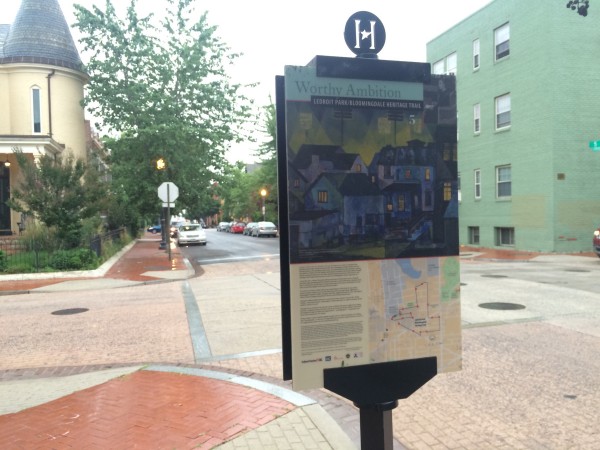
Neighborhood history trail nearly complete

LeDroit Park and Bloomingdale history buffs need to mark their calendars for Thursday night. The LeDroit Park-Bloomingdale Heritage Trail Working Group will meet to go over updates to the pending bi-neighborhood heritage trail.

You’ve seen these heritage trails elsewhere in Washington. The signs feature historical photographs and explanations of the areas’ historical significance.

At the last meeting we attended, we heard from residents who lived in the neighborhood that stood where the Gage-Eckington School was later built, neighbors who had to walk several extra blocks to school because Washington ran a segregated school system, and neighbors who remember seeing Eleanor Roosevelt visiting what is now Slowe Hall at 3rd and U Streets.

These are the oral histories that Cultural Tourism, which organizes these trails, documents for the historical record and includes in the signs.  So much of Washington’s history, nay human history, is committed to memory that if we don’t record it, it risks being lost.

The trail, which is put together by Cultural Tourism DC, is close to completion, but the next few meetings are critical in determining final details and extra stories that may be incorporated.  Even if you don’t have stories or original research to contribute, attending the meeting solely to listen will be worthwhile.

Thursday, April 19 at 7 pm
St. George’s Church
(basement)
2nd & U Streets NW

Be the first to comment »
April 06, 2012 - 8:40 am

44 year ago today, Washington burned

A neighbor pointed us to this poignant video footage of the riots that occurred 44 years ago here in Washington after the assassination of Dr. Martin Luther King.

Contrary to popular belief, suburban flight and urban disinvestment were already well-underway by 1968. The destruction that occurred in American cities that year was not the cause of urban decay; it merely accelerated a pre-existing, post-war urban decline. Most middle-class Americans, regardless of race, do not want to live or shop in a war zone, after all. Thus DC’s commercial districts quickly declined.

The riots that year were a mixed result: they meaningfully displayed frustration at systematized racism in American society, but they also destroyed the essential businesses in DC’s majority-black neighborhoods.

The sociology of the matter is controversial, but it’s important we review accounts of the history just to know what happened.

Look carefully at video and you’ll recognize 7th Street in Shaw, U Street, and 14th Street. Washington was never the same after April 1968.

1 Comment »