October 06, 2011 - 8:02 pm

Weekend Metro closure may bring unintended improvement

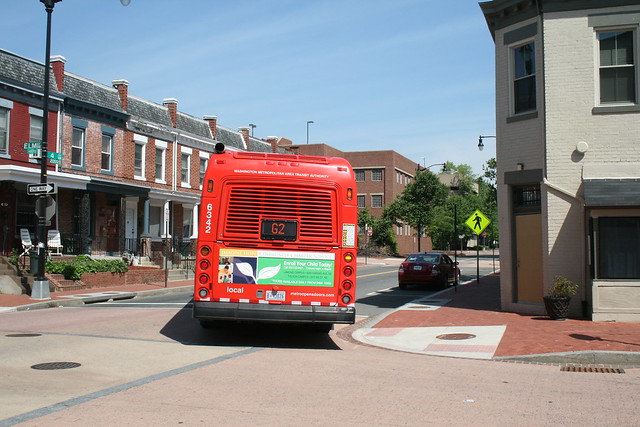
Temporarily closing a segment of the Green Line might ironically improve service for some this weekend. WMATA announced that it will close the Shaw, U Street, and Columbia Heights stations this weekend for scheduled track maintenance.

The stations will close at 10 pm Friday and won’t reopen until Tuesday morning’s normal opening time (Monday is a holiday). A similar closure will be in place on the Orange Line between East and West Falls Church stations as Metro works to connect the new Silver Line.

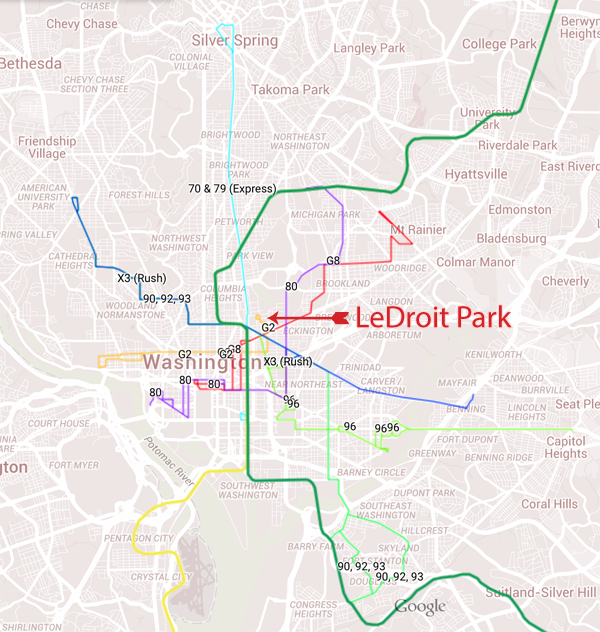
In the meantime, Metro will operate free shuttles along the route to ferry passengers through this service gap. Ironically, these shuttles may sometimes operate more frequently than the rail service would on a typical weekend.

Metro instituted a similar closure along a section of the Red Line on Labor Day weekend. On that weekend, we went to have brunch at a friend’s house in the Brookland neighborhood. During that time, Metro shuttles were running down his street every 2 minutes. Many of the buses were nearly empty, but for a moment we were jealous at the thought of transit service every 2 minutes.

Likewise, if WMATA keeps similarly short headways for the shuttles this weekend, the agency might actually enhance mobility between the Convention Center, Shaw, U Street, Columbia Heights, and Petworth.

One of Metro’s main shortcomings is that riding during non-rush periods, especially on weekends or at night, can entail waiting on platforms for as much as 24 minutes. This is an unacceptably low level of service, but our region lacks the political leadership to set a minimum level of transit service the way we do for utilities.

In DC, where 37% of households lack a car, the mayor and council chairman drive luxury cars at taxpayer expense, and other councilmembers receive free parking in front of the Wilson Building.

In the abstract, our leaders may appreciate the importance of frequent service, but nothing drives home the point like waiting on a Metro platform with 100 other people only to watch a packed train arrive half an hour later.

Though buses can’t match the speed and comfort of rail service, the frequency of bus shuttles this weekend might prove to be a significant, though temporary, transit improvement.

1 Comment »
October 06, 2011 - 1:54 am

LeDroit Park getting Zipcars soon

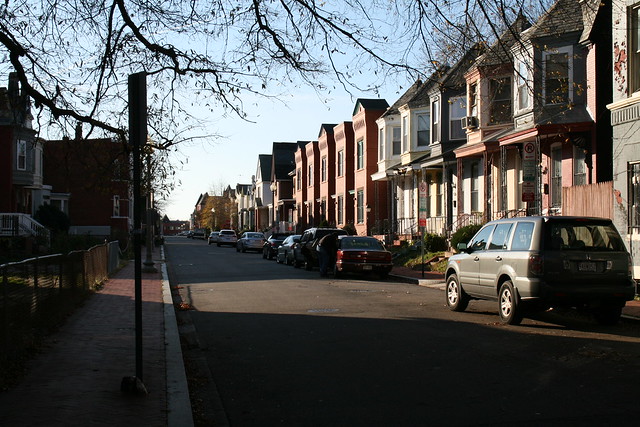
Cars on the Corner by M.V. Jantzen, on Flickr

LeDroit Park is getting two Zipcars soon.  Though the District auctioned off many of the street spaces reserved for carsharing services like Zipcar, the vast majority of Zipcar’s spaces are actually in private parking lots, driveways, and garages.

Zipcar is always looking for more spaces. If you have a private parking space and would like to rent it to Zipcar, drop them a note online, call their office downtown at (202) 737 4900.

1 Comment »
September 27, 2011 - 9:16 am

Bikeshare expansion passes over LeDroit Park

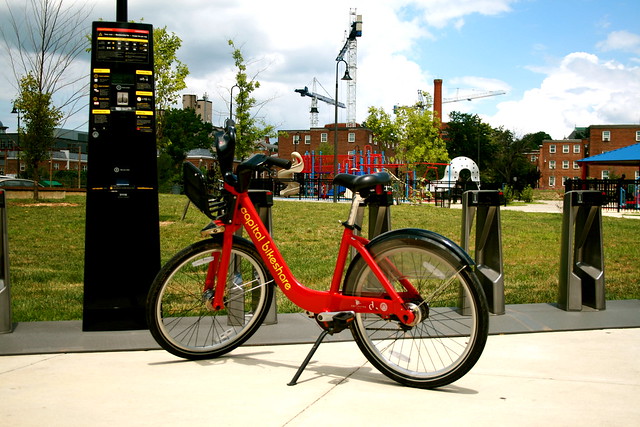
Capital Bikeshare at the WWII Mem.

Capital Bikeshare, the District’s smashingly successful bikesharing system, will expand this fall.  Unfortunately, the expansion plans for this fall exclude LeDroit Park.

The District and Arlington launched the system a year ago with 14 stations in Arlington and 100 in the District.  This fall, DDOT will add 34 stations in the District.  In our area, DDOT will add a station by the Shaw Library and another at 1st Street NW and Rhode Island Avenue NW in Bloomingdale.

These additions should help alleviate the pressure placed on the existing stations at 7th & T Streets NW in Shaw and at Florida Avenue and R Street NW in Bloomingdale.  Currently, LeDroiters and Bloomingdalers compete to use these two stations and thus frequently leave the stations empty or full during rushhour.

Last week DDOT Director Terry Bellamy announced that the district will add 50 stations early next year.  We hope that in this new round DDOT focuses more attention on LeDroit Park and other neighborhoods in ANC 1B.

For instance, a Capital Bikeshare station could easily go in at the Park at LeDroit’s south entrance at 3rd and Elm Streets NW.  This location is central to the neighborhood and could bring some extra eyes to the park throughout the day.

Outside of LeDroit Park, there is a noticeable station gap in the northern reaches of Bloomingdale and around Cardozo High School.

Capital Bikeshare is particuarly successful in our part of DC for several reasons:

  • Car ownership is relatively low compared to the rest of the nation, region, and city.  This inclines people to bike more.
  • Parking is particularly difficult on many neighborhood streets, thus making cycling more attractive.
  • The historical development of this area has permitted the close proximity of commercial uses to residential uses.  This means trips to shops and restaurants are short and easily made by bike.
  • Downtown is a short ride away and biking is often faster than taking the bus.
3 Comments »
June 27, 2011 - 8:45 am

Opposition to taxi medallions mounts

Yellow cab, green cabOn Thursday, July 7, ANC 1B will discuss and likely adopt a resolution (appended below) opposing the proposed taxi medallion system recently proposed by several councilmembers.  The medallion bill, written by lobbyist John Ray at the behest of some of the city’s big taxi magnates, seeks to halve the number of taxis in the city.

The issue came up in the ANC because many independent taxi owners live in the Pleasant Plains neighborhood and view the bill as a means by big taxi companies to force them out of the business.

The ANC 1B Transportation Committee held its inaugural meeting to discuss the bill and how it would impact taxi service for drivers and for passengers, i.e. the public.

Commissioner Tony Norman (ANC 1B10 – Pleasant Plains) proposed the committee adopt his draft resolution opposing the bill.  Mr. Ray, the bill’s chief lobbyist, was invited to attend but did not.

The Transportation Committee did, however, agree that the industry needs reform, but that this particular medallion bill is fundamentally flawed to the degree that it will harm the public.  The committee agreed to add to the resolution a clause expressing the need for meaningful taxi reform.

Radio reporter Pete Tucker, who hosts a radio show on taxi issues, recorded much of the meeting and aired select quotations on the June 19 episode of his program.

(Mr. Tucker himself became news at the DC Taxicab Commission meeting the week after the Transportation Committee meeting.  The U.S. Park Police, at the behest of the commission’s Chairwoman Dena C. Reed, arrested Mr. Tucker and other journalists for recording at the commission’s June 22 hearing.)

* * *

Left for LeDroit sees the bill as a wolf in sheep’s clothing, conflating real taxi reform with a severe reduction in the number of taxis.  The bill places costly barriers to entry for independent cab drivers and will likely lead to one or two cab companies holding all of the medallions.

Real reform includes mandating and enforcing a minimum quality of service.  This means ensuring the cabs are clean and air conditioned and that they accept credit cards.  Furthermore, the city should consider GPS tracking to alert customers with smartphones as to the availability of nearby taxis.  Furthermore, a centralized dispatching system should aid consumers looking to schedule a trip.

Medallions, however, are a deliberate attempt to limit competition.  This is ultimately bad for the public.  After New York, Washington is the easiest American city in which to hail a cab and the ability to do so aids our quality of life and increases our diversity of practical transportation options.

* * *

Here is the resolution the committee adopted and which the ANC will discuss on July 7:

WHEREAS: The Council for District of Columbia is contemplating an overhaul of the taxicab system by proposing a medallion system for taxicabs in the District of Columbia; and

WHEREAS: There is a clear and present need for the Mayor of the District of Columbia and the Council for the District of Columbia to review and propose objective reforms in the present taxicab system, in terms of taxicabs being modernized, i.e. energy efficient, gps, air conditioning, credit cards and drivers knowledge of best routes; and

WHEREAS: The present number of taxicabs in the District of Columbia is over 9,000, the proposed medallion system would place an arbitrary cap on the number of taxicabs at 4,000, this restricts the supply and creates barriers to competition; and

WHEREAS: The District of Columbia Chief Financial Officer’s Office studied in 2010 how the taxicab medallion system worked in other major cities and the study concluded that the system would result in windfall profits for a small group of people; an overall decline in service with longer waits and higher fares, create a system more amenable to corruption in the District of Columbia; and

WHEREAS: The substantial reduction of taxicab in the District of Columbia will have a negative effect on residents, in terms of the quality and quantity service, particularly in underserved low income areas, whom will have longer waits and face more service refusals; and

WHEREAS: The substantial reduction of taxicab in the District of Columbia will also have a negative effect on businesses: particularly small businesses, hotels, bars, night clubs and restaurants, as it related to customers quality and quantity of service, in terms of longer waits for an available taxicab; and

WHEREAS: The present proposals would result in loss of opportunity for would be entrepreneurs, most of whom would be low-income and/or minorities; and

WHEREAS: Over 900 hundred independent taxicab drivers (so far) have signed a petition to oppose the arbitrary regulations proposed to reform the taxicab industry;

NOW, THEREFORE BE IT RESOLVED, That ADVISORY NEIGHBORHOOD COMMISSION 1B requests that the Mayor of the District of Columbia and the Council for the District of Columbia reject the taxicab medallion system and adopt the findings of the District of Columbia Chief Financial Officer.

BE IT FURTHER RESOLVED, That ADVISORY NEIGHBORHOOD COMMISSION 1B requests that the Mayor of the District of Columbia and the Council for the District of Columbia review and propose objective reforms in the present taxicab system, in terms of taxicabs being modernized, i.e. energy efficient, gps, air conditioning, credit cards and drivers knowledge of best route.

1 Comment »
June 21, 2011 - 9:10 am

U Street’s worst pedestrian hazards will soon disappear

DDOT will begin reconstructing U Street this fall. Stretching from 9th Street to just short of 14th Street NW, the project’s first phase will fix many of the worst pedestrian problems with this street. Sadly, not being a Great Streets project, it isn’t getting some of the decorative touches of other projects like H Street NE.

Most of the details in the plan are the same as they were three years ago. A major theme is that the street will better accommodate pedestrians, especially those in wheelchairs. DDOT is guaranteeing a 4-foot-wide clearance throughout the project, and to do so the agency will eliminate parking spaces and driving lanes and move walls, street poles, and trees where necessary.

On the 1300 block, the staircases of three buildings on the south side currently make for a sliver of a sidewalk. Instead of trying to move or reconfigure the stairs, which are on public space, and instead of looking for an exception to the 4-foot clearance, DDOT will remove parking spaces and extend the sidewalk toward the travel lane.

Curb extension design for the 1300 block of U St. NW. Image from DDOT.

Additionally, the construction process itself is designed to minimize disruptions to pedestrians. The city will require its contractor to work on only one block at a time and will divert pedestrians to the parking lane when the sidewalks are being replaced.

Phase 1 will start in the fall and construction is expected to last 9 months. Phase 2, which stretches from 14th Street all the way to 18th Street, will start after phase 1 and the 18th Street reconstruction project are both finished.

In phase 1, the roadway will simply be milled down and resurfaced, a process that itself takes about 3 hours per block. The sidewalks will also be replaced except in front of the African-American Civil War Memorial and the Ellington, where they are very new. Phase 2 is more complicated, involving digging up the entire road bed, replacing a century-old water main, and rebuilding the entire roadway. The phase 1 section’s water main was replaced in the late 1980s with the construction of the Green Line, so the road work is less extensive there.

On the 1700 block, the north side’s sidewalk is notoriously narrow, poorly lit, and buckled by tree roots. DDOT will eliminate an eastbound driving lane on this residential block and redistribute the reclaimed area to both sidewalks.

Design for the 1700 block of U St. NW. Image from DDOT.

At the intersection with 16th Street and New Hampshire Avenue, the agency will include bulbouts (“B”) to reduce the street-crossing distances for pedestrians.

Design for the intersection of U St., 16th St., and New Hampshire Ave. NW. Image from DDOT.

Just east of the intersection and on the north side of U Street, the agency will remove an existing retaining wall (“A”) on the public right-of-way and rebuild it several feet back. This move will widen this otherwise narrow section of sidewalk.

The elimination of the slip lanes onto New Hampshire Avenue on both sides discourages speeding and creates small pedestrian plazas.

As we have documented before, some transportation departments are prone to neglecting pedestrians or expecting them to take needlessly long detours around construction. This will not be the case on U Street, much to the relief of pedestrians and business owners.

To minimize obstructions along the sidewalks, the city will install multi-space meters. This will be a good time to consider implementing performance parking for the U Street corridor, as parking becomes especially difficult on Friday and Saturday nights. The increased revenue could be used to improve and maintain the street amenities over the coming years, as is being done on Barracks Row.

The city will save street trees where it can and replant new trees in empty boxes and where trees cannot be saved.

While these improvements will enhance the experience for the many pedestrians who traverse the corridor, this reconstruction lacks many of the decorative design touches of some other projects around the city including the Great Streets projects.

U Street will receive the standard blue-gray concrete sidewalks instead of the beige, exposed aggregate concrete sidewalks now on H Street and currently being installed in Adams Morgan. H Street’s sidewalks enjoy pedestrian-scaled street markers etched in granite slabs embedded in the sidewalks. The metal street banners are another nice touch on H Street that won’t come to U Street under the current plan.

We can certainly add some decorative elements later, but the sidewalk pavement is something expected to last decades and must be done right the first time. With such a storied history, U Street deserves some of the qualities of a Great Street.

Be the first to comment »
May 31, 2011 - 8:32 pm

Two new restaurants, a new condo project, and a new committee

Rendering of 1905 14th St NW

It’s that time again.  The monthly meeting of ANC 1B will be on Thursday at 7 pm on the second floor of the Reeves Center at 14th and U Streets NW.

On this month’s agenda:

Liquor licenses

Mama Chuy DC2620 Georgia Avenue NW – Class C restaurant license – Full-service Mexican restaurant with carry-out and delivery service. No live entertainment. Summer Garden with 16. Seating capacity is 16. Total occupancy 32. Hours inside and outside: Sun-Thurs 9 am-2 am, Fri & Sat 9 am-3 am. Hours for sales and consumption of alcohol: Sun-Thurs 9 am-2 am, Fri & Sat 10 am-3 am.

Happy Hour1201 U Street NW (above the Islander) – Class C tavern license – Neighborhood bar with light food, games including Skiball, Wii Stations, and other electronic video games. Entertainment includes live bands. Hours (including alcohol): Sun-Thurs 11 am-2 am, Fri & Sat 11 am-3 am. Live entertainment: Sun-Thurs 6 pm-2 am, Fri & Sat 6pm-3 am.

Land use and transportation

The ANC is starting a transportation committee to address parking policy, streetscape proposals, Metro service, and other transportation topics.

1 Comment »
March 31, 2011 - 8:46 am

Should DC allow more angle parking on Sunday mornings?

Councilmember Harry Thomas, Jr. (D — Ward 5) introduced a bill to ease Sunday parking tensions by permitting angle parking for religious institutions with ANC and DDOT approval. The councilmember held a forum on the bill and its companion commercial district bill last week.

In DC neighborhoods where street parking is at a premium, few things raise a resident’s ire like church congregants who park illegally on Sunday mornings. Congregants who drive from other parts of the District, from Maryland, and from Virginia have been known to double-park, park in alleys, block crosswalks, and block fire hydrants.

After receiving numerous complaints from residents, Mr. Thomas introduced the bill to primarily allay residents in Bloomindale and Eckington. Since these neighborhoods are among Ward Five’s most densely populated, they, like LeDroit Park, suffer from high street parking occupancy.  Last week in Eckington, Mr. Thomas hosted a forum on his bills and took questions from residents.

Mr. Thomas acknowledged what residents have long known: parking enforcement around churches is intentionally lax on Sundays. Though Mr. Thomas admitted the unique challenges to transportation on Sunday mornings, he also decried congregants who park illegally, block residents in, and hinder public safety.

Transit service reaches its nadir on Sunday mornings, and churchgoers often travel to churches in residential neighborhoods with light Sunday service. Since transit service and car traffic are relatively low on Sunday mornings, Mr. Thomas thinks DDOT will be able to find instances of roadways wide enough to accommodate both angle parking and through traffic on Sunday mornings. In each case, though, DDOT will make the final determination of what is safe and permitted, even if an ANC supports the petition.

Left: typical curbside parking. Right: possible angle parking

We asked Mr. Thomas why he singled out angle parking and not other non-traditional parking arrangements and he admitted that the bill was just a first draft and could be expanded to include other measures.

For instance, DDOT permits parking beside the median on Sundays on the 1300 and 1400 blocks of New York Avenue NW downtown. This arrangement works since there is still one lane available for through traffic and since Sunday morning traffic flows are small. A similar arrangement might work along other multi-lane avenues in the District, including Rhode Island Avenue.

In other cases, solutions could be less radical. The congregants of several churches on Florida Avenue park in the right lane on Sunday morning even where parking is never permitted at any time. DDOT may be able to simply change the signs and permit curbside parking in such places on Sunday mornings. The extra parking can act as a traffic-calming measure, though, as we know, easier parking can induce more driving.

No matter what happens, the Department of Public Works, the primary agency in charge of parking enforcement, needs to end its practice of lax Sunday enforcement near churches. Only DDOT, not pastors and not congregants, should make the determination as to what constitutes safe Sunday morning parking. Mr. Thomas acknowledged that the law needs to be enforced uniformly as it is unfair to overlook, as one resident noted, illegal parking in residential neighborhoods, while actively ticketing illegal parking downtown on Sundays.

Though residents expressed frustration with some, though not all, neighborhood churches, Mr. Thomas rightly advised residents that parking tensions need not be adversarial. In fact, he called attention to instances in which neighborhood residents and churches collaborated to resolve parking problems. This can include urging pastors to rent unused lots for their congregants or to provide shuttle service from satellite lots or from congregants’ homes. He even touted bikesharing several times but said it is not practical for everyone.

Whatever the solution, Mr. Thomas admitted the bill was in its infancy and that he wants to provide a template for cooperation; angle parking may be one of many possible solutions.

Mr. Thomas was eager to mention the companion bill to allow permanent angle parking in business districts. Though most meeting attendees were there to complain about church parking in residential neighborhoods, Mr. Thomas said that many Ward 5 businesses depend heavily on customers arriving by private car. However, when he asked a local business owner how much of his business is from outside his neighborhood, the owner said that very little came from elsewhere.

The business corridor bill is significantly different from the Sunday parking bill. The former would permit businesses to seek diagonal parking at all times, regardless of transit service, or if the street space could be reallocated to bike lanes or wider sidewalks.

The Sunday parking bill carries more merit than the business corridor bill because of the unique circumstances of church locations and Sunday transit service. The business corridor bill, in contrast, too hastily and disproportionately prioritizes parking to the detriment of other road uses.

5 Comments »
March 19, 2011 - 2:16 pm

Howard wants to increase campus housing 28%

Last month Howard University’s Board of Trustees agreed to proceed the planning process to build 1,300 beds of student housing in two new dorms on campus. This marks a 28% increase from the current 4,609 beds the university controls.  This is smart move that will aid academic success and reduce commuting pressure through the surrounding neighborhoods.


View Howard University’s future development in a larger map

The university’s goal is to create a “Freshmen Village” on 4th Street just north of LeDroit Park.  Ms. Maybelle Bennett, Howard’s community outreach director, said that enhancing academic performance and graduation rates is the university’s motivation for concentrating housing and services for new students in Freshmen Village.  Since a student’s first year is critical to a student’s success during an undergraduate career, the university wants, as Ms. Bennett adoringly put it, “to bring our babies home.”

The university will add these two new buildings to their forthcoming campus plan proposal that they will submit to the Zoning Commission in the coming months.  Each university in the District is required to submit a campus plan for the commission’s approval every ten years.

We think this is a smart move on the university’s part and will benefit everyone.

National social benefits

Universities serve a unique social mission: they exist to educate America’s youth.  As such, we must remember that a university’s success is in the national social interest.  The university’s goal of improving academic performance is laudable and its reasonable measures should be supported on social grounds.

Traffic and environmental benefits

Furthermore, by bringing more students onto campus, the university reduces the commuting pressure currently placed on students and the surrounding neighborhoods. More students walking from bed to class means fewer students driving from home to campus.

As it stands today, hundreds of students commute from housing in Prince George’s Plaza alone.  Though most of them probably take the Metro, many will undoubtedly drive on occasion, thus adding traffic and pollution to surrounding neighborhoods.  Carpooling in a Prius still has a greater environmental impact than walking, which is mankind’s oldest, cheapest, cleanest, quietest, and most universal form of transport.

Economic development benefits

With 1,300 more people within a short walk of Florida Avenue, the new dorms will increase the economic viability of the commercial spaces along LeDroit Park’s southern edge.  All of the properties along Florida Avenue are zoned for both residential and commercial use, even though most are solely residences at the moment.  In fact a century ago the 400 block of Florida Avenue (across the street from the Post Office) hosted numerous prominent black-owned businesses and doctors’ offices.

What do you think? Are you supportive of the university’s desire to add more housing on campus?

Ms. Bennett will present the plan for Freshmen Village to the LeDroit Park Civic Association. The meeting is open to the public and residents are encouraged to attend. The meeting will be at 7 pm on Tuesday, March 22 in the basement of the Florida Avenue Baptist Church (enter through the back at U and Bohrer Streets).

5 Comments »
August 11, 2010 - 6:04 am

New Contraflow Lanes Open on New Hampshire Ave

DDOT just activated the new contraflow bike lanes on the two blocks of New Hampshire Avenue connecting from U Street.  Cyclists traveling against the flow of car traffic now have separate lanes in which to travel all the way to the crossroads of U Street, Sixteenth Street, and New Hampshire Avenue.

At the intersection, DDOT has installed special bike traffic lights to allow cyclists to cross into the bike-boxes ahead of the queues of car traffic waiting on Sixteenth Street. (See the green bike-boxes ahead of the stop lines in the diagram above.)

This is a pilot project for DDOT and there are a few kinks to work out. First, the bike signals are not placed in ideal positions.  Look carefully at southwest corner of the diagram above.  Notice that a cyclist stopped at the stop line on New Hampshire Avenue does not directly face a bike signal.  The cyclist must know to look to the right and to look up to heights that are unusual for bike signage. In much of the world, bike signals are placed five to seven feet above the ground.  Even if the signals cannot be located to other poles, lowering them on their existing poles could help.

Second, there are induction loops embedded in the pavement to sense a waiting cyclist but there’s no indication that cyclists should wait exactly at the stop line in order to trip the sensor. While filming, we pulled to the curb to stop and failed to trip the sensor.

This is merely the first step in DDOT’s plan to reconfigure the intersection, which suffers a high number of pedestrian injuries.  Until now, these two blocks of New Hampshire Avenue have been the missing link between New Hampshire Avenue and Sixteenth Street and the bike lanes on T and V Streets (eastbound and westbound, respectively).

1 Comment »
May 20, 2010 - 1:02 am

Carless in LeDroit

Source: U.S. Census Bureau

Among the nicest features of LeDroit Park are its walkability and its proximity to downtown.  We can bike downtown to work in 15 minutes, or if it’s raining, take the bus or the metro and be there in 25 minutes.  The restaurants, shops, and bars along U Street are only a short walk away.

The notion that it is easy to live in LeDroit Park without a car consistently confounds many suburbanites, but our variety of transportation options is no accident.

Our neighborhood is just outside the original L’Enfant city.  In L’Enfant’s time, the main form of transportation was the human foot, so a city designed from scratch, like Washington, had to be relatively flat, like Washington, and compact, like Washington.  Horse-drawn streetcars made commuting across the city easier, and electric streetcars eased the daily climb to neighborhoods like Columbia Heights and Mount Pleasant.

After World War II, housing construction exploded, particularly suburban housing construction.  The suburban housing model was— and, for the most part, still is— based on several main principles, most significantly, the uniformity of housing sizes (usually large) and the separation of residential and commercial uses.  Both larger lots and the separation of uses create longer distances between any two points, requiring a greater effort to go between home, work, and the grocery store.

These longer distances between daily destinations made walking impractical and the lower population densities made public transit financially unsustainable.  The only solution was the private automobile, which, coincidentally, benefited from massive government subsidies in the form of highway building and a subsidized oil infrastructure and industry.

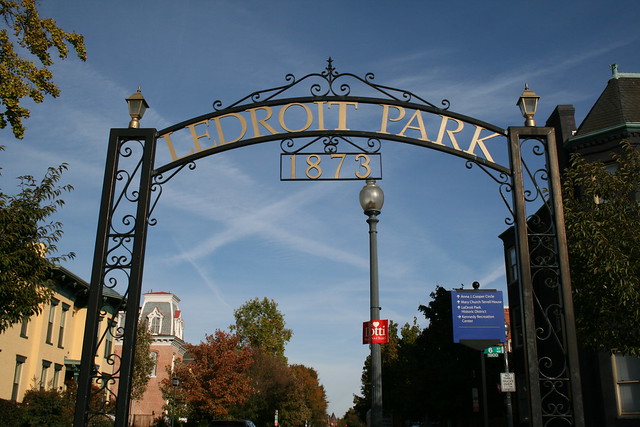
LeDroit Park was founded in 1873 and the first wave of single-family and duplex houses designed by James McGill soon followed.  The second housing wave brought rowhouses to LeDroit Park, but most of the neighborhood was finished in the early twentieth century long before the dominance of the automobile.

Notice this 1908 photo of the 400 block of U Street in LeDroit Park.  You’ll see four people, but only one car.

It’s no coincidence that our neighborhood’s founding, long before the automobile age, relates to its walkability and abundance of transit options.  In fact, when we look at the regional Census data, we find a strong relationship between the age of the housing stock and the rate of households without a car.

The only other factor that might influence the rate of carlessness is income, but the closeness of the carless rate and the pre-war housing stock rate is too glaring to ignore. There are plenty of middle-class people in Washington who choose to forgo a private car and the age of the neighborhood may be a strong indication of just how easy it is to live without a car.

Be the first to comment »