
Did Hillary Clinton assassinate a Bloomingdale man? No, you idiot.
… Despite the ridiculousness of this claim, Julian Assange, the WikiLeaks founder self-exiled in the Ecuadorian Embassy in London, is actively fueling this conspiracy theory.
Some background: Seth Rich, a 27-year-old staffer for the DNC, was found murdered on a sidewalk at Flagler Place and W Street NW in Bloomingdale at 4:30 am on August 10. The police suspect his murder was a botched robbery in a neighborhood suffering a tripling of armed robberies this year.
When police found Mr. Rich, they found his watch, wallet, and credit cards on him. These facts have led conspiracy theorist away from the simplest explanation, a panicked robber, to a fantastical story of political revenge by Hillary Clinton on a DNC staffer who Mr. Assange strongly insinuates leaked tens of thousands of DNC emails.
This wild cloak-and-dagger theory has been thoroughly debunked, yet WikiLeaks is offering a $20,000 reward to catch the killer. While that may seem helpful, Mr. Assange is using one family’s tragedy to push some political agenda against Mrs. Clinton.
The Rich family and the police appealed to the public to come forward with information and the MPD is offering a $25,000 reward to informants. Mr. Assange’s publicity stunt distracts investigators from real leads.
Turn down that Prince music!

In 1998 LeDroit residents wrote an open letter to incoming Mayor Anthony Williams to complain about Prince and the House of Secrets (507 T Street).
Clean Up Street in LeDroit Park
We live amongst trash and filth in the 500 block of T Street NW, in the historic area of LeDroit Park. We are proud of our aged homes and the famous black Americans who lived in them. But when we turn the corner at Sixth and T streets, we are appalled at the piled garbage and trash. When we have special guests at our homes, we must hire a private company to remove the trash so that we will not be embarrassed. We also have a problem with the parties held in our neighborhood at an after-hours nightclub, the House of Secrets. It’s no secret that the last two times The Artist Formerly Known as Prince performed in the area, he had a party that went on from 1 a.m. until 5 a.m. on a Tuesday morning. The purple buses roared down our one-way street and unloaded noisy passengers. The limousines, cars and taxis pulled up, double parked and blocked our driveways. How is it that an after-hours establishment is allowed to exist in our neighborhood? We, law-abiding citizens, do not want this nightclub. We do not want to party. We want to sleep.
Lois Wiley and LilliAnn Williams, T Street NW
This letter appeared with other residents’ letters to Anthony Williams, who officially became mayor two days later. The House of Secrets has hosted parties for decades, but has been relatively quiet since 2013, when two people were stabbed outside the house during a party.
The Alcoholic Beverage Control Board investigated the incident to decide whether it should decline future temporary liquor license requests for the house. Although nightclubs and bars are not permitted in that location by zoning, the city does issue occasional temporary event licenses, usually for one specific day. Both the LeDroit Park Civic Association and ANC1B submitted letters protesting future licenses.
A lost iPad and thoughtful neighbors

In the wake of Saturday’s homicide on 7th Street, a neighbor posted about her son’s lost iPad on the neighborhood listserv:
Our children and our family friends were witnesses to the shooting yesterday afternoon at 7th and S St. During the chaos, my four year old (who has a developmental disability and can’t speak) dropped his iPad that he uses as a communication device. It is an iPad mini in a life proof case. If you find it, please let us know. There is a reward upon return.
If you found the missing iPad mini, send me a private message and I’ll put you in touch with the family.
Last night the resident posted this thoughtful follow-up:
After we shared a message about the shooting at 7th and S on Saturday and our son’s lost communication iPad, we received so many heartfelt messages of support and concern from friends and neighbors. Thank you for your outreach – it reconfirms everything that we love about living in this community.
We are struggling with how to reconcile this violence in our community with our family’s needs. We are heartbroken for Matthew Shlonsky and his loved ones, we are sad and angry about the violence in our community making it less safe for our kids, and we are committed to fighting the root causes of this violence.
Many people have asked what they can do to help replace our son’s lost communication iPad, and have even offered donations for a new one. We so appreciate all of these offers of support.
We are going to order a new iPad for our son to take to his first day of school next week, but we are also making donations to community organizations that work every day to improve the lives of children and families in our community. We invite you to join us in supporting these organizations, or others of your choosing.
Northwest Settlement House operates a child care center on the corner of 7th and S that serves kids from all backgrounds and helps working parents find affordable childcare.
ONE DC is a community organization, based a block from 7th and S that organizes for access to better jobs and housing.
Crime is up, but murder is rare
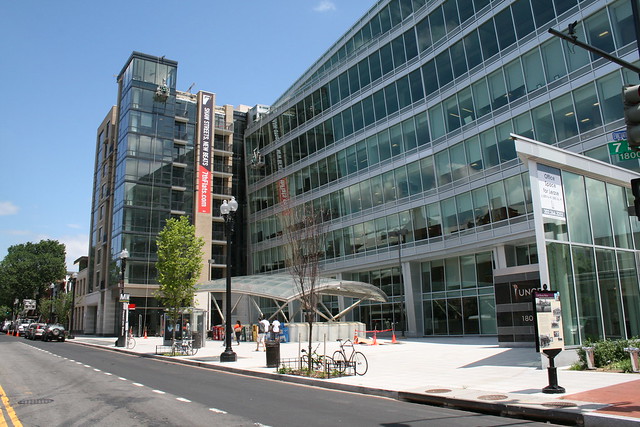
On Saturday afternoon, Matthew C. Shlonsky, a recent graduate of American University, was murdered on Seventh Street near the Shaw Metro’s north entrance. Mr. Shlonsky’s murder is part of a documented uptick in violence across Washington.
Crime has risen and MPD’s online data tool reveals this.
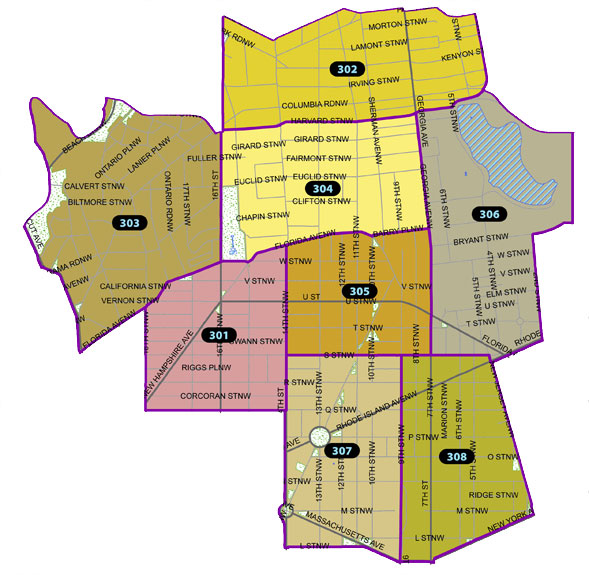
LeDroit Park, Howard University, and the section of Shaw near Progression Place are in police service area (PSA) 306. Over the past 12 months, violent crime has increased 8.1%, property crime has increased 4.9%, and total crime has increased 5.4% compared to the 12 months before that.
| Number of Crimes Reported Between | ||||
| Crime Type | 8/17/2013 to 8/17/2014 | 08/17/2014 to 08/17/2015 | Change | |
| Homicide | 0 | 1 | +1 | |
| Sex Abuse | 4 | 4 | 0 | |
| Robbery Excluding Gun | 19 | 24 | +5 | |
| Robbery With Gun | 17 | 14 | -3 | |
| Assault Dangerous Weapon (ADW) Excluding Gun | 20 | 16 | -4 | |
| Assault Dangerous Weapon (ADW) Gun | 2 | 8 | +6 | |
| Total Violent Crime | 62 | 67 | +5 | |
| Burglary | 21 | 13 | -8 | |
| Theft | 129 | 140 | +11 | |
| Theft F/Auto | 157 | 168 | +11 | |
| Stolen Auto | 20 | 23 | +3 | |
| Arson | 1 | 0 | -1 | |
| Total Property Crime | 328 | 344 | +16 | |
| Total Crime | 390 | 411 | +21 | |
However, when looking at year-to-date numbers for 2015 (Jan. 1 – Aug. 18, 2015) versus the same range last year (Jan. 1 – Aug. 18, 2014), violent crime declined 8.1%, property crime tumbled 10.9%, and total crime in the fell 10.6%.
| Number of Crimes Reported Between | ||||
| Crime Type | 1/1/2014 to 8/18/2014 | 01/01/2015 to 08/18/2015 | Change | |
| Homicide | 0 | 1 | +1 | |
| Sex Abuse | 3 | 0 | -3 | |
| Robbery Excluding Gun | 11 | 12 | +1 | |
| Robbery With Gun | 10 | 6 | -4 | |
| Assault Dangerous Weapon (ADW) Excluding Gun | 11 | 10 | -1 | |
| Assault Dangerous Weapon (ADW) Gun | 2 | 5 | +3 | |
| Total Violent Crime | 37 | 34 | -3 | |
| Burglary | 15 | 9 | -6 | |
| Theft | 87 | 72 | -15 | |
| Theft F/Auto | 84 | 85 | +1 | |
| Stolen Auto | 16 | 14 | -2 | |
| Arson | 0 | 0 | 0 | |
| Total Property Crime | 202 | 180 | -22 | |
| Total Crime | 239 | 214 | -25 | |
Mr. Shlonsky’s murder, though tragic, is rare. In the past five years, the only other person murdered was a man found with stab wounds in car that crashed on Florida Avenue in the early hours of May 1, 2012. He was believed to be driving himself to the hospital.
Residents concerned about crime are encouraged to attend the ANC 1B public safety meeting on Thursday, August 20 at 7 pm at the Thurgood Marshall Center (1816 12th St NW).
[This post has been updated to include year-to-date crime numbers.]
Watch a film about the flooding of 2012

The National Geographic Society is sponsoring a free film screening and discussion about the street and basement flooding that afflicted parts of Bloomingdale and LeDroit Park in 2012. The film, Neighbor to Neighbor: The Bloomingdale Story, will be shown on Thursday, May 21 from 7 to 9 pm at St. George’s Episcopal Church (2nd & U Streets).
Here’s the full description from the flyer:
In September 2012 Bloomingdale was hit by one of the severest storms in recent memory. As Mike Thomas’ home flooded, neighbors—from different backgrounds and walks of life— came together to help him recover from the storm. This film tells that story.
Why Attend: Storms are hitting the District at an ever-increasing rate. In addition to infrastructure problems, weather crises due to climate change are on the rise: flash floods, severe freezes and snowstorms, and intense heat waves.
Katrina and the Chicago Heat Wave taught us that knowing your neighbors is one of the best predictors of survival. We know that communities with the strongest social connections are also the most resilient (able to bounce back from a challenge).
Bloomingdale, LeDroit Park, and the Southwest Waterfront are on the front line of critical weather events. Come see this insightful short film, share some food (provided), conversation, and wisdom about human connections and the resilience of our neighborhoods. The director of the film, Steve Droter, and Mike Thomas will be available to participate in the conversation.
This screening is funded in part by the National Geographic Climate and Urban System Partnership (CUSP).
Photo: A drop shaft in Bloomingdale for the tunnel boring machine that will drill a stormwater retention tunnel under First Street in Bloomingdale. The tunnel is expected to resolve flooding problems for good.
Neighbors to show their support for the market after it was robbed

LeDroit Park residents plan to show support for the LeDroit Park Market (1901 4th Street NW) after it was robbed on Friday at 8:15 pm. The armed, masked robber made off with less than $400 in cash and undoubtedly terrified the two women who were staffing the store at the time.
To show our support for the store, which reopened within the past year under new management, the LeDroit Park Civic Association is asking neighbors to stop by on Wednesday, March 25th from 7 pm to 9 pm.
Your favorite neighborhood blogger will be there too!
Street sweeping resumes Monday

The Department of Public Works, which collects trash, plows snow, and issues parking tickets, will resume street sweeping on Monday, March 16. If you park on the street, be sure to move your car according to the street sweeping signs posted on each street.
Street sweeping ended in October and several of our streets desperately need cleaning.
Shoveling your sidewalk becomes mandatory next month
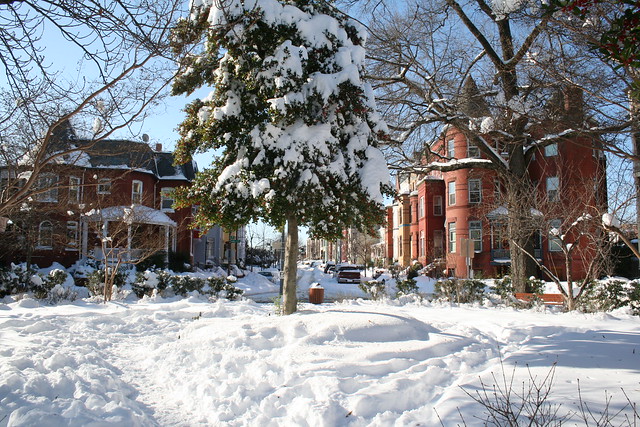
LeDroit Park residents woke up this morning to find four to six inches of snow on the ground. Please be kind to your neighbors and shovel your sidewalks.
Next month DC law will change to require homeowners to shovel their adjacent sidewalks within eight daylight hours after snowfall ceases.
Photo: Snowfall from the storm that buried the region in December 2009.
A trashcan thief has struck LeDroit Park
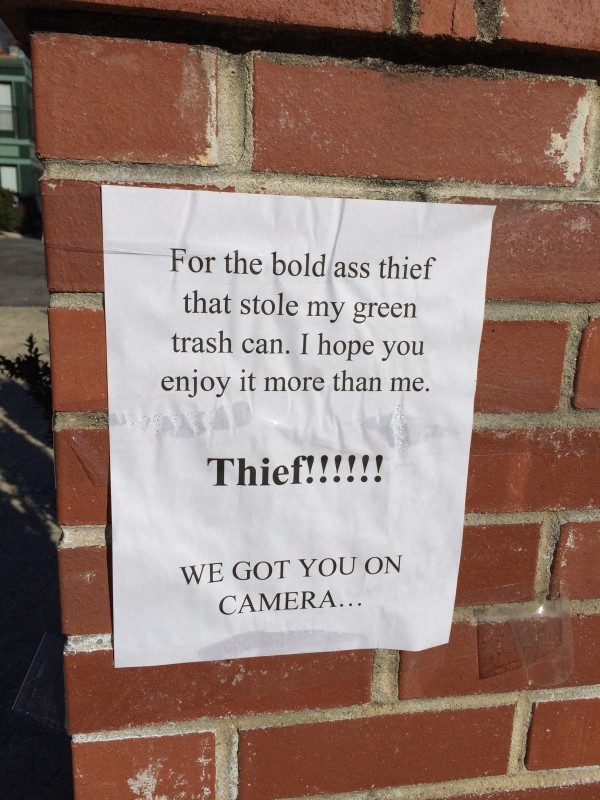
Several neighbors reported their trashcans stolen last week. One neighbor also reported following her can’s tracks in the snow in the sidewalk, but losing the trail blocks away at Florida Avenue, where the snow had melted. Another resident posted the frustrated notice above.
Kevin Twine, the spokesman for the Department of Public Works, the District agency that collects trash and recycling and plows the streets, advised residents the discourage theft by “painting your address on your containers in the most garish way possible”.
Does anyone have any magenta paint and Comic Sans stencils I can borrow?
Please let the pumpkins be
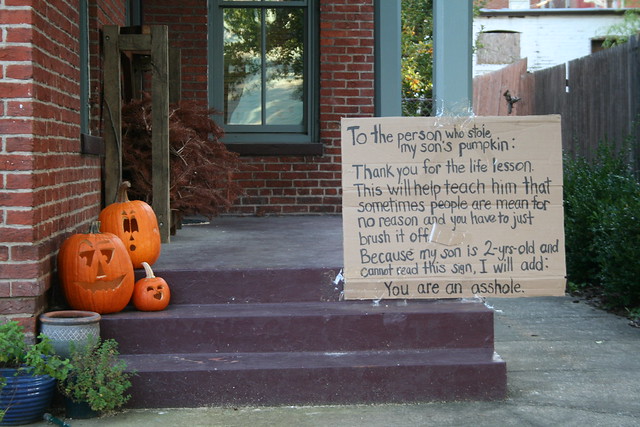
Someone snatched a pumpkin from a porch on the 400 block of U Street. The resident is not happy and left this sign:
To the person who stole my son’s pumpkin:
Thank you for the life lesson. This will teach him that sometimes people are mean for no reason and you have to just brush it off.
Because my son is 2-yrs-old and cannot read this sign, I will add:
You are an a‐‐‐‐‐‐‐.







Recent Comments