
How LeDroit Park’s demographics have changed since 1970
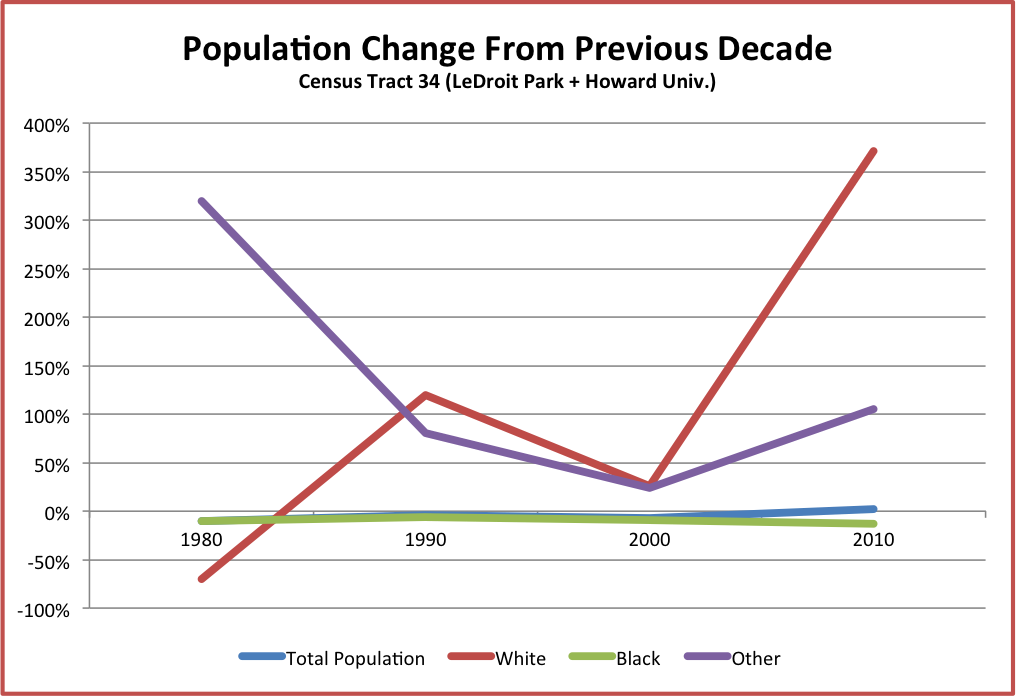
Since 2000 the census tract that includes LeDroit Park has grown more educated, more expensive, and wealthier. Meanwhile the tract’s total population held steady after decades of slow decline. While the white population has increased, the census tract is still overwhelmingly black.
Governing Magazine recently ran a story on gentrification in DC and labeled Census Tract 34, which contains LeDroit Park and Howard University, as “gentrified“. LeDroit Park has certainly changed over the years and I finally got around to compiling decennial census data from 1970 to 2010 as well as data from the American Community Survey.
Let’s start off with the biggest changes.
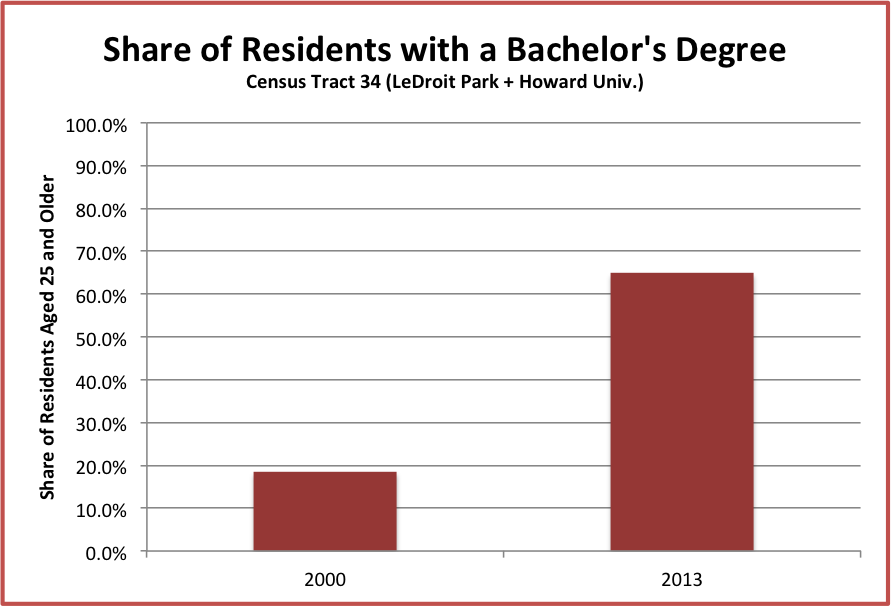
LeDroit Park is now better educated than the DC region and the nation
Data from Governing show that the share of adults age 25 and older who earned a bachelor’s degree more than doubled from 18.5% in 2000 to 64.9% in 2013. In fact the neighborhood catapulted over the regional figure (48%) and the national figure (28.8%).
Home prices fluctuate more drastically in LeDroit than in the rest of DC
Data from NeighborhoodInfoDC show that until 2004, the median sale price of single-family homes in the neighborhood moved closer to the average of the median values of all DC census tracts. The median price in LeDroit Park quintupled from 1996 to 2005, marking the greatest period of price appreciation. Though prices fell a bit from the recession, the neighborhood’s median price is slowly converging on the District-wide figure. (Disclosure: I do consulting work for the think-tank that produces NeighborhoodInfoDC)
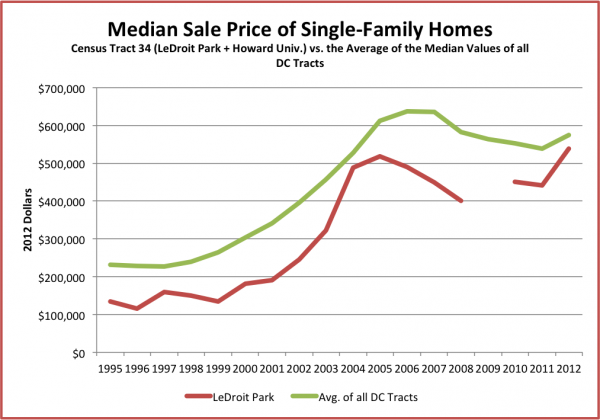
Note: 2009 data not available
Governing’s data of the median home value (both single-family homes and condos) show that housing prices nearly doubled from 2000 to 2013.

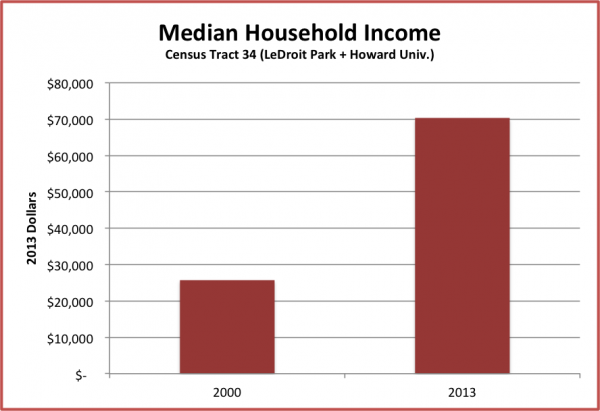
Median household income more than doubled from 2000 to 2013
(For comparison, median household income nationwide declined during this period.)
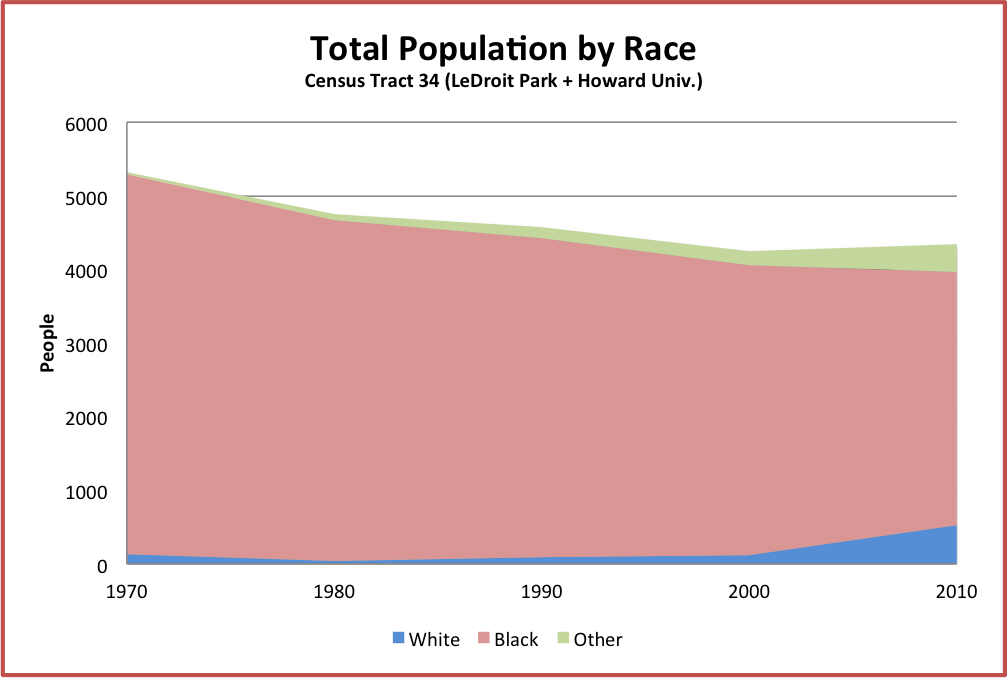
LeDroit Park is still predominantly black
The population of LeDroit Park and Howard’s campus held steady since 2000 after decades of modest decline. Though the number of whites more than tripled and number of blacks fell 13% from 2000 to 2010, our census tract is still 79% black. A few years ago I got a limited data set of the 2010 Census from the Office of Planning and was able to separate LeDroit Park figures from the rest of the census tract that lies north of W Street. Even then I found that the neighborhood was 70% black.
One popular gentrification narrative is that the process turns poorer black neighborhoods into wealthy white neighborhoods. While income and home values in LeDroit have soared, it still remains a predominantly black neighborhood.
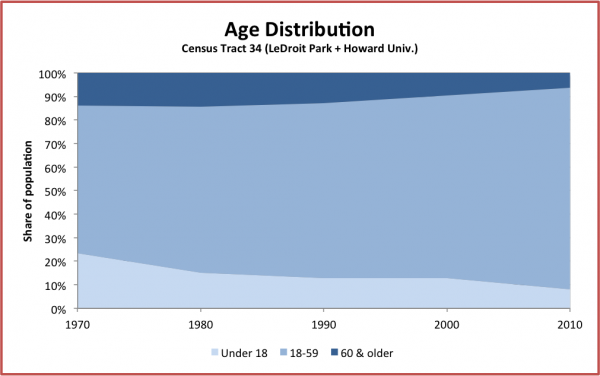
Lil’ LeDroiters are becoming scarcer
From 1970 to 2010, the population of residents under 18 tumbled from 23% of the population (1,244 children) to 8% of the population (350 children). For comparison, DC’s under-18 population in 2010 stood at 17%.
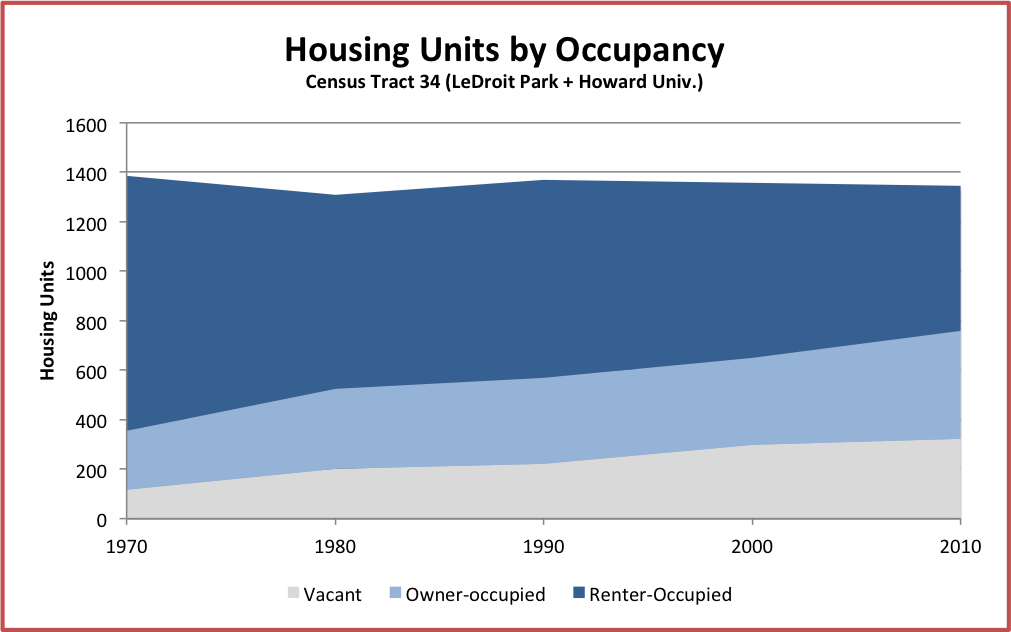
Homeownership has expanded, the housing stock has not
This was one of the more surprising facts. Despite construction of numerous infill rowhouses (especially on the 300 and 500 blocks of U Street) and despite the conversion of many one-unit rowhouses into two-unit rowhouses, the total number of housing units is slightly lower than in 1970. Also, vacancy has been rising, which contradicts what I have seen since I moved here in 2009. Perhaps the vacancy numbers were driven by the remodeling of the 161 units at Kelly Miller or perhaps Howard University dorm rooms do not count as “occupied” since many are vacant during the summer.
The definition of gentrification is a matter of great debate, but Governing defined it as any census tract that met the following criteria from the 2000 Census to the 2010 Census:
- It must start out poorer, i.e. “median household income and median home value needed to fall within the bottom 40th percentile of all tracts within a metro area at the beginning of the decade.”
- It must end up pricier and more educated, i.e. “in the top third percentile for both inflation-adjusted median home values and percentage of adults with bachelors’ degrees.”
According to Governing’s analysis, our tract, like half of the other DC tracts that met the first condition above in 2000, satisfied the second condition in 2010 and thus gentrified.
Sources:
- Longitudinal Census Bureau data (1970 – 2010) came from the US 2010 project, which used a peer-reviewed method adjust older tract data to conform to the latest tract boundaries.
- Governing, which used Census Bureau data.
- American Community Survey, a Census Bureau project that collects detailed demographic data for years between and overlapping each decennial census.
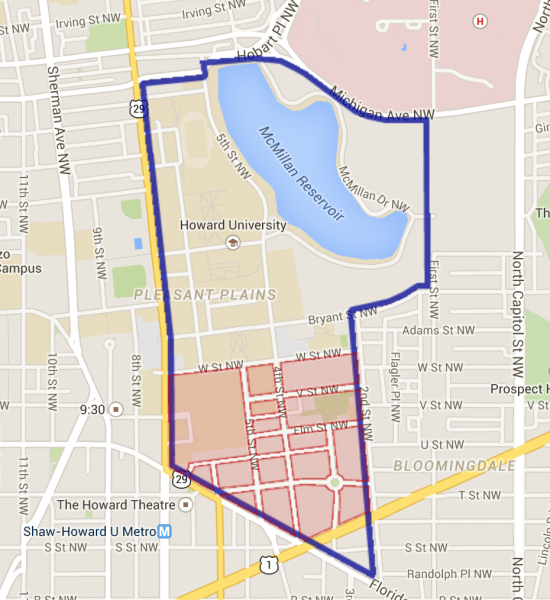
Our census tract (outlined in blue) is larger than the neighborhood and includes much of the Howard University campus.
LeDroit Park was a hot market in 1978, but much more affordable than today
A neighbor pointed us to this 1978 article in the Washington Star naming LeDroit Park the neighborhood with the highest annual appreciation in single-family home assessments. Home values increased 51% in just two years.
Much of the increase was attributed to Howard University’s purchase of homes in the neighborhood. The university has since divested itself of nearly all single-family houses here.
The average neighborhood assessment back then, according to the assessor quoted in the article, was about $25,000. Even in 1978 that was considered low and the figure was about 1.5 times the District’s median household income in 1979, which was $16,211. In 2013 the average sales price of a LeDroit Park home (including condos) was $562,029, which was 9.2 times the District’s median household income in 2013, which was $60,675.
LeDroit Park fast became a fashionable neighborhood

We found this 1875 article about LeDroit Park’s fast-growing population from 1875. This was just as the neighborhood was being developed as “suburb” of Washington City.
Local News.
Evening Star
October 9, 1875AN INTERESTING ITEM, showing the growth of the city to the north, is the fact that eighteen months ago only two families lived at LeDroit Park, while now more than twenty families make it their residence, and the demand for homes in that beautiful locality is far beyond the supply.
Download a PDF of the original story. You can browse the entire Evening Star online with your DC library card.
LeDroit Park demographics in the 1890s
 Though the Constitution mandates a decennial census, the District’s police force undertook its own census, presumably to balance deployments through the growing city.
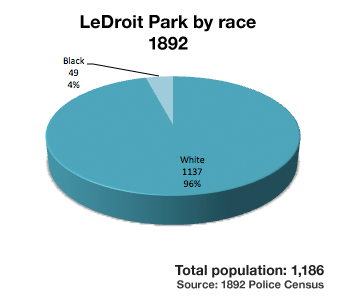
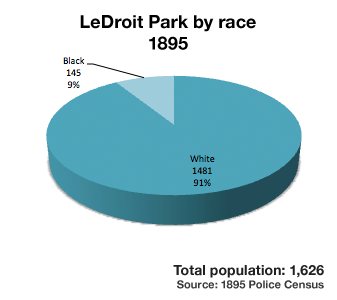
The 1892 and 1895 police census tables, reported in the Evening Star, showed LeDroit Park growing 37% in those three years. Furthermore, the neighborhood was slowly becoming more diverse as the whites accounted for 96% of the population in 1892, but 91% in 1895.
Though LeDroit Park was established as an exclusively white neighborhood, by 1910 the neighborhood had become almost entirely black.
Despite these pendulum swings, LeDroit Park’s demography is more diverse today.
Our zip code, now with some more white people
Every now and then the Census Bureau or some organization releases a report or new data showing that DC’s demographics changed. A recent analysis of census data found that the 20001 zip code, which covers LeDroit Park, Pleasant Plains, Bloomingdale, Truxton Circle, Shaw, and Mount Vernon Square, saw its non-Hispanic white population increase by 27.2 percentage points from 5.6% to 32.8%. In fact, 20001 made the list of “most-whitened zip codes” in the nation.
Our review of the 2010 census data found that LeDroit Park is 21% white, which is below the figure for the zip code.
What does this mean? Without more information, the report doesn’t mean much other than the unsurprising fact that neighborhood demographics change. This plain answer will dissatisfy some. In a city in which identity is inevitably intertwined with politics, many will feel compelled to read too much into the data for some larger narrative that confirms preexisting social or political views.
However, the reasons that people move into and out of a neighborhood are complicated and there are both push and pull factors, both voluntary and involuntary.
Why a person might leave a neighborhood:
- Your new spouse wants to live elsewhere.
- You graduated from the local university and intend to return to your hometown.
- You dislike too many of your neighbors.
- You got a new job far away.
- The rent has become unaffordable.
- You lost your job and can’t pay any rent.
- You want to retire closer to where your children live.
- Perceptions of crime.
- Divorce.
- Death.
- You want to send your children to school elsewhere.
- You’re pursuing a degree somewhere else.
Why a person might move into a neighborhood:
- You are born and that’s where your parents live.
- You found the perfect home.
- Friends and family are nearby.
- There are people like you nearby.
- You got a new job nearby.
- The area is familiar.
- You’re moving in with friends or relatives.
- Rent is cheaper here than in some other place.
- The neighborhood is visually appealing.
Each person’s story is different, but there is far more at work than the simplistic displacement narrative that gets so much press.
The 1940 Census reveals a full profile of LeDroit Park
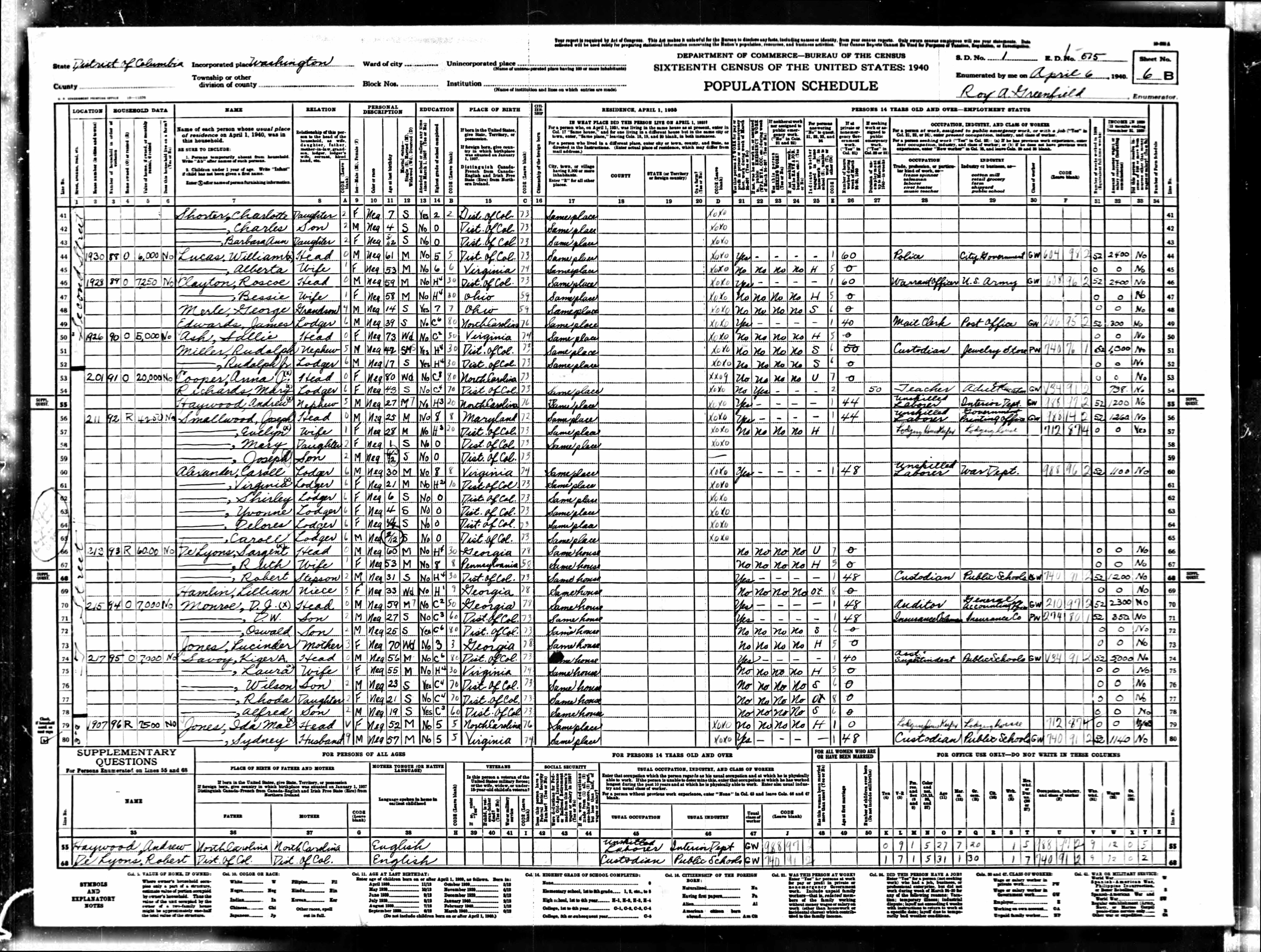
U.S. Census records are kept confidential for 72 years, meaning that the 1940 Census went public yesterday. Whereas previous census ledgers were difficult to find online for free, the U.S. Archives released the full 1940 Census online. We have started perusing the pages to look for famous figures and interesting patterns in LeDroit Park, which is covered by enumeration districts 1-514 through 1-516.
A few things stand out. First, nearly the entire population of LeDroit Park in 1940 was black, illustrating the sharp racial segregation at the time. Second, nearly every house was packed with residents and many residents took on lodgers. Our house, a modest two-bedroom built in 1907, housed 13 people!
* * *
We will publish some interesting records as we find them, but let’s start off with the listing for Anna J. Cooper (née Haywood), her lodger, and her nephew, who lived at 201 T Street (pictured below). The Cooper household is listed as entries 53 – 55 in the ledger at the top of this post.

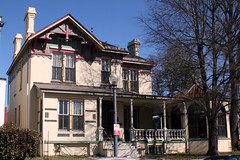 Cooper was the principal of the M Street High School, she was an author, a feminist, and a teacher. The census only collects unambiguous personal statistics, so there is actually a longer story behind every column entry.
The first column in the snippet above states the value of her home as $20,000, a high sum compared to other LeDroit Park homes.
The 11th column lists “C8”, meaning that she received eight years of a college education. What the record doesn’t state is that she received a PhD from the Sorbonne in 1924, making her among the first black American women to receive a doctorate.
The 8th column states her age as 80 (she was actually 81) and the 13th column simply states that she was born in North Carolina. What the record doesn’t state is that she was born in North Carolina in 1858 into slavery.
The rest of the record not pictured in the above snippet states that by 1940 she was unable to work, though in reality she was likely still running a small night school.
She died in 1964 at the age of 105. The circle at 3rd and T Streets is named in her honor, she is featured on a postage stamp and on pages 26 and 27 of the U.S. passport.
Before the park, before the school, there were apartments

The Park at LeDroit was built on the site of the Gage-Eckington School. The school, built in the 1970s, was itself built over streets, houses and apartment buildings.
At the time, 3rd Street extended north of Elm Street and dead-ended just before reaching V Street. Oakdale Place extended eastward from its current terminus at the park to dead-end at what is now the eastern boundary of the park.
Two apartment buildings on the site, the Linden and the Harewood were named after local streets. Before the city changed the neighborhood’s street names, 3rd Street was Harewood Avenue and 4th Street was Linden Street.
We found this 1901 description of the apartments. What’s most notable is that the apartments are marketed to black Washingtonians and thus reflects the neighborhood’s turn-of-the-century transition from a white neighborhood to a black neighborhood.
THE LINDEN AND HAREWOOD FLATS
Le Droit Park—Corner of Harewood and Oak Streets.
The Colored American
January 5, 1901Mr. Banes the the real estate dealer has erected two of the most modern flats in Washington situated in Le Droit Park. The situation of these flats is an ideal one, on Third street, two doors from the Fourt street car line. The finish of the flats is elegant, and they have a preposessing appearance. They are three stories high, and each floor has three flats of four rooms each and bath. The whole flat is heated by steam, thus saving the necessary expense of buying fuel. Each flat has a parlor, dinning [sic] room, bed room, kitchen, and bath room and private hall rooms, and halls are heated by steam. The kitchens have a modern gas range, hot and cold water, cupboards, pantry attachment. These flats are no doubt, the best in the city. Persons having a large family can easily rent two adjoining flats saving the enormous rent of an entire house. They are thoroughly and artistically finished. The walls are papered and frescoed, and glasses of a large size, supported by a modern mantel piece are in each parlor. Le Droit Park has become a pleasant part of Washington in which to reside and these beautiful flats are a happy addition to the residences there. Mr. Banes has spared no pains in making these flats comfortable and inviting and already applications are being made for retals thereof. Colored people with first class reference who desire a beautiful part of the city in which to live, and at the same time occupy comfortable and improved apartments without renting a whole house, and paying high rent, can find a happy medium in these flats. The terms are easy. The buildings are open daily for inspection. For further information call at the office of Mr. Charles E. Banes, corner of 14th and G sts. n. w.
Census data for LeDroit Park
In preparation for redistricting Ward 1’s ANCs, the DC Office of Planning has released block-by-block demographic data for the District. We have combined the data for the blocks that comprise LeDroit Park to create a LeDroit Park census.
Analyzing U.S. Census data for LeDroit Park proves difficult because the of the way census tracts are drawn. Our census tract, 34, combines LeDroit Park and Howard University. Dorms on the northern end of the campus, far away from LeDroit Park, account for 717 of the tract’s 4,347 residents, thus skewing tract data. Furthermore, the tract also inclues several blocks bounded by Rhode Island Avenue NW, Florida Avenue NW, and 2nd Street NW.
Fortunately, the Census Bureau provides data for each block, allowing us to combine the statistics for those blocks in LeDroit Park, while excluding the Howard University campus. In the map below, we have outlined the tract in blue and shaded the blocks for LeDroit Park in red.
View LeDroit Park Census in a larger map
Though LeDroit Park started out as an exclusively white suburban neighborhood, by 1910 the neighborhood was almost entirely black. Today, 100 years later, the neighborhood is 70% black and is continuing to diversify.
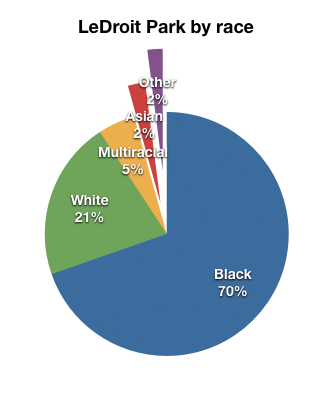
However, when looking at the numbers on a block-by-block basis, you see that the neighborhood demography, must like that of the District itself, is unevenly distributed.
The block bounded by 5th Street, T Street, 6th Street, and U Street is 53% white, the highest in the neighborhood. Likewise, the block containing the Kelly Miller public housing is 91% black, the highest percentage in the neighborhood. The block containing the arch and the Florida Avenue Baptist Church comes closest to black-white equilibrium at 44% and 49% for each group respectively.
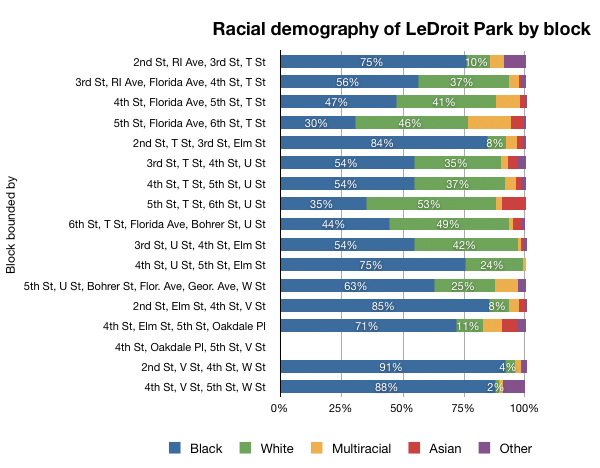
When looking at total population numbers for each block, you see that the two most populous blocks contain Howard University dorms. The block bounded by 2nd Street, T Street, 3rd Street, and Elm Street has 382 residents and contains Slowe Hall, which houses 299 students.
The second most populous block contains the new park. However, it also contains Carver Hall, which itself houses 173 students. Certainly these blocks are big, but the fact that their population numbers are off the chart has more to do with student dorms than with any inherent difference in housing density.
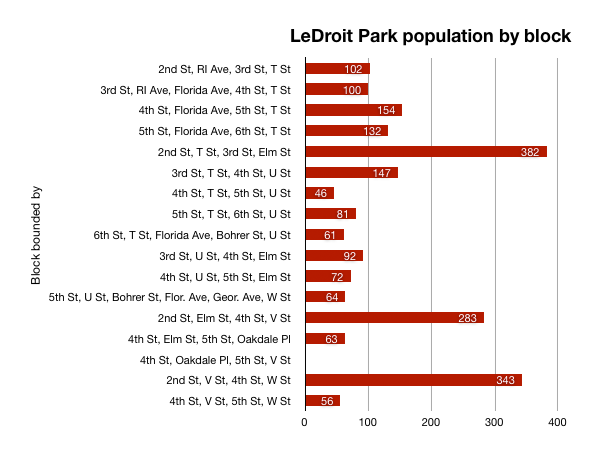
Finally, when we look at housing vacancy, we see that the block bounded by 5th Street, T Street, 6th Street and U Street has 38% of its housing units vacant. We’re not sure what’s causing this number, but we suspect that the apartment building at 5th and U Streets NW boosted the vacancy rate. The building has since been finished and is fully rented.
The block with the second-highest rate of vacancy contains the now-renovated Ledroit Place condo building at 1907 3rd Street NW.
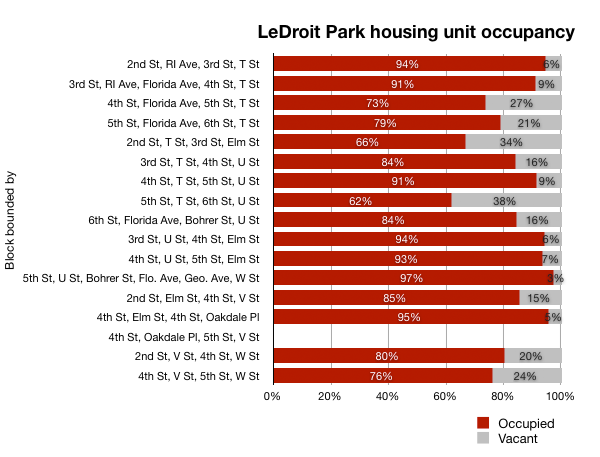
It would be interesting too look at other data, including household income, car ownership, and age distribution for the neighborhood. However, the Office of Planning’s spreadsheet only covered population numbers, racial distribution, and housing unit numbers, so those are the metrics we graphed.
Carless in LeDroit
Source: U.S. Census Bureau
Among the nicest features of LeDroit Park are its walkability and its proximity to downtown. We can bike downtown to work in 15 minutes, or if it’s raining, take the bus or the metro and be there in 25 minutes. The restaurants, shops, and bars along U Street are only a short walk away.
The notion that it is easy to live in LeDroit Park without a car consistently confounds many suburbanites, but our variety of transportation options is no accident.
Our neighborhood is just outside the original L’Enfant city. In L’Enfant’s time, the main form of transportation was the human foot, so a city designed from scratch, like Washington, had to be relatively flat, like Washington, and compact, like Washington. Horse-drawn streetcars made commuting across the city easier, and electric streetcars eased the daily climb to neighborhoods like Columbia Heights and Mount Pleasant.
After World War II, housing construction exploded, particularly suburban housing construction. The suburban housing model was— and, for the most part, still is— based on several main principles, most significantly, the uniformity of housing sizes (usually large) and the separation of residential and commercial uses. Both larger lots and the separation of uses create longer distances between any two points, requiring a greater effort to go between home, work, and the grocery store.
These longer distances between daily destinations made walking impractical and the lower population densities made public transit financially unsustainable. The only solution was the private automobile, which, coincidentally, benefited from massive government subsidies in the form of highway building and a subsidized oil infrastructure and industry.
LeDroit Park was founded in 1873 and the first wave of single-family and duplex houses designed by James McGill soon followed. The second housing wave brought rowhouses to LeDroit Park, but most of the neighborhood was finished in the early twentieth century long before the dominance of the automobile.
Notice this 1908 photo of the 400 block of U Street in LeDroit Park. You’ll see four people, but only one car.

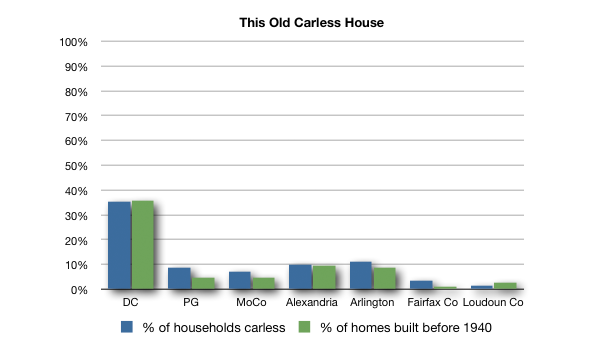
It’s no coincidence that our neighborhood’s founding, long before the automobile age, relates to its walkability and abundance of transit options. In fact, when we look at the regional Census data, we find a strong relationship between the age of the housing stock and the rate of households without a car.
The only other factor that might influence the rate of carlessness is income, but the closeness of the carless rate and the pre-war housing stock rate is too glaring to ignore. There are plenty of middle-class people in Washington who choose to forgo a private car and the age of the neighborhood may be a strong indication of just how easy it is to live without a car.
Out of School, Out of Work
The Bureau of Labor Statistics released the unemployment rate for December and the news for the District is not good. Unemployment ticked up to 12.1%, far above Maryland’s 7.5% and Virginia’s 6.9%.
Though the District added 6,100 jobs from December 2008 to December 2009, the unemployment rate jumped from 8.9% to 12.1% in the same period.
The Post speculates:
But because the labor force in the District has a large proportion of undereducated people, experts said, the majority of those high-paying jobs usually go to more qualified residents of suburban Maryland and Northern Virginia. Less-educated residents typically work in construction, which lost 200 jobs last month; in leisure and hospitality, which lost 400 jobs last month; and in retail and transportation, which lost 500 jobs last month.
Cynthia Ward, vice president of market and account services at the recruiting and career management firm Lee Hecht Harrison, said candidates who grew up in the District often are unable to compete with their suburban counterparts because of the troubled city school system.
“I graduated from the D.C. public schools, where I had been an A and B student. When I went to college, I discovered I was way behind [other students], especially in writing, and I had to work hard” to catch up, said Ward, who is on a task force seeking ways to better prepare District residents for higher-skills jobs.
Perhaps now our city will finally begin to see what everyone else has known all along: that the poor performance of our public school system is not just a civil rights disgrace, but an economic impediment, too.








Recent Comments