
Lick free ice cream on Thursday
Meet your neighbors over free ice cream sundaes, ice cream floats, banana splits, brownies, and cookies. The LeDroit Park Civic Association is hosting an ice cream social on Thursday, July 30 from 6 to 8pm in Ms. Norman’s backyard (1853 3rd St NW).
Brianne Nadeau, who represents Ward 1 on the DC Council, will be in attendance.
Attendance is free, but please R.S.V.P. so we know how much ice cream to buy
110 units proposed for Wiltberger and T Streets
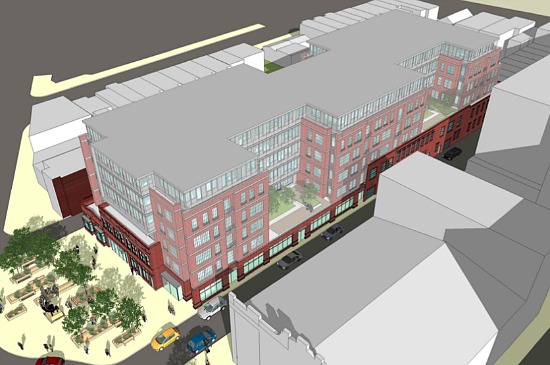
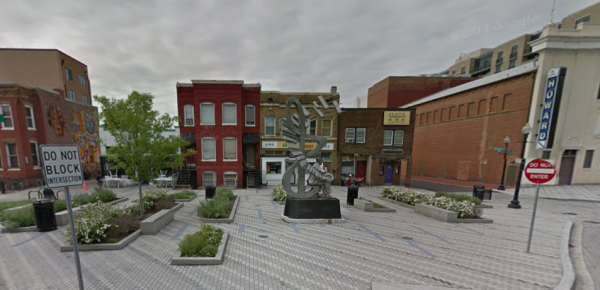
UrbanTurf reports that a 110-unit apartment building may be coming to T Street next to the Howard Theatre. The project would replace the warehouse on Wiltberger Street and the stretch of buildings on T Street from Flava to Zenebech Restaurant (see photo below).
The project would also include 8,000 square feet of retail and 50 parking spaces. According to UrbanTurf, the project developer plans to build the project matter-of-right, meaning the project will not require any historic design review and will not require zoning relief for things like height, rear yards, parking, etc.
The map below shows the zoning context of the project site.
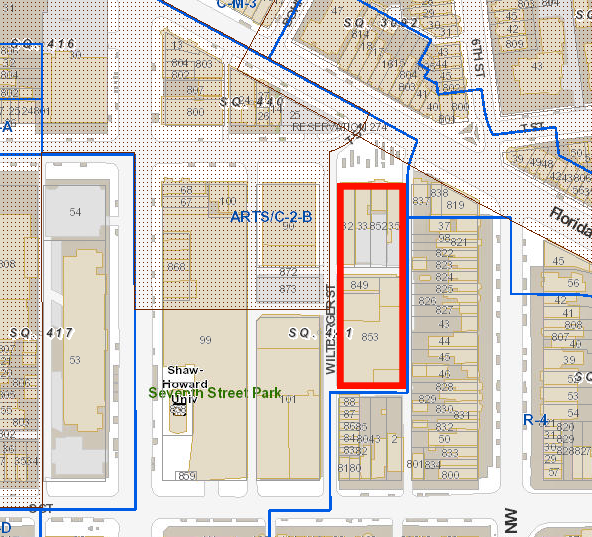
The site lies just outside the LeDroit Park and Greater U Street Historic Districts (brown dotted area). The site also lies within the C-2-B zone, which allows
- office, retail, and residential uses
- maximum lot occupancy of 80% for residential uses and 100% for all other uses*
- maximum FAR of 3.5 for residential uses and 1.5 FAR for other permitted uses**
- maximum height of 65 feet.
- rear yard requirement of fifteen (15) feet
- 1 parking space for every 3 housing units + 1 parking space for every 750 sq. ft. of retail over 3,000 sq. ft.
As long as the project stays within these constraints, the developer is entitled to receive building permits.
* This calculation applies to different floors of the building based on the floor’s use. If you have ground-floor retail, you can cover 100% of the lot for that floor. If there are residential floors above that, each residential floor cannot cover more than 80% of the lot.
** This calculation is separated by use, meaning you can have 3.5 FAR of residential uses on top of 1.5 FAR of commercial uses. This would give the building a total of 5.0 FAR.
The Royal receives plenty of good press

The Royal, the new cafe/bar that opened at Fifth Street and Florida Avenue last month is receiving a lot of positive press coverage.
- “Colombian-ish Restaurant The Royal Now Open in LeDroit Park.” Washington City Paper.
- “The Royal brings South American flavors and homemade vermouth to LeDroit Park.” Washington Post.
- “Take a Look Inside Ledroit Park’s Exciting New Restaurant: The Royal.” Washingtonian.
- “First Look: The Royal Opens in LeDroit Park.” Zagat.
- “Another Peek Inside The Royal now Open in LeDroit Park.” PoPville.
Two businesses open this week
Two restaurants open this week on Florida Avenue, continuing the transformation of intermittently vacant properties into food establishments.
The first is the LeDroit Royal (501 Florida Ave NW), which opens today (Thursday) at 7 am. The Royal has been under construction for months and I was able to attend its soft opening on Tuesday night. The interior renovations are remarkable and the menu provides a wide array of cocktails, on-tap vermouth, and Colombian and Guatemalan food. Like Bistro Bohem, the Royal opens as a coffee shop during the day and transforms into a bar at night.
Read the Post’s review for more details.

Just up the street, Rito Loco (606 Florida Ave NW) opens on Friday at 11 am. Like the Royal, Rito Loco has been under construction for several months. Rito Loco is the brick-and-mortar incarnation of the popular burrito food truck.
The shop is more of a fast-food operation with limited seating, but it may expand. I talked with the owner two weeks ago and he said he would eventually like to add a roof deck once he gets financing for it.
Meet your neighbors at July’s happy hour
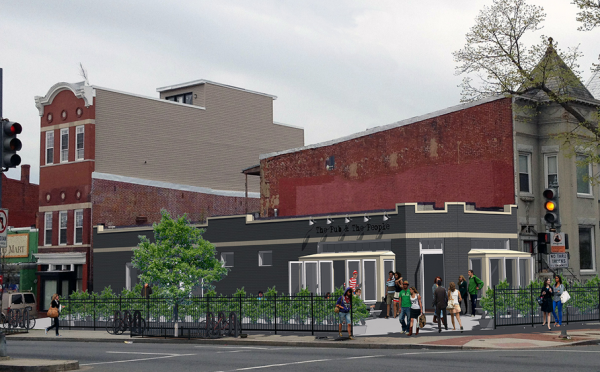
Meet your neighbors and check out Bloomingdale’s newest pub! The next LeDroit Park happy hour will be at The Pub and the People (1648 North Capitol St NW) in Bloomingdale on Tuesday, July 14 from 6:30 pm to 8:30 pm.
We hope to see you there.
WAMU reports on the new heritage trail
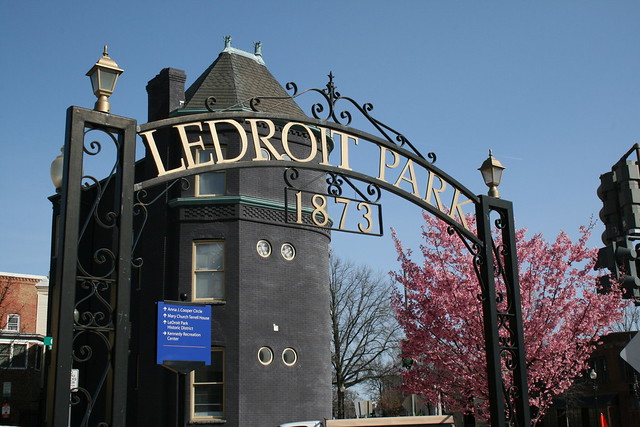
On Thursday the Kojo Nnamdi Show aired a program on the new LeDroit Park-Bloomingdale Heritage Trail.
Weekend Events
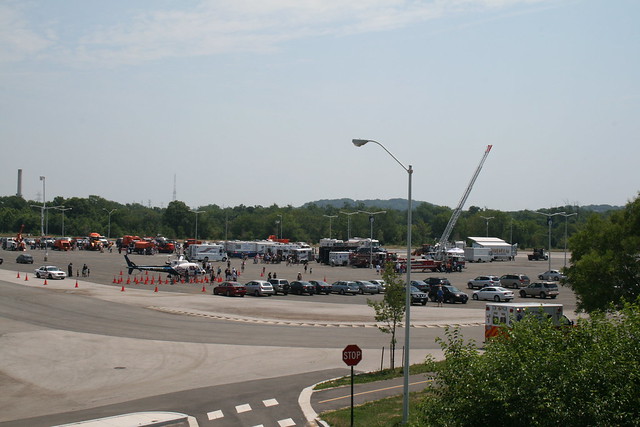
There are two interesting events going on tomorrow:
Masjid Muhammad Community Open House
Masjid Muhammad is the mosque at 1519 Fourth Street NW in Shaw. The mosque is hosting an open house tomorrow from 11 am to 4 pm.
Eight Annual D.C. Truck Touch
The D.C. Government is hosting its annual “truck touch”, an event where residents (especially kids!) get to sit in firetrucks, touch the police helicopter, watch DC Water’s sewer robot in action, gaze at snow plows, peer under street sweepers, and much more.
The Truck Touch is tomorrow from 8 am to 1 pm at Lot 7 at RFK Stadium. View some photos I took of the 2010 Truck Touch.
Have tea with your neighbors
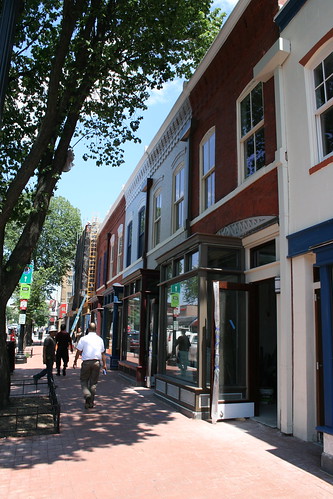 Meet your neighbors and explore a new local business at next week’s LeDroit Park happy hour. This month we are going to Calabash (1847 7th St NW) on Tuesday, June 9 from 6:30 pm to 8:00 pm. Calabash is the new tea shop that opened by the Shaw Metro.
In other news, the Washington Business Journal has a good summary of the retail transformation of Shaw, which is attracting high-end and boutique retailers who used to set up shop in Georgetown instead.
Heritage Trail signs finally installed
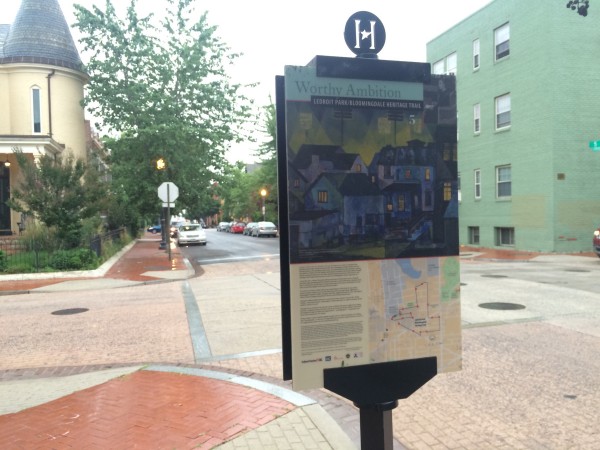
This week, after years of work, the LeDroit Park-Bloomingdale Heritage Trail is finally being installed. The signs scattered throughout both neighborhoods mark important historical sites and form a linear path history buffs can follow for a full tour of both neighborhoods.
This heritage trail is titled Worthy Ambition, a line from a Paul Laurence Dunbar poem about black achievement in spite of slavery.
Cultural Tourism DC, which researches and sponsors these trails, is partnering with the civic associations in both neighborhoods for an official unveiling. Stay tuned for details.
Learn about street improvements; run for the civic association board
Learn about DDOT street improvements, review a neighbor’s request for a variance, and vote for civic association officers at the next week’s civic association meeting. The next meeting is Tuesday, May 26 at 7 pm in the basement of the Florida Avenue Baptist Church (623 Florida Ave – enter at the rear).
DDOT will present its plan for installing green infrastructure to reduce stormwater flow into the sewers during storm events. Such infrastructure can include rain gardens and pervious alleys that absorb water.
A neighbor at 2118 2nd St NW will present her plan to add a 90-square-foot addition to her house. She will request support for a zoning variance to build her addition.
The association will also hold annual elections for officers. The positions are President, Vice President, Secretary, and Treasurer. All association members are eligible to run and vote.
President Golda Philip and Secretary Brian Footer, who is also our ANC Commissioner, have chosen not to run again. At least one person has agreed to run for each position, but we will open the floor to additional nominations (you may nominate yourself).
(Disclosure: I am now the Vice President and will run for President.)







Recent Comments