
Shaw Fits and Starts
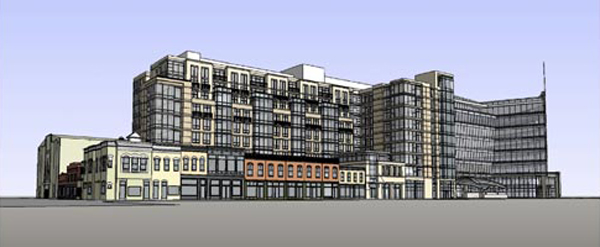
Broadcast Center One as viewed from the CVS at 7th & T Streets
When climbing the escalator out of the Shaw Metro’s north entrance, one emerges between Seventh Street on the left and a vacant field on the right. The vacant field has been set for renewal with a plan going back several years. In January, when we first started writing about the project, Radio One was still planning to move its headquarters to the site and the United Negro College Fund (UNCF) was considering space there, too.
At the February ANC1B meeting, the development team’s lawyer stated that the combination of UNCF and Radio One would require a reduction in the number of apartments from 180 to 133. With Radio One unceremoniously backing out, the number is now restored to 180. In January, the amount of retail space was reported to be 22,000 square feet. Now that UNCF plans to occupy 5,000 square feet on the ground floor for an outreach center, the retail component may have changed.
Two weeks ago we reported that Radio One had snubbed Shaw and decided to stay put in Lanham, possibly putting the project in jeopardy. Luckily, UNCF, in offering to purchase half of the 100,000 square feet of office space, provides a sufficient commitment to get the project further financing.
The following table illustrates the changes in the project since the beginning of the year and reflects numbers gleaned from various sources.
| Radio One | Radio One + UNCF | UNCF | |
|---|---|---|---|
| Office Space (sq ft) | 96,000 | 160,000 | 100,000 |
| Housing units | 180 | 133 | 180 |
On Friday, the WBJ reported that UNCF’s chief had formally testified before the D.C. Council seeking a $3.8-million property tax break and a $710,000 grant to move to Shaw. LeDroit Park’s ANC commissioner Myla Moss (ANC1B01) testified in support of the legislation, which will be taken up by the full council in April. If approved, the development team promises (yet again) to break ground in August.
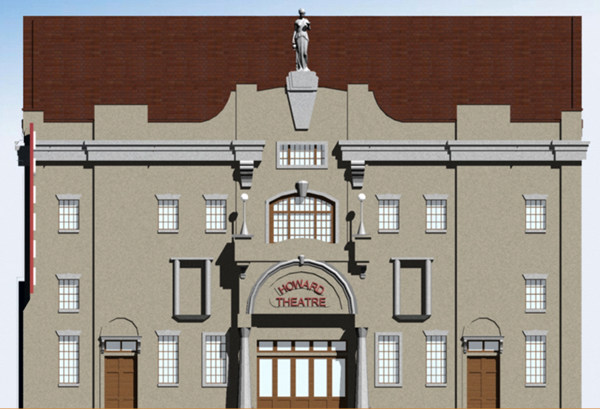
One casualty of the proposed move is the Howard Theater, already delayed and crumbling under the elements. The $710,000 relocation grant would come from money set aside for the theater’s revival.
What’s That on the Grassy Knoll?
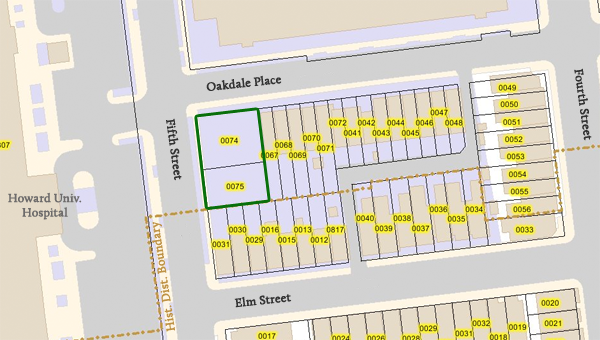
At the corner of Fifth Street and Oakdale Place, at the very edge of the Howard University campus, sits a fenced-in grassy knoll. The site is across the street from the hospital and sits just outside the historic district boundary. About a year ago a sign planted on the site announced the pending arrival of new houses. The sign came down many months ago and nothing much happened. Sure, Howard mowed the lawn, but not much else happened.
On Christmas Eve, Howard University sold the two lots for $250,000 each to Bowie-based Tito Construction Company LLC and just last month DCRA issued building permits for the two lots (#B1000822 & #B1000823). Each permit states the scope of work as
BUILDING A NEW 3-FLOOR WITH A CELLAR 2-UNIT FLAT STRUCTURE.
The lots are much larger than every other lot on the block and these two two-unit houses will likely be spacious.
A New Prescription for Georgia & Florida Avenues
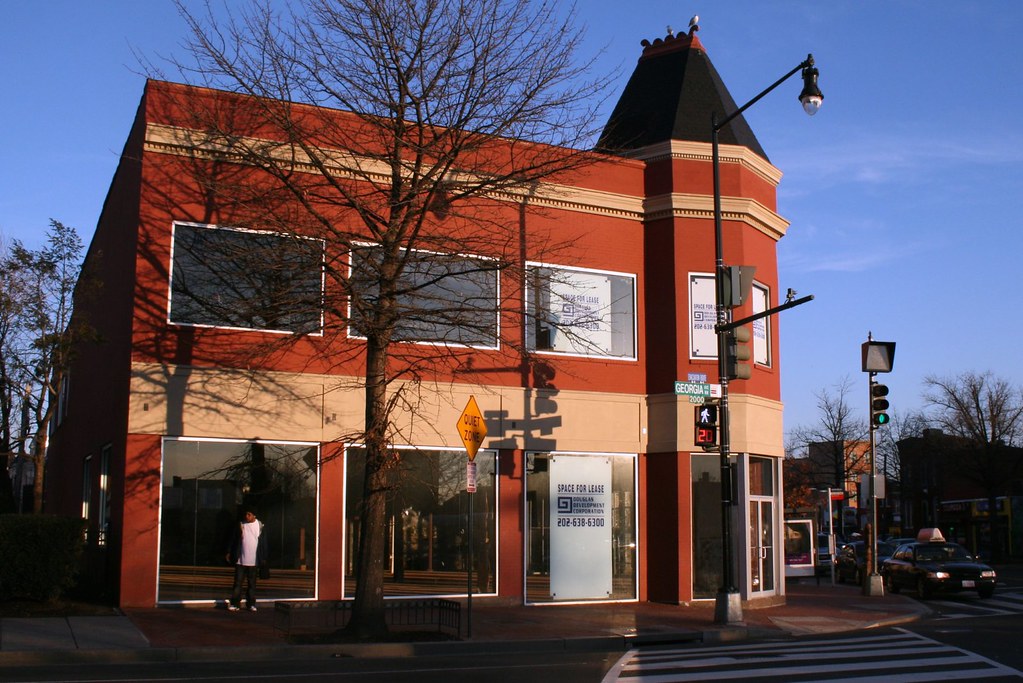
After months of sitting empty, the recently renovated building at Georgia and Florida Avenues now sports a few building permit in its window. The plumbing permit #P1002466 issued on February 16, 2010, suggests that a drugstore may be moving in:
TENANT FIT-OUT FOR PHARMACY SPACE. NO EXTERIOR IMPROVEMENTS. SEE DRAWINGS FOR COMPLETE SCOPE.
Maybe the CVS diagonally across the intersection is relocating or maybe they’re simply getting more competition.
Whither Mr. Postman? Wither Mr. Postman.
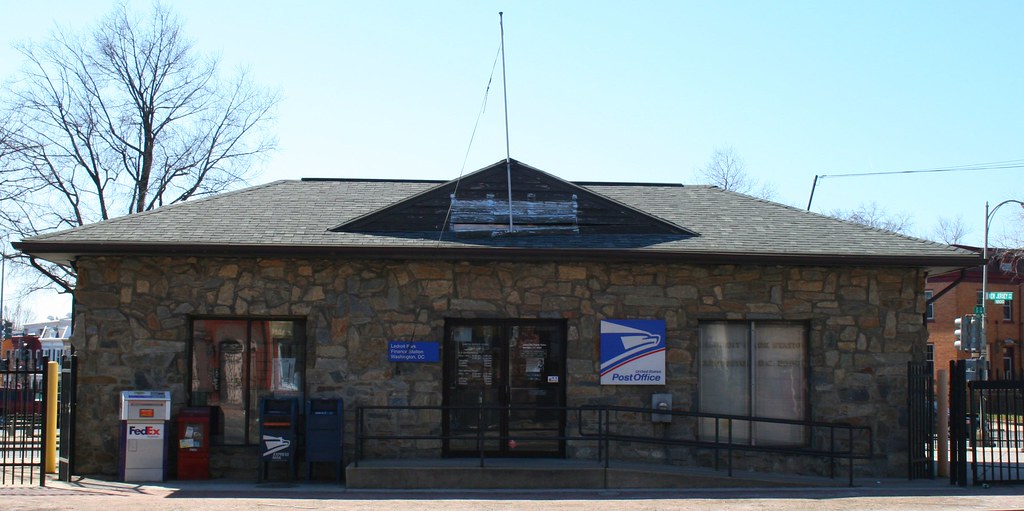
The LeDroit Park post office, located at the entangled crossroads of Rhode Island, Florida, and New Jersey Avenues and S and Fourth Streets, is a mystery to us. Every time we have paid it a visit— even during the day on weekdays!— it has been closed for lunch or just closed for the rest of the day. In fact, we have never set foot inside due to its inconvenient hours.
When in April the City Paper reviewed the post office (yes, they used to do such a thing), they awarded it a D+, but we doubt the reliability of such a whimsical alt-paper metric.
Nonetheless, just before we moved to the neighborhood— that is, before we left for LeDroit— we couldn’t help but wonder how a post office with such inconvenient hours could generate enough revenue to justify its existence.
Our intuition was right, for we soon learned that the Postal Service had added the location to its list of offices to close nationwide. Makes sense, after all, and the second-nearest post office isn’t too far away, located on the Howard campus.
Not so fast. Del. Eleanor Holmes Norton (D) congratulated herself in her most recent biannual newsletter for removing all District post offices from the closure list. Though Ms. Norton surely believes she’s helping her constituents, nowhere does she explain how the Postal Service is supposed to close a projected $238-billion budget gap over the coming decade. If every Member of Congress intervenes on the behalf of each low-performing post office in his own district, the Postal Service will have to find other ways to compensate for the resource drain, perhaps by raising rates and eliminating Saturday delivery. Mrs. Norton may think she did the District some good, but she and her colleagues are hastening the demise of the mail.
Old Maps: The Map that Saved the Capital (1859-1861)
This is the second in a series of posts about historic maps of LeDroit Park. Read the first post, The District Before LeDroit Park (1792 – 1859).
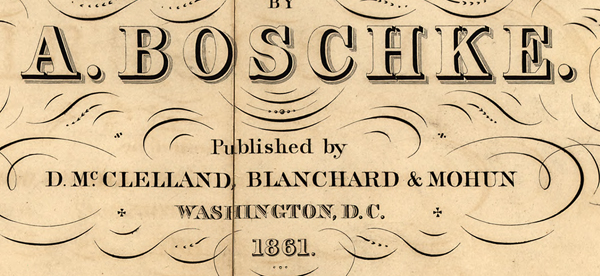
Just a few years after German cartographer Albert Boschke finished his detailed map of Washington City, he completed a map covering the entire District of Columbia. The 1861 map depicts the area around what is now LeDroit Park to be the properties of C. Miller, D. McClelland, and Z. D. Gilman. The original advertisement for LeDroit Park, entitled Le Droit Park Illustrated, also mentions the inclusion of the Prather property, which is not labeled on the map.
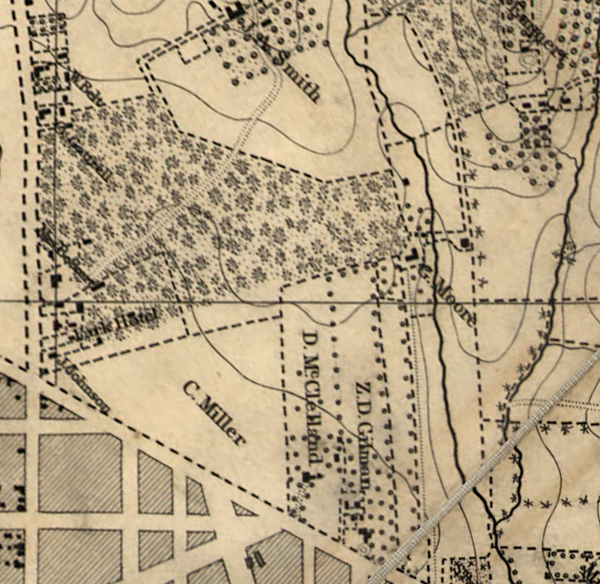
Download the full version of this map from the Library of Congress
Interestingly enough, David McClelland, an engraver, is listed as one of the publishers of the map, so we can assume that he ensured the accuracy of the parcels around his home in what was to become LeDroit Park.
Mr. McClelland continued to live at 301 Boundary Street long after LeDroit Park began to sprout up around him. In fact, Mr. McClelland sold part of his property to form the neighborhood and James H. McGill, architect of LeDroit Park, designed his home, which stood where the United Planning Organization (the old Safeway) now stands.
At the outbreak of the Civil War, Mr. McClelland possessed the most accurate map of the nation’s capital. In the hands of the Confederate Army, it could provide a detailed plan for marching on the capital city. In the hands of the Union Army, it could provide a detailed plan for fortifying the capital city. Mr. McClelland knew the value of what he had and unsuccessfully tried to sell it to the War Department, which got a hold of it anyway.
A National Geographic article from 1894 recounts the history of the Boschke map and trouble it caused Mr. McClelland:
At the outbreak of the [Civil W]ar the United States had no topographic map of the District, the only topographic map existing being the manuscript produced by Boschke. He sold his interest in it to Messrs Blagden, Sweeney, and McClelland. Mr McClelland is an engraver, now seventy-four years old, living in Le Droit park. He engraved the Boschke map, which was executed in two plates. With his partners, he agreed to sell the manuscript and plates to the Government for $20,000. Secretary of War [Edwin] Stanton, not apparently understanding the labor expense of a topographic map, thought that $500 was a large sum. There was, therefore, a disagreement as to price. After some negotiations, Mr McClelland and his partners offered all the material, copper-plates and manuscript, to the Government for $4,000, on condition that the plates, with the copyright, should be returned to them at the close of the war. This offer also was refused. There then appeared at Mr McClelland’s house in Le Droit park a lieutenant, with a squad of soldiers and an order from the Secretary of War to seize all the material relating to this map. Mr McClelland accordingly loaded all the material into his own wagon and, escorted by a file of soldiers on either side, drove to the War Department [next to the White House] and left the material.
The Committee on War Claims compensated Mr. McClelland in the amount of $8,500 and never returned the maps.
To the northeast of the McClelland estate sat the narrow pasture of Mr. George Moore, from whose house all the way west to Georgia Avenue (then Seventh Street Road) stood a large grove of trees. Today the grove is covered by the south end of the Howard campus and by Howard University Hospital. In late August and early September of 1861, however, the grove served as a camp for the First New York Cavalry. Lieutenant William H. Beach recounted in his memoirs his stay at the Moore farm:
[T]he companies formed and took up their march … to a part of the city now known as Le Droit Park. This section now well built up was then open country the farm of Mr. Moore. In a grove of scattering scrub oaks near the present intersection of Fourth and Wilson [now V] streets the camp was established and named Camp Meigs.
….
Mr. and Mrs. Moore and their two daughters, with two or three colored servants, were well-to-do and hospitable people of Union sympathies. Some of the officers messed in the house and a few averse to living in a tent had rooms here. On a recent visit the writer found Mrs. Moore still living, about eighty five years of age, and her two daughters with her. Her mind was clear, and her memory of the officers and some of the men very accurate, and not unkind, although there were at that time many things that were annoying to the family.
Next: The Civil War ends and Howard University is established with land that a trustee, Amzi Barber, sells to… himself.
More Details on 1922 Third Street
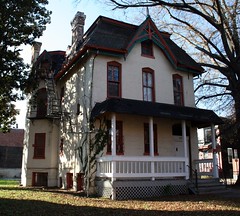
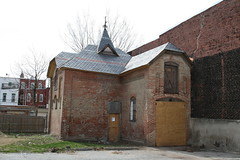
At Thursday’s monthly meeting of ANC1B, Grant Epstein, president of Capitol Hill-based Community Three Development, presented his proposal for 1922 Third Street, a project we wrote about a few days ago.
His proposal calls for renovating the main house (top right) and carriage house (bottom right) and for constructing a connecting section as well as a new townhouse. Because the lot is 13,600 square feet, the R-4 zoning code permits multi-unit apartments with the maximum number of units set to the lot area divided by 900. Although Mr. Epstein proposes 14 units, the zoning code actually permits 15 units by right (13,600 / 900 = 15.1).
Since LeDroit Park is a historic district, most exterior renovations and all new construction within the district’s boundaries must undergo a review process that begins with the Historic Preservation Office (HPO), which is tasked with ensuring that such projects preserve, match, or enhance the historic character of the neighborhood. Ay, there’s the rub: historic character means different things to different people.
Even if the standards for historic preservation are themselves nebulous, the process itself is designed with a good deal of transparency. Mr. Epstein’s proposal must be approved by the city’s Historic Preservation Review Board, which holds a public hearing during which the applicant presents the plan, the HPO staff present their report, and ANC representatives, community groups, and interested citizens may testify either way on the plan. The board then approves the project, rejects it, or approves it with conditions.
Mr. Epstein stated that he has consulted with HPO staff to refine his proposal to satisfy their interpretation of historic preservation suitable for LeDroit Park. We say “their interpretation” not to be snarky, but rather to remind readers that what constitutes historically appropriate is often a subjective matter of taste and judgment. The past, much like the present, is a collection of different stories, styles, and attitudes. Sometimes there is no one right answer in preservation matters, especially in a neighborhood featuring the Victorian, Queen Anne, Italianate, Second Empire, Gothic Revival, and Spanish Colonial styles among others.
At the ANC meeting and in discussions with residents, we have gleaned the following concerns in addition to many thumbs-up.
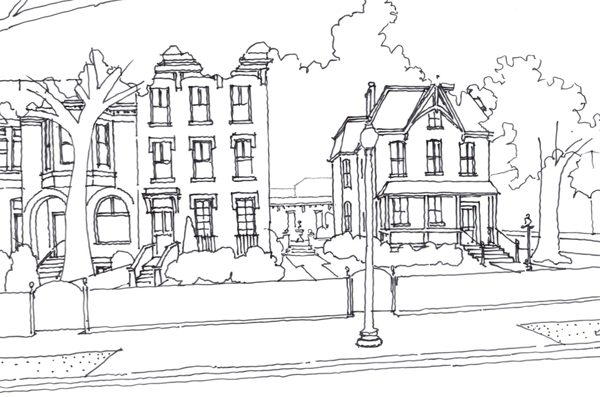
1922 Third Street concept, east face on Third Street
Height
Commissioner Myla Moss (ANC1B01 – LeDroit Park), expressed concern that the proposed townhouse (the middle building in the drawing above) was too tall for the row of neighboring townhouses. Mr. Epstein replied that the added height of the building was in fact the suggestion of HPO staff. Their reasoning, Mr. Espstein stated, is that in Washington, end-unit rowhouses have typically been more prominent than the intervening houses. The prominence was typically marked by extra size, extra height, and extra ornamentation. The added height, Mr. Epstein asserted, is in keeping with an end-unit rowhouse. He also noted that many other buildings on the street are taller than what he proposes.
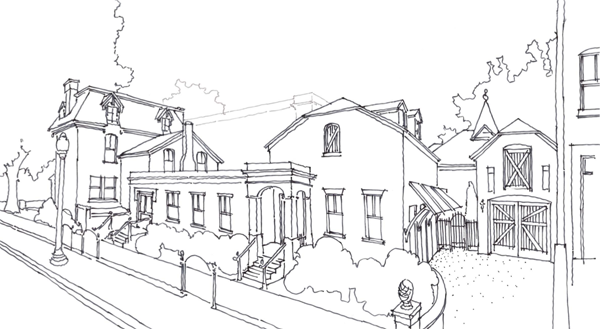
1922 Third Street concept, north face on U Street
Parking
Others expressed concern that the addition of 14 homes on the site would overwhelm the adjacent streets with parked cars since the proposal includes only four parking spaces (one in the carriage house and three in the new adjacent structure pictured above). Mr. Epstein replied that he originally proposed five spaces, but HPO staff suggested that he reduce the number to four so as not to overwhelm a historic structure with an abundance of car parking. Since fewer people owned cars back then, historic architecture is less car-obsessed than today’s buildings— notice how few driveways and garages you’ll find in Georgetown compared to any neighborhood built in the last 60 years.
Mr. Epstein stated that a way to discourage new residents from owning cars was to reduce the amount of available on-site parking. There was at least one skeptical guffaw from the audience, though the reality will likely depend on a variety of factors. Mr. Epstein suspects the project will attract residents more inclined to live car-less.
Commissioner Thomas Smith (ANC1B09), an architect, asked what features besides reduced on-site parking Mr. Epstein would incorporate to discourage car ownership. Mr. Epstein had none, but was open to considering bike storage and car-sharing.
Use
One resident expressed concern that converting what was once a single-family house (before it became a rooming house in the 1970s) into a multi-unit condo building could itself contradict LeDroit Park’s original intent as a country suburb of single-family homes.
Other Details
In response to our question, Mr. Epstein stated that he intended to follow the city’s new inclusionary zoning regulations, which would translate to one of the fourteen units being set aside for a buyer of modest means.
We also noted to Mr. Epstein that though the rowhouse is intended to be an ornamental end-unit— an “exclamation mark” at the end of a row, as he put it— the side of the townhouse, as illustrated in his drawing above, lacks the adornment typical of end-unit rowhouses. Mr. Epstein stated that there was some debate on the issue, still unresolved, as to whether the side of the rowhouse should fully serve as the “exclamation mark” or serve as “canvas” upon which to view the original 1880s structure.
Mr. Epstein also explained the dire condition of the house and carriage house. The main house was entirely gutted of its original interior and years of neglect have left a damaged foundation and ample mold. The carriage house (pictured at the top of this post) is itself crumbling from the weight of the recent replacement roof. Both structures require a significant investment of money to rehabilitate. The investment of money required as well as the uncertain historic review process both make the project something that Mr. Epstein says few developers would touch.
* * *
As a tactical measure to postpone the HPRB’s review of the proposal, the ANC voted to oppose the concept until the developer could present his proposal to the LeDroit Park Civic Association and the ANC’s newly formed design review committee. The ANC will likely address the matter again at the April meeting.
If you’re interested in learning more about the proposal or expressing your concerns or support, feel free to attend any of the following meetings:
- ANC1B Design Committee – Tuesday, March 16 at 6:30 pm at 733 Euclid Street NW.
- LeDroit Park Civic Association – Tuesday, March 23 at 7 pm at the Florida Avenue Baptist Church, 6th & Bohrer Streets.
- ANC1B – Thursday, April 1 at 7 pm on the second floor of the Reeves Building, 14th & U Streets.
U Street Music Hall Takes Flight
 We reported earlier on the proposed U Street Music Hall, a dance club venue to occupy the former Cue Bar at 1115 U Street NW. According to their Facebook page, the curtains will go up for the first time on Saint Patrick’s Day with music by the Belgian group AEROPLANE and the Maryland group Beautiful Swimmers.
We’re glad to see new businesses sprouting in this economy.
The Fall of the Howard Theater
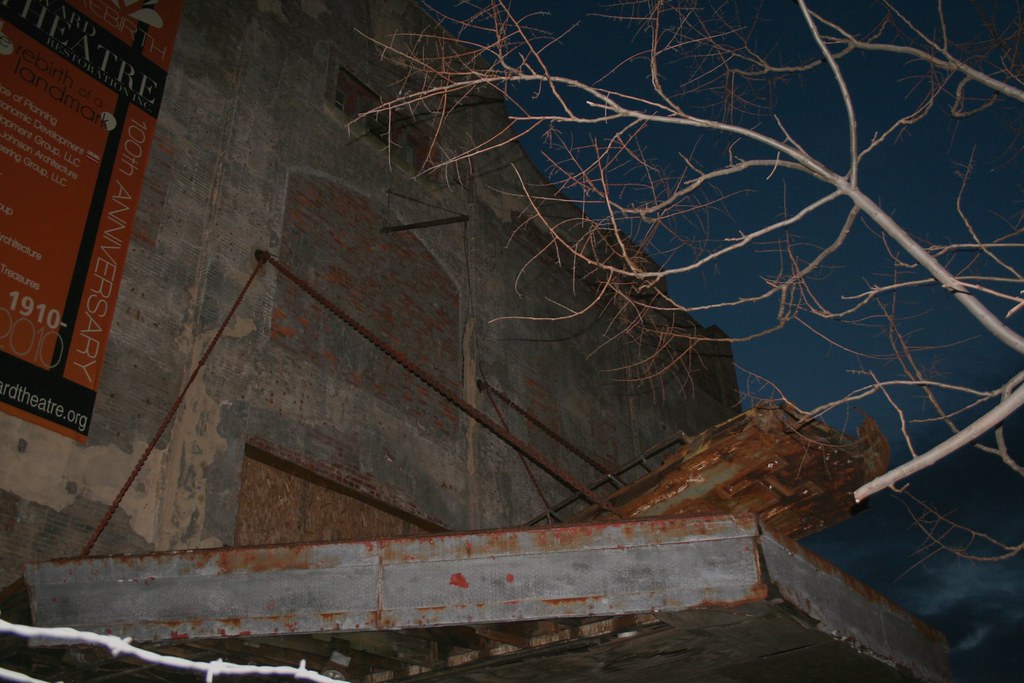
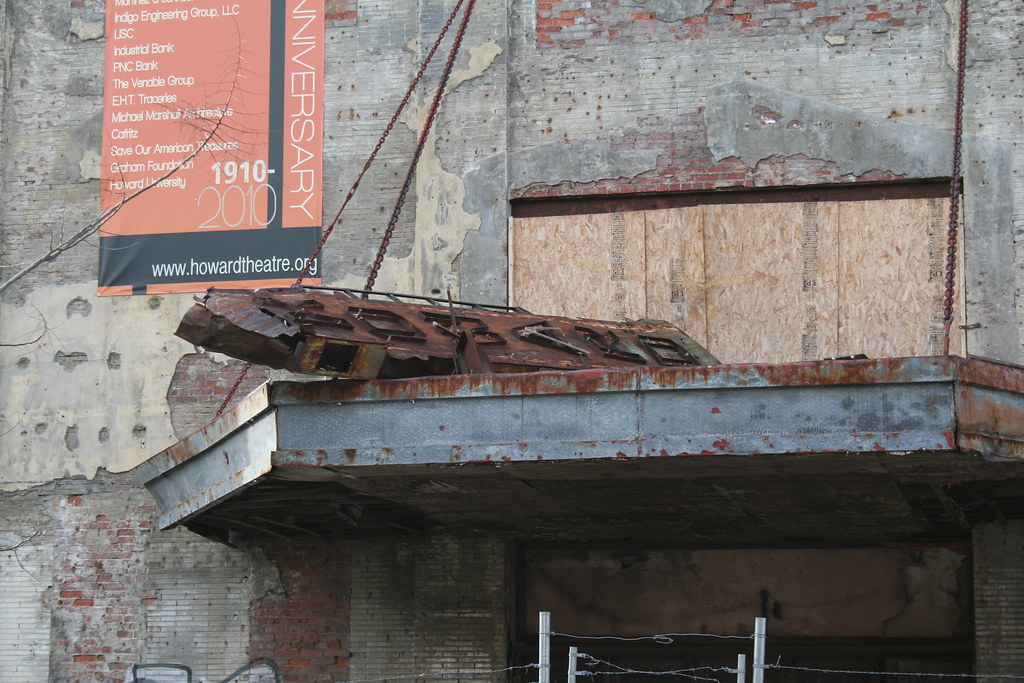
Commenter Paul noted that Thursday’s blustery gusts toppled the sign at the dilapidated Howard Theater, depositing the rusting hulk atop the rickety marquee. We wonder how long it will be before the marquee comes crashing to the ground.
Neither the sign nor the marquee will survive the renovation anyway.
Narrowly Missing the Mud

Thanks to a wave of citizen pressure on the council, LeDroit Park narrowly avoided yet another delay in park construction.
Last night we learned that Councilmember Harry Thomas, Jr. (D – Ward 5), would offer a bill this morning to prevent the mayor’s office from re-appropriating $1.5 million to the park project here in LeDroit Park. His stated reason for throwing a wrench in the process was that his bill was simply a “procedural matter to ensure that the funding source is constant with the Deputy Mayor[‘s] testimony that the funds will not be taken from other projects and that the funds are properly identified.”
As though a phone call within the Wilson Building wouldn’t have answered that question. Threatening to further delay a much-needed construction project that the council and mayor had already promised may not be the most prudent way to stick it to the mayor’s office; Mr. Thomas woke the sleeping dragon.
Deluged with emails between residents, civic association leaders, Jim Graham (D – Ward 1), Kwame Brown (D – at large), and Mr. Thomas, himself, the council passed a revised version of Mr. Thomas’s bill, this time explicitly approving the re-appropriation. Now there’s a u-turn!
Our thanks to all the residents who contacted the council to voice their disapproval. Mr. Thomas admitted receiving an avalanche of 230 emails this morning on the matter.
And who said citizen democracy doesn’t work?
ANC1B Meets Thursday
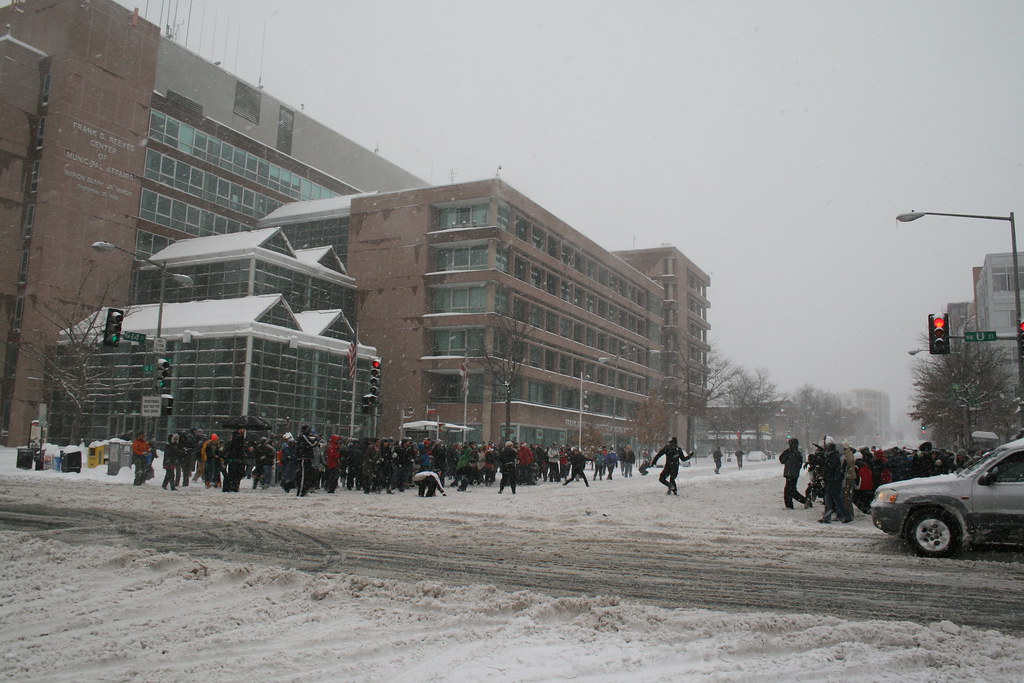
The monthly meeting of ANC1B will be held on Thursday, March 4 at 7 pm on the second floor of the Reeves Building at Fourteenth and U Streets.
Highlights include the presentation of the conceptual design for 1922 Third Street in LeDroit Park and a liquor license application for a hamburger restaurant called Standard to occupy the former Garden District (1801 Fourteenth Street).







Recent Comments