
City Paper Reports on 1922 Third Street
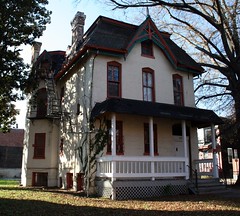 The house and carriage house at 1992 Third Street are still on the market after Community Three Development withdrew its offer. The Washington City Paper ran a story on the current owners’ woes in buying and now selling the property. It turns out the current owners invested in the house in 2000 with a man who turned out to be a con-man. After several legal battles with their partner, they were able to obtain the full title to the house and paid $75,000 to repair the carriage house roof, in addition to the expensive legal bills.
In April 2009 they decided to put the place on the market, but the offers fell through. The City Paper writes,
She had four serious offers, but by then, amid widespread economic uncertainty, nobody could get a mortgage—even a tenured Howard University professor, she adds.
That’s not exactly true, though. Having bought our LeDroit Park house in May 2009, we know from experience that it was certainly possible at that time to get a mortgage. The problem was that it was difficult to get mortgages on overpriced properties or for buyers with poor credit. Certainly these restrictions narrowed the field, but to say it was impossible to get a mortgage is an exaggeration.
Buyers interested in buying 1922 Third Street might want to consider an FHA 203(k) mortgage, a Federally-subsidized housing rehabilitation loan that combines the purchase and renovation costs into a single loan. Only certain lenders are qualified to make these loans and these loans require a good deal of preparatory work (appraisals, inspections, estimates, permits, etc.), but they provide relatively affordable interest rates that regular construction loans rarely match.
Coffeehouse Coming to Florida Avenue
At tomorrow’s monthly meeting of ANC1B, representatives for a fledgling coffeehouse/lounge, The Independent (715 Florida Avenue NW), will petition for a Class C liquor license. The Independent seeks to serve beer, wine, and liquor to a maximum of 235 people (199 seats) on the first floor and a maximum of 90 people (75 seats) in the summer garden. They propose these hours:
| Sun | Mon | Tue | Wed | Thu | Fri | Sat | |
|---|---|---|---|---|---|---|---|
| Open | 7am | ||||||
| alc. served | 10am | 8am | |||||
| last call & close | 2am | 3am | |||||
Entertainment will run 6pm – 2am (Sun. – Thurs.) and 6pm – 3 am (Fri. and Sat.).
Up at 2632 Georgia Avenue, GII Restaurant & Lounge plans to host acoustic jazz bands, karaoke, open mike nights, and DJs to a maximum of 102 people (86 seats). They propose the following business hours: 6 am-2:30 am (Mon. – Wed.) and 6 am-3 am (Thurs. – Sun.). The propose serving alcohol 10 am-2 am (Sun.), 8 am-2 am (Mon. – Thurs.) and 8 am-3 am (Fri. and Sat.). Entertainment will be 6 pm-2:30 am (Mon. – Wed.) and 6 pm – 3 am (Thur. – Sun.).
Here in LeDroit Park, the Elks Lodge at 1844 Third St seeks to renew its license but not without controversy. In April 2008 the lodge was the site of a triple-stabbing and just a few months ago, the lodge was delinquent in paying license fines.
In addition to the lodge, the following restaurants seek to renew their licenses:
- Alero Lounge, 1301 U Street, Class C
- Crème Café & Lounge, 1322 U Street, Class C
- Little Ethiopia Restaurant, 1924 Ninth Street, Class C
- Portico, 1914 Ninth Street, Class C
- Mesobe Restaurant and Delimarket, 1853 Seventh Street, Class C
As usual, the ANC meeting will be held tomorrow (Thursday) at 7 pm on the second floor of the Reeves Building at Fourteenth and U Streets.
U Street Strut
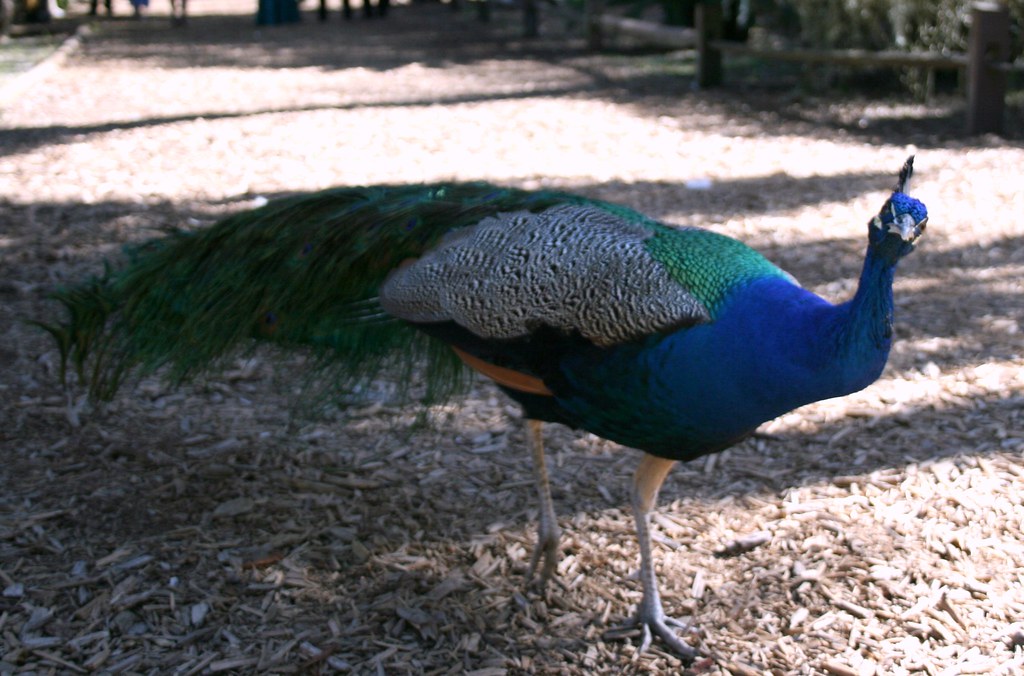
Zipping through the City Paper we came across this mention of two glamorous LeDroit Park residents— a peacock and a peahen— discovered on the 500 block of U Street.
“A person claiming to be the owner of the birds did not know they were illegal to own,” according to the Humane Society. The owner surrendered the birds, which were relocated to a sanctuary in Virginia.
At least it’s a more innocuous form of fowl play.
1922 Withdrawn
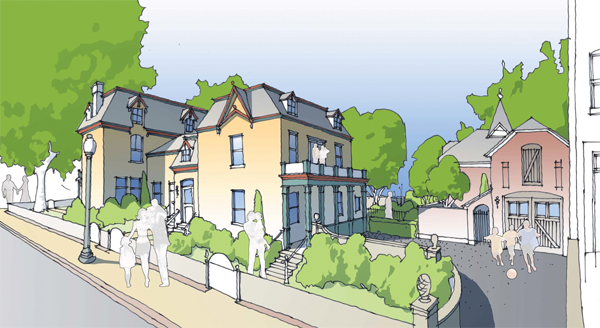
Community Three Development withdrew its application for 1922 Third Street. As we wrote before, the developer proposed renovating and expanding the historic main house, renovating the historic carriage house, and constructing a new townhouse on the south side of the lot.
The proposal was set to go before the Historic Preservation Review Board last Thursday, but the developer, while at the meeting, withdrew his proposal and the board ended discussion on it.
In preparation for the board meeting, the Historic Preservation Office issued this staff report critiquing the proposal from a historic preservation standpoint. One of the most significant suggestions was that the developer remove the “hyphen” section connecting the main house with the proposed townhouse, a concept alteration that would require a zoning variance. Receiving a zoning variance is by design a costly and protracted process that’s not guaranteed to succeed.
In an email to us, the developer stated that due to these various issues, ranging from some neighborhood opposition to unresolved zoning issues, they could not proceed with their plan.
Regarding the politics of the proposal, the developer wrote:
[T]he economic and physical constraints inherent in the redevelopment of this site require all participants to contribute to a solution that benefits the greater whole, and in this case, we unfortunately found that certain stakeholders were unwilling to do so. We will potentially revisit this project when local pressures realign, but it may be very difficult for progress while these differences remain irreconcilable.
Through this process, we were surprised to the degree to which the developer reduced his ambitions, but ultimately the business of housing is a business driven by public tastes, local regulation, construction methods, and— above all— economics. If a proposal is financially impractical, it will not get built, unless it is built at a loss as a pet project of a wealthy financier.
Somebody will eventually buy the house, though maybe not soon. For it to remain a single-family house, as many want it, a potential owner must be able to afford replacing the roof, gutting the interior, building a new kitchen and bathrooms, replacing the wiring, replacing the plumbing, installing insulation, replacing many of the floors, installing a new furnace, replacing much of the drywall, fixing the foundation, and repairing the carriage house— renovations that will likely run near a million dollars, if not more, on top of the sale price.
A condo project with fewer units (and without a townhouse) could still succeed, but the reduced number of units will likely exclude an affordable housing component (only required of projects with 10 or more units). Furthermore, those fewer units will have to be sold at higher prices to justify the renovation costs.
The neighborhood opposition (far from universal, mind you) unwittingly set a new entry criterion for purchasing the property: if you want to live at 1922 Third Street, you must be a very wealthy person.
* * *
What do you think? Are you glad or are you disappointed that the proposal was withdrawn?
Planting the Circle

Heuchera americana
Who maintains Anna J. Cooper Circle? Well, many people do, and you can, too!
Join your neighbors tomorrow (Friday) at 5:00 pm to help plant some heucheras (pictured above).
We also learned that a group called Community Bridge has a contract with the District to maintain small parks and that they often clean up the circle, mowing the grass and pulling weeds.
The planting, however, is a resident-driven labor of love, so any help this Friday would be greatly appreciated. Bring your shovel if you have one.
Culinary Abbreviation
Amendments to the zoning code usually proceed at a snail’s pace, but when DCRA recently announced that it would no longer permit any new restaurants along Fourteenth and U Streets, the MidCity Business Association, with the support of other neighborhood groups, demanded an immediate change.
The District government is listening. The Office of Planning (OP) is poised to hold a hearing on Monday, April 26th to lift the maximum restaurant street frontage restriction from 25% to 50% of the total frontage along Fourteenth and U Streets within the overlay (shaded in red below).
View U-14th-Florida-9th Arts Overlay in a larger map
The proposed amendment will also adjust how the limit is calculated. Currently the limit applies to and is calculated from all properties fronting U and Fourteenth Streets within the zone. (These frontages are marked in red above.)
OP proposes not only to raise the limit to 50%, but also to calculate it per “block-face” rather than as the aggregate of all blocks together. For instance, on the 1300 block of U Street, restaurants will be limited to 50% of frontage on the south side of the street and 50% of frontage on the north side of the street.
OP also proposes to “clarify” the existing regulation so that “[a]n eating and drinking establishments not located on the ground (street) level of a building shall not count towards the 50% limit.” The ground-level exemption will also apply above- and below-street entrances.
OP also proposes another clarification to stipulate that the limit only applies to lots fronting Fourteenth Street and U Street within the overlay; the existing wording is ambiguous as to whether the restriction applies only to these two streets or to all lots within the entire zone.
Once the 50% limit is reached on a block-face, OP proposes stricter requirements for exemptions.
Check out the full proposed amendment:
McGill Carriage House Reimagined
In the last round of concept changes for 1922 Third Street, the developer proposed restoring an old wall (pictured above) attached to the carriage house. The developer added it after we discovered an 1880 architectural pattern book produced by James McGill, the architect of LeDroit Park’s original and eclectic houses.
Google, in its effort to scan and publish old, public-domain documents, scanned the pattern book and posted it online. You will notice engravings of several other houses that still stand in LeDroit Park today.
We have recreated a 3D model of the carriage house based on James McGill’s original design. We had to guess the colors since the McGill publication was printed as a simple black-and-white engraving. Download the Google SketchUp file (get SketchUp for free to view it) or watch the video tour below.
Unlike today’s garages, these carriage houses were designed to house a carriage or two, several horses, and bales of hay. Modern cars, once fondly called “horseless carriages”, obviate need for these equine accouterments and the developer wishes to convert the carriage house into living quarters.
The problem is that the zoning code is more accepting of car housing than of people housing; converting an old carriage house into living quarters will require a zoning variance. Whatever gets built at the site, be it through this developer or another, would ideally include the restoration of the carriage house and its adaptation from housing for horses into housing for people.
* * *
The design for 1922 Third Street will go before the Historic Preservation Review Board on Thursday. Interested parties may comment on the proposal either way at the hearing.
Historic Preservation Review Board – Thursday, April 22 at 10 am at One Judiciary Square (441 Fourth Street NW), Room 220 South. Read the public notice
Park Design Meeting Tonight
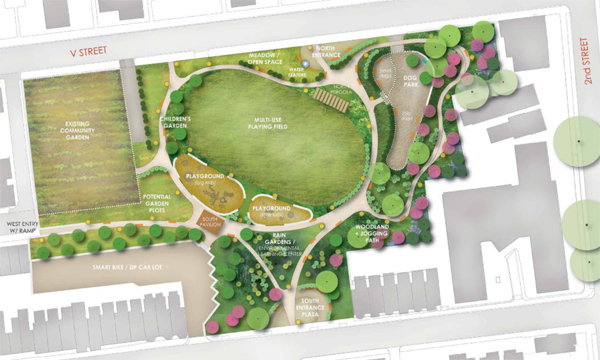
The city is in the process of finalizing the design for the new park, but there are still opportunities for public input.
Come out tonight at 6:30 to see what the latest proposal has to offer in terms of pavement materials, benches, pavilions, and playground equipment.
April 14th at 6:30 pm
St. George’s Church
Second and U Streets NW
Are There Too Many Restaurants?
Are there too many restaurants, bars, and cafés on U Street and Fourteenth Street? According to the zoning code, the answer is yes.
View U-14th-Florida-9th Arts Overlay in a larger map
The Uptown Arts Overlay District (shaded in red above) covers much of the commercial areas on U Street and Fourteenth Street (and some side streets) and limits eating establishments in the zone to 25% of the linear frontage as measured along Fourteenth and U Streets in the zone (red lines above). The original purpose of the limitation was to prevent the area from becoming “overrun” with restaurants, thus crowding out other non-eating establishments.
DCRA recently finished surveying the zone and found that the area is a mere 12.6 feet short of hitting the 25% limit, meaning that DCRA will not issue new Certificates of Occupancy or Building Permits for restaurants unless they receive zoning variances. Variances takes months to approve and aren’t guaranteed. Now opening even a modest café will require much more time and money and may require hiring a lawyer to apply for zoning variances.
The MidCity Business Association is upset and is demanding a zoning text amendment to raise the limit from 25% to 50%. Their fury directed at DCRA is unwarranted, though, as the agency must enforce zoning laws.
MidCity, though, has a lot of support on its side. Last year the three ANCs in the overlay, 2B, 2F, and 1B, as well as the Logan Circle Community Association and the U Street Neighborhood Association all supported increasing the limit from 25% to 50%. Though the changes to the Uptown Arts Overlay were expected to be included as part of the District’s city-wide zoning rewrite, DCRA’s recent decision, combined with the fact that the city-wide zoning rewrite is over a year away, have given new urgency to an immediate text amendment.
Now it is the time to act. As Greater Greater Washington (GGW) explains, zoning amendments typically originate from either the Zoning Commission or the Office of Planning, but an ANC or ordinary citizen can propose a text amendment, too. The Zoning Commission, if it decides to take up the matter, would hold a hearing and decided whether to approve the amendment.
Limiting the space devoted to eating establishments allows for more space devoted to neighborhood-serving retail such as dry cleaners, grocery stores, furniture stores, and clothing stores. Even still, restaurants serve residents, too, and the 25% limit is too low. Seventeenth Street in Dupont, as GGW explains, enjoys a sufficient variety of neighborhood-serving retail stores even though frontage devoted to eating establishments far exceeds 25%.
The Overlay extends as far east as the Howard Theater and even down Ninth Street’s Little Ethiopia. If the 25% rule holds, don’t expect any new restaurants to open up there, either. [see update below]
What do you think? Should the District allow more eating establishments in the area?
Update: We emailed the Office of the Zoning Administrator for clarification, and we stand corrected: “The 25% restriction only applies to businesses within the subset of 900-1400 blocks of U St NW and the 1300-2200 blocks of 14th St NW; so a potential restaurant on 9th St NW would be able to proceed without seeking BZA relief.”
Bloomin’ Road Rage
The driver of a car intentionally hit a cyclist at First Street and Florida Avenue NW in Bloomingdale, TheWashCycle reports. The victim wrote:
Around 5:50 PM [Wednesday] I was riding along First St. NW with other commuters. We crossed over Florida Ave and a car came in behind me, horn continuously on, and accelerated into my rear wheel knocking me to the ground. The driver then got out of the car and yelled some obscenity at me. He got back into his car and left the scene.
I ended up with a few bruises and bumps but luckily no serious injury, but my rear wheel was destroyed along with my saddle, still not sure about the frame. Although there were seven plus witnesses, we were only able to get a partial license plate. We did get a great description of the car. The police arrived on the scene and took all the witness statements, etc and the incident will be filed as a hit and run.
Using a vehicle as a weapon is a serious crime. It’s also important to remember that cyclists and drivers are equally entitled to use the streets of the city.







Recent Comments