
Help write history this Saturday
 The third meeting of the LeDroit Park-Bloomingdale Heritage Trail working group is Saturday. Attend if you’re interested in the history of our neighborhoods and would like to help bring the heritage trail to fruition.
The next meeting is Saturday, April 16 at 10 am at the office of the Howard University Community Association, 2731 Georgia Avenue.
In the coming months, Cultural Tourism DC, which sponsors the heritage trails, will collect all the interview transcripts and photographs and draft a series of trail markers like the one pictured right.
After neighborhood review, Cultural Tourism DC will install these markers throughout the neighborhoods marking locations of notable events, buildings, and residents.
Read the flyer for Saturday’s meeting.
Explore DC’s zoning code with Google Maps
The DC Office of Zoning recently released a slick interactive zoning map of the District. Not only can you view a neighborhood’s zone boundaries, but you can also view campus plans, historic districts, and overlay zones, too.

Click to view the interactive zoning map.
The map also plots each individual property in the District and notes the square number (block number), and the lot number. When you click on a lot, a dialog opens displaying the owner’s name, a photo of the property as well as any zoning rulings that apply to the property.
The site uses Google Maps as a base platform, but overlays other city data on top. Displaying zoning, property ownership, and zoning ruling data in an easy interface helps demystify these otherwise obscure areas of public policy.
Howard development & Cardozo’s renovation
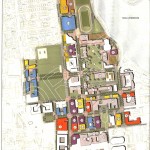
Draft Campus Plan
Representatives of two large projects of local interest will appear at Thursday’s monthly meeting of ANC1B.
First, Howard University will give a short presentation of its draft campus plan (right). The university is finishing up the draft that it intends to submit for public review and Zoning Commission approval in the coming months. The draft we’ve seen shows positive steps for development along lower Georgia Avenue. We will post more details later this week.
Second, the city and its architects will present the concept design for the renovation of Cardozo Senior High School. The historic school building opened at a time when girls and boys were separated within schools. As a consequence, the building has two small gyms, rather than one adequate gym. The architecture team proposes appending a new gym to the west side of the building and partly burying it into the hillside. Burying the structure into the hillside allays residents’ previous objections to any additions that would obstruct the spectacular views from Clifton Street NW. The roof of the gym will serve as a parking lot and may provide a fireworks view (not launching!) platform for future Independence Days.
Two liquor licenses are on the agenda, too:
- Sankofa Café, 2714 Georgia Avenue NW – New tavern. “Live entertainment and a Summer Garden. Total seating is 86. Total occupancy load is 136. Summer garden 40 seats. Hours of operation: Sunday-Thursday 7 am-2 am, Friday & Saturday 7 am-3 am. Hours of sales/service/consumption of alcoholic beverages: Sunday-Thursday 5 pm-2 am, Friday & Saturday 12 am-3 am. Hours of live entertainment: Sunday 6:00 pm-2 am, Thursday through Saturday 6 pm-1 am. Summer Garden hours of alcoholic beverage sales/service/consumption: Sunday 12 pm-12 a,. Monday through Thursday 3 pm-12 am,Friday & Saturday 12 pm-12 am. Summer Garden hourse lf live entertainment: Sunday 6 pm-9 pm, Thursday through Saturday 6 pm-9 pm.”
- H2 LLC Voluntary Agreement
The monthly meeting of ANC1B will be Thursday at 7 pm at the Reeves Center at 14th & U Streets NW.
Before Shaw’s Tavern there was Ethical Pharmacy
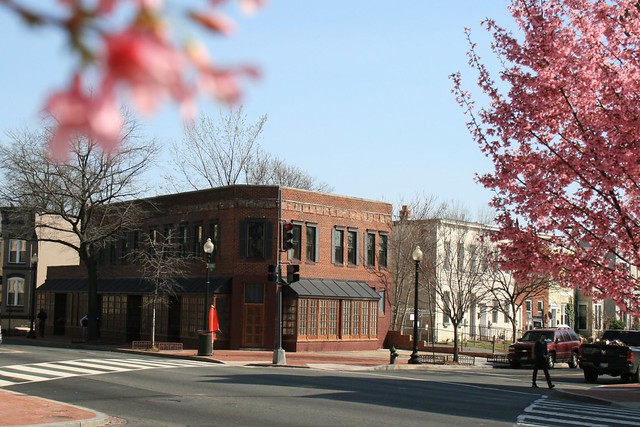
This is the fourth in a series of the Scurlock photos. Read the others.
We have reported before on the coming of Shaw’s Tavern to the building (pictured above) at the southeast corner of 6th Street and Florida Avenue. It turns out that the bar at Shaw’s Tavern will not the be the first establishment to stir up elixirs at that location.
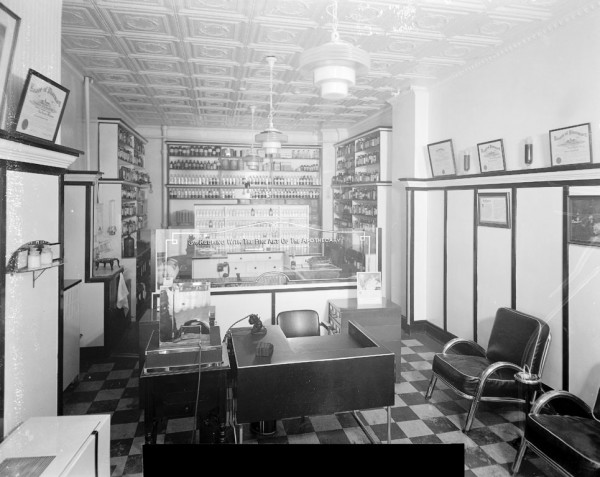
While perusing the Smithsonian’s Scurlock photo archives, we found that one of the building’s previous tenants was the Ethical Drug Store (also known as Ethical Prescription Pharmacy and Ethical Pharmacy), one of the many black-owned businesses along the 400 – 600 blocks of Florida Avenue NW.
Pharmacist Lewis Terry (1904- 1978) graduated from pharmacy school at Temple University in 1928. The following year he opened Ethical Pharmacy at 518 Florida Avenue NW. The pharmacy had filled 1 million prescriptions by 1953 earning him a special honor from Temple. Though Mr. Terry sold the business in the mid-60s, the pharmacy stayed in operation until the 1990s.
The name Ethical Pharmacy is a relic of a professional division in the pharmacy field a century ago. An “ethical pharmacy” proudly devoted itself solely to filling prescriptions and did not sell other extraneous products as modern drug stores, such as CVS, do today. The use of ‘ethical’ was a high-minded misnomer since a pharmacist could sell other wares ethically or devote himself exclusively to quack medicine.
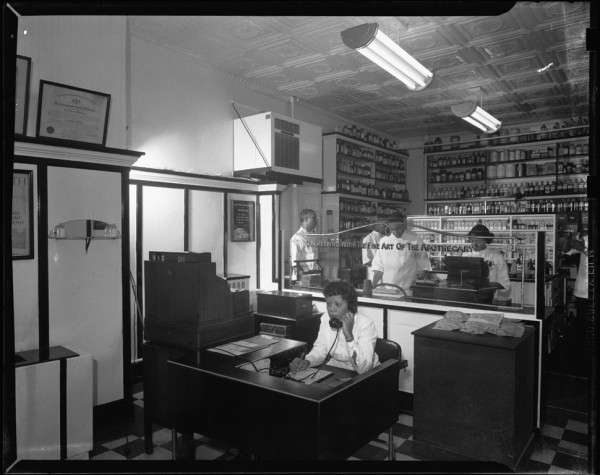
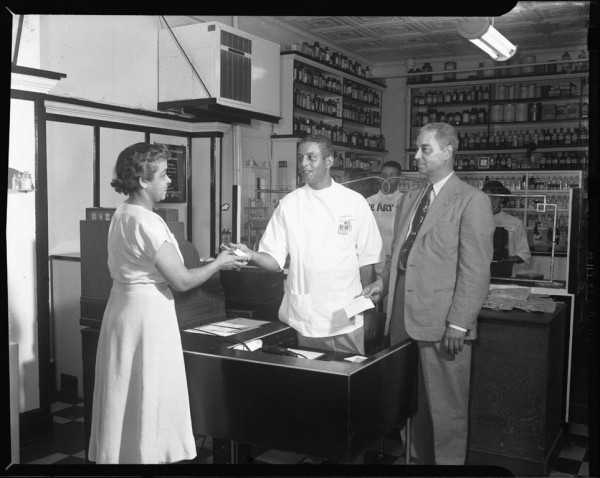
The Scurlock Studio photographed the pharmacy in 1937 and again in 1950. We have included both photo shoots below.
1937
Here is a photo Addison Scurlock took of Ethical Pharmacy in 1937:
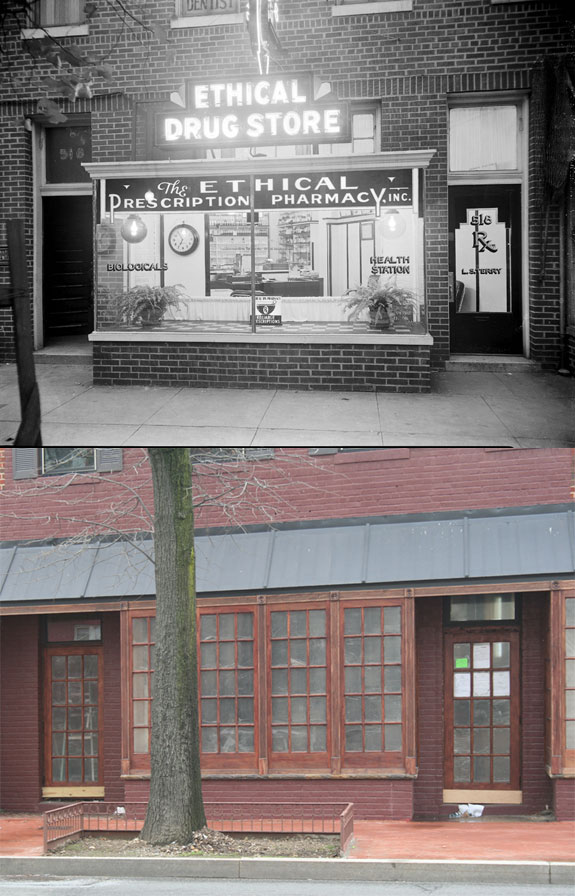
[Toggling between now and then photos will not work in RSS readers. View the actual post]
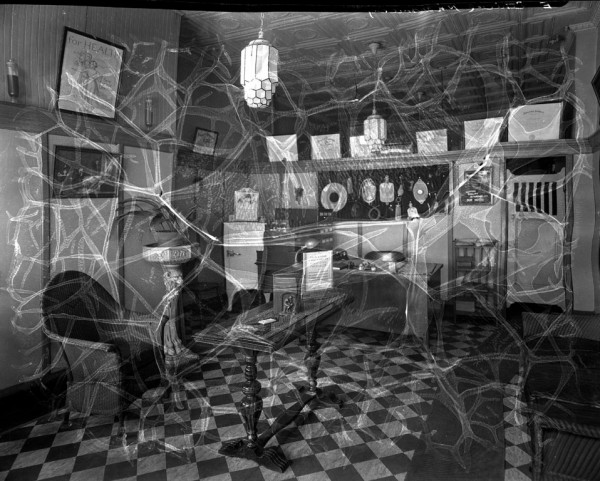
Here are some other shots of the interior. Though the Smithsonian has no date for the first two, we suspect they was shot in the 1930s. The third photo is dated 1937 and judging from the change in the interior, we suspect the pharmacy had undergone some sort of renovation to appear more modern.

1950
Mr. Scurlock photographed the pharmacy again in July 1950:

[Toggling between now and then photos will not work in RSS readers. View the actual post]
He also took more shots of the interior in 1950:
1968 riots at 7th & T Streets NW
This is the third in a series on the Scurlock photo archive. Read the others.
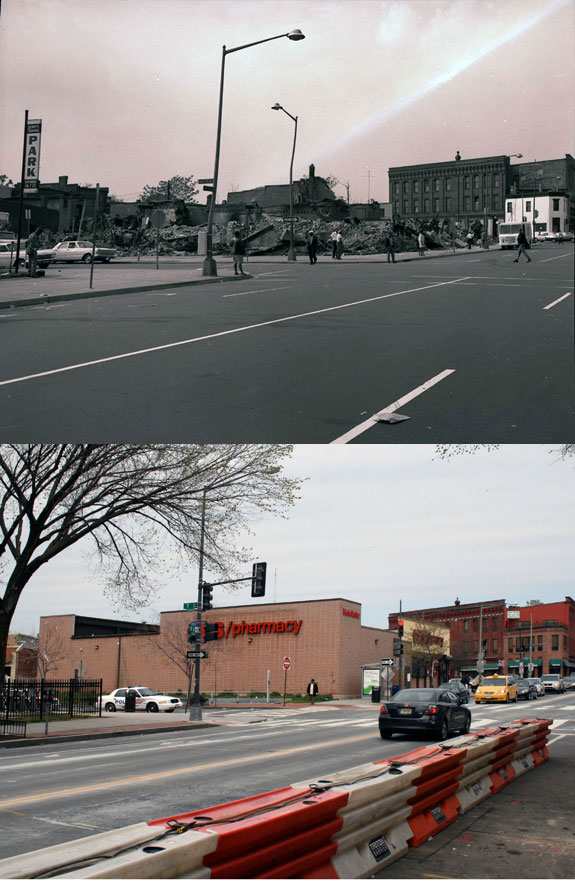
The 1968 riots burned and economically destroyed many commercial districts throughout Washington. Riots came to U Street, too, and several properties which were obliterated have not entirely recovered from the devastation.
After World War II, many of America’s cities faced population and economic decline as the nation suburbanized; Washington was certainly no exception. The retail corridors on 14th St NW, U St NW, and H St NE were already declining when riots hit American cities in 1968 following the Martin Luther King’s assassination.
Addison Scurlock (1883-1964) was Washington’s most prominent black photographer and when the riots started in April 1968, Mr. Scurlock[‘s sons, who inherited his studio] at 9th and U Streets (where Nellie’s now stands) knew that [they were]he was witnessing history in the making. Mr. Scurlock The Scurlocks photographed rioters at the beginning of the riots and photographed some of the aftermath.
The corner of 7th Street, Florida Avenue, and Georgia Avenue suffered from the mayhem. The southwest corner now houses a CVS and a parking lot on land that Howard University owns. Beneath this store runs the Metro tunnel between the Shaw and U Street stations. Back in 1968, this site featured a strip of retail stores until the riot.
One of the most striking Scurlock photos is of the northwest corner of 7th and T Streets NW, where the CVS currently stands. Rioters burned the buildings that stood on the site.
[Toggling between now and then photos will not work in RSS readers. View the actual post]
Should DC allow more angle parking on Sunday mornings?
Councilmember Harry Thomas, Jr. (D — Ward 5) introduced a bill to ease Sunday parking tensions by permitting angle parking for religious institutions with ANC and DDOT approval. The councilmember held a forum on the bill and its companion commercial district bill last week.
In DC neighborhoods where street parking is at a premium, few things raise a resident’s ire like church congregants who park illegally on Sunday mornings. Congregants who drive from other parts of the District, from Maryland, and from Virginia have been known to double-park, park in alleys, block crosswalks, and block fire hydrants.
After receiving numerous complaints from residents, Mr. Thomas introduced the bill to primarily allay residents in Bloomindale and Eckington. Since these neighborhoods are among Ward Five’s most densely populated, they, like LeDroit Park, suffer from high street parking occupancy. Last week in Eckington, Mr. Thomas hosted a forum on his bills and took questions from residents.
Mr. Thomas acknowledged what residents have long known: parking enforcement around churches is intentionally lax on Sundays. Though Mr. Thomas admitted the unique challenges to transportation on Sunday mornings, he also decried congregants who park illegally, block residents in, and hinder public safety.
Transit service reaches its nadir on Sunday mornings, and churchgoers often travel to churches in residential neighborhoods with light Sunday service. Since transit service and car traffic are relatively low on Sunday mornings, Mr. Thomas thinks DDOT will be able to find instances of roadways wide enough to accommodate both angle parking and through traffic on Sunday mornings. In each case, though, DDOT will make the final determination of what is safe and permitted, even if an ANC supports the petition.
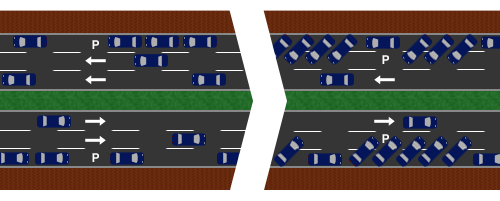
Left: typical curbside parking. Right: possible angle parking
We asked Mr. Thomas why he singled out angle parking and not other non-traditional parking arrangements and he admitted that the bill was just a first draft and could be expanded to include other measures.
For instance, DDOT permits parking beside the median on Sundays on the 1300 and 1400 blocks of New York Avenue NW downtown. This arrangement works since there is still one lane available for through traffic and since Sunday morning traffic flows are small. A similar arrangement might work along other multi-lane avenues in the District, including Rhode Island Avenue.
In other cases, solutions could be less radical. The congregants of several churches on Florida Avenue park in the right lane on Sunday morning even where parking is never permitted at any time. DDOT may be able to simply change the signs and permit curbside parking in such places on Sunday mornings. The extra parking can act as a traffic-calming measure, though, as we know, easier parking can induce more driving.
No matter what happens, the Department of Public Works, the primary agency in charge of parking enforcement, needs to end its practice of lax Sunday enforcement near churches. Only DDOT, not pastors and not congregants, should make the determination as to what constitutes safe Sunday morning parking. Mr. Thomas acknowledged that the law needs to be enforced uniformly as it is unfair to overlook, as one resident noted, illegal parking in residential neighborhoods, while actively ticketing illegal parking downtown on Sundays.
Though residents expressed frustration with some, though not all, neighborhood churches, Mr. Thomas rightly advised residents that parking tensions need not be adversarial. In fact, he called attention to instances in which neighborhood residents and churches collaborated to resolve parking problems. This can include urging pastors to rent unused lots for their congregants or to provide shuttle service from satellite lots or from congregants’ homes. He even touted bikesharing several times but said it is not practical for everyone.
Whatever the solution, Mr. Thomas admitted the bill was in its infancy and that he wants to provide a template for cooperation; angle parking may be one of many possible solutions.
Mr. Thomas was eager to mention the companion bill to allow permanent angle parking in business districts. Though most meeting attendees were there to complain about church parking in residential neighborhoods, Mr. Thomas said that many Ward 5 businesses depend heavily on customers arriving by private car. However, when he asked a local business owner how much of his business is from outside his neighborhood, the owner said that very little came from elsewhere.
The business corridor bill is significantly different from the Sunday parking bill. The former would permit businesses to seek diagonal parking at all times, regardless of transit service, or if the street space could be reallocated to bike lanes or wider sidewalks.
The Sunday parking bill carries more merit than the business corridor bill because of the unique circumstances of church locations and Sunday transit service. The business corridor bill, in contrast, too hastily and disproportionately prioritizes parking to the detriment of other road uses.
7th & T was always the seedier end of the U Street corridor
This is the second in a series on the Scurlock photo archive. Read the first entry.
During the Jazz Age of the 1920s and later into the 1930s, U Street was dubbed the “black Broadway” as it featured such venues as the Lincoln Colonnade (now the Lincoln Theater), the Howard Theatre, and other clubs and restaurants. In a segregated city in which blacks were excluded from most restaurants, theaters, and stores, U Street served as a refuge to catch a show and enjoy a meal.
This photo from the Scurlock archives was taken looking east at 7th and T Streets NW in 1939.
[Toggling between now and then photos will not work in RSS readers. View the actual post]
We have referred to this area as the block of blight for its dilapidated buildings, copious litter, and frequent police arrests. It turns out that some things never change. Even when this photograph was taken, U Street was not uniform in character and the area around the Howard Theatre was considered downscale compared to the classier venues west on U Street. (For more on U Street’s evolution, see Blair Ruble’s recent book, Washington’s U Street: A Biography.)
Pictured here at the corner is National Grill, which, like Harrison’s Café in LeDroit Park, advertised itself as open all night. The lighted vertical sign attached to the façade appears to read “LUNCH” and the pediment at the cornice bears the building’s name, “Scott’s”. (View a larger version of the photo.)
Just to the right (south) of National Grill is the S.W. Keys Luncheonette, whose vertical sign advertises coffee and waffles. Just south of that is Harlem Cafe, located in a building that has since been replaced.
On T Street, just behind Scott’s Building and just before the Howard Theatre, you will see a sign that reads “BILLIARDS”. That marks Frank Holliday’s pool hall, a popular gathering spot for Howard scholars, jazz musicians, and city laborers alike. Duke Ellington captured the scene at the pool hall:
Guys from all walks of life seemed to converge there: school kids over and under sixteen; college students and graduates, some starting out in law and medicine and science; and lots of Pullman porters and dining-car waiters.
Just beyond the pool hall, you’ll see the Howard Theatre sporting its original Italianate façade. The theater was later covered with plaster, which was only recently removed for the restoration project.
Today the last two buildings on 7th Street are a Chinese take-out and a tiny market. One of the developers of Progression Place, the large development project underway on the block (rendering below), said that the late owner of these two buildings refused to sell to his development. Progression Place will incorporate every building on this block except for these two.
If anyone is looking for a two-building restoration project, here is your chance!
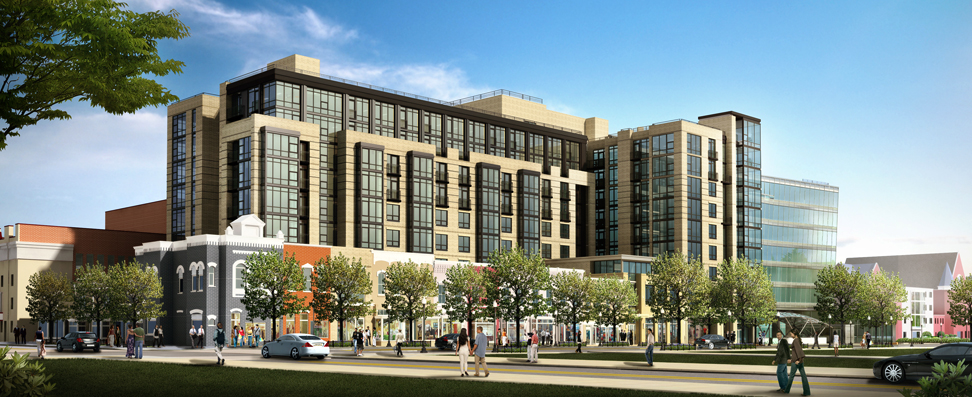
Progression Place will include all but the gray and orange buildings.
Scurlock archives: Harrison’s Café
If you have ever walked by Nellie’s Sports Bar at 9th and U Streets NW, you may have noticed a small plaque on the wall noting the site of the former Scurlock Studio.
Addison Scurlock (1883-1964) was a prolific Washington photographer whose studio stood at that corner from 1911 to 1976. During his lifetime, Mr. Scurlock’s studio photographed mundane portraits and scenes, but also photographed famous people such as Frederick Douglass, Marian Anderson at the Lincoln Memorial and Martin Luther King and FDR at Howard University.
The Smithsonian purchased his collection and in paging through the online catalog, we found several photographs of scenes around LeDroit Park. This is the first in a series of photos.
[Toggling between now and then photos will not work in RSS readers. View the actual post]
This undated photograph shows Harrison’s Café, which stood at 455 Florida Avenue NW on the edge of LeDroit Park. It was a neighborhood restaurant and bar that attracted the various musical and academic notables of the area.
HARRISON’S CAFÉ
OPEN ALL NITE
SALADS SANDWICHES
Update: We took a trip to the Washingtoniana Division of the MLK Library and found more information on Harrison’s Café.
Robert Hilliard Harrison opened a candy store at 467 Florida Avenue NW and soon opened his cafe at 455 Florida Avenue NW in 1920. Harrison’s Café catered to a variety of appetites, serving fancy lobsters to 20-cent hamburgers. In an era of segregated restaurants, black residents have fewer dining choices and Harrison’s tried to serve them all.
Attached to the cafe, Mr. Harrison also owned the Golden Room, which hosted banquets and private events. Above the cafe, Harrison’s served liquor privately after the city’s midnight liquor curfew.
After World War II, LeDroit Park, like other close-in urban neighborhoods suffered from disinvestment and decline. Mr. Harrison died in 1957 and the restaurant closed in 1962.
Further reading:
- Fitzpatrick, Sandra. The Guide to Black Washington.
- Ruble, Blair A. Washington’s U Street: A Biography.
Zee’s Review
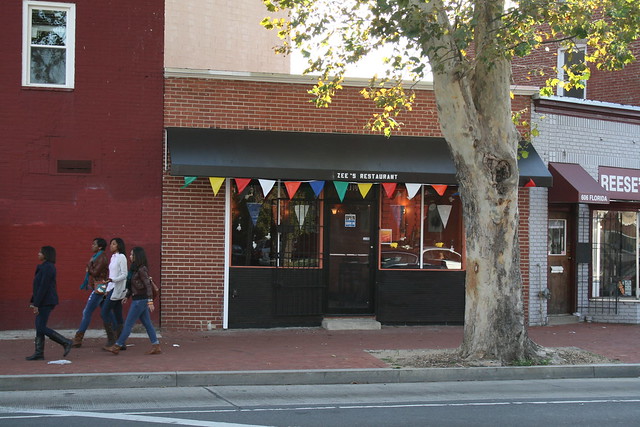
In January Tom Sietsema, the Post’s food critic, gave Zee’s Restaurant (600 Florida Avenue) a highly positive review. In fact, the restaurant is now listed as an editor’s pick on the Post’s website.
Curried goat, cooked over a low fire until the meat is tender, is almost a meal for two when you factor in the accompanying lettuce salad, the chunky potatoes and the folded flatbread known as roti. Chicken stew, seasoned with thyme and other herbs, comes with a shovelful of pigeon peas that are flecked with carrot and corn. (They could use a sprinkle of salt.) Shrimp, oxtail, beef and mixed vegetables are among the featured ingredients that are either curried or stewed, take your pick, at Zee’s.
We’re happy to see neighborhood businesses succeeding.
Shaw’s Tavern, with apartments above, will open mid-June

Mr. Steve May relayed more details on Shaw’s Tavern at last night’s meeting of the LeDroit Park Civic Association. The restaurant, slated to open in mid-June, will seat 65 – 70 people inside and 15 – 18 people on a sidewalk patio on the 6th Street front. On Florida Avenue near the eastern end of the building, the restaurant will feature a special door just for take-out pizza orders. (Click the image above for a larger version.)
Inside, however, the restaurant will feature a variety of entrées priced from $12 – $18. Mr. May distributed a tentative menu.
The restaurant expects to stay open until 11:30 or midnight on weeknights and until midnight or 1 am on weekends.
As for the adjacent empty lot on 6th Street, Mr. May offered to buy it, but says the owner demanded $1 million, which is far too much for a vacant lot of that size.
While Shaw’s Tavern will occupy the first floor, the restaurant will rent out three one-bedroom apartments upstairs and expects to have them ready by May.








Recent Comments