
City Paper contrasts the Howard and the Lincoln

The Lincoln by M.V. Jantzen, on Flickr

Howard Theatre. Photo by the author.
We wrote before about how the Howard Theatre differs significantly from the often-dark Lincoln Theatre on U Street. Now the City Paper published a longer essay contrasting the theaters and showing that the Howard will not repeat the mistakes of the Lincoln. According to the City Paper, there are six main reasons that the Howard will likely succeed where the Lincoln failed:
- The Howard will book a variety of popular acts, including acts that typically perform elsewhere.
- A professional management company with a history of running music clubs will manage the theater.
- The Howard can convert from a standing-room venue to a seated supper club in a flash. The Lincoln Theater’s seats, by contrast, cannot be removed.
- The Howard will serve much more food and, more importantly, alcohol, which is where profits are made in the restaurant business.
- The District government, though holding title to the property, has little influence in its operations.
- The Howard has better developed PR and marketing strategy.
44 year ago today, Washington burned
A neighbor pointed us to this poignant video footage of the riots that occurred 44 years ago here in Washington after the assassination of Dr. Martin Luther King.
Contrary to popular belief, suburban flight and urban disinvestment were already well-underway by 1968. The destruction that occurred in American cities that year was not the cause of urban decay; it merely accelerated a pre-existing, post-war urban decline. Most middle-class Americans, regardless of race, do not want to live or shop in a war zone, after all. Thus DC’s commercial districts quickly declined.
The riots that year were a mixed result: they meaningfully displayed frustration at systematized racism in American society, but they also destroyed the essential businesses in DC’s majority-black neighborhoods.
The sociology of the matter is controversial, but it’s important we review accounts of the history just to know what happened.
Look carefully at video and you’ll recognize 7th Street in Shaw, U Street, and 14th Street. Washington was never the same after April 1968.
Neighbors reminisce about the Howard Theatre
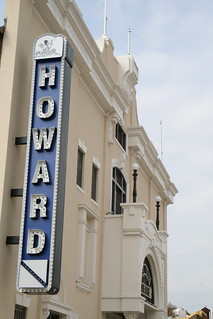 In preparation for the Monday’s grand (re)opening of the Howard Theatre, the Post ran a story about the theater’s past and how the Shaw and LeDroit Park have changed over the decades since the theater’s heyday.
The article also describes the histories of some long-time local businesses, including the Hall Brothers Funeral Home, the HJM Variety Shop, and Gregg’s Barber Shop.
A neighbor we know who studies local history likes to ask long-time residents if they feel the city has lost anything with the influx of residents, wealth, and investment over the past 15 years. Inevitably, the answer is yes and the answers differ to some degree.
The Post article is striking in that the residents who remember the theater in its golden age don’t expect its current incarnation to live up to the excitement of its younger self.
For those Washingtonians, the Howard’s rebirth stirs a mix of curiosity and excitement for what is new, and nostalgia and melancholy for what has been lost.
“It looks like a mausoleum to me,” said Juan Rosebar, 61, eyeing the theater on a recent afternoon, as workers laid cobblestones on the street outside.
As a kid, Rosebar watched the stars migrate from the Howard to Cecilia’s Stage Door, a bar a few yards away where they’d mix with their fans and drink post-performance cocktails. Cecilia’s closed long ago, as did Jimmy’s Golden Cue, the pool hall across the street where Rosebar learned to hustle. All that’s left is Jimmy’s rusted sign, the letters barely legible.
“You can’t turn the clock back,” Rosebar said. “You won’t get the scene; you won’t get the flamboyance.”
Another resident, Frank Love, concurs:
“It’s all changed around here,” said Love, 77, shaving a customer’s sideburns and listing the names of a half dozen long-gone barbershops. He can’t wait for the Howard’s reopening and the chance to step inside the place where he went to see Jackie Wilson with his future wife, Pearl Love.
He knows the theater can’t be what it was, but he’s okay with that. “That was then, and this is now,” he said. “You can’t look for it to be the same.”
You can tell from the posts on this blog that history fascinates us. However, the study of history is part real and part imagined. Though buildings can be preserved and restored, the people and societies that made them relevant cannot. The Howard will reopen on Monday and it will serve as a lively venue for a diverse array of national acts, but its cultural relevance may never again match its storied past.
Historian describes Mickey Mantle’s LeDroit Park home run record

On April 17, 1953, Mickey Mantle hit one of the longest home runs in baseball history at Griffith Stadium, which stood where Howard University Hospital stands today. The ball landed in LeDroit Park and was alleged to have traveled the remarkable distance of 565 feet.
Sports historian Jane Leavey investigated the so-called “tape measure home run” in her 2010 book The Last Boy: Mickey Mantle and the End of America’s Childhood. She appeared on NPR’s Talk of the Nation yesterday to discuss that record-setting home run that landed in LeDroit Park and she described her efforts to verify distance claim.
The 1940 Census reveals a full profile of LeDroit Park
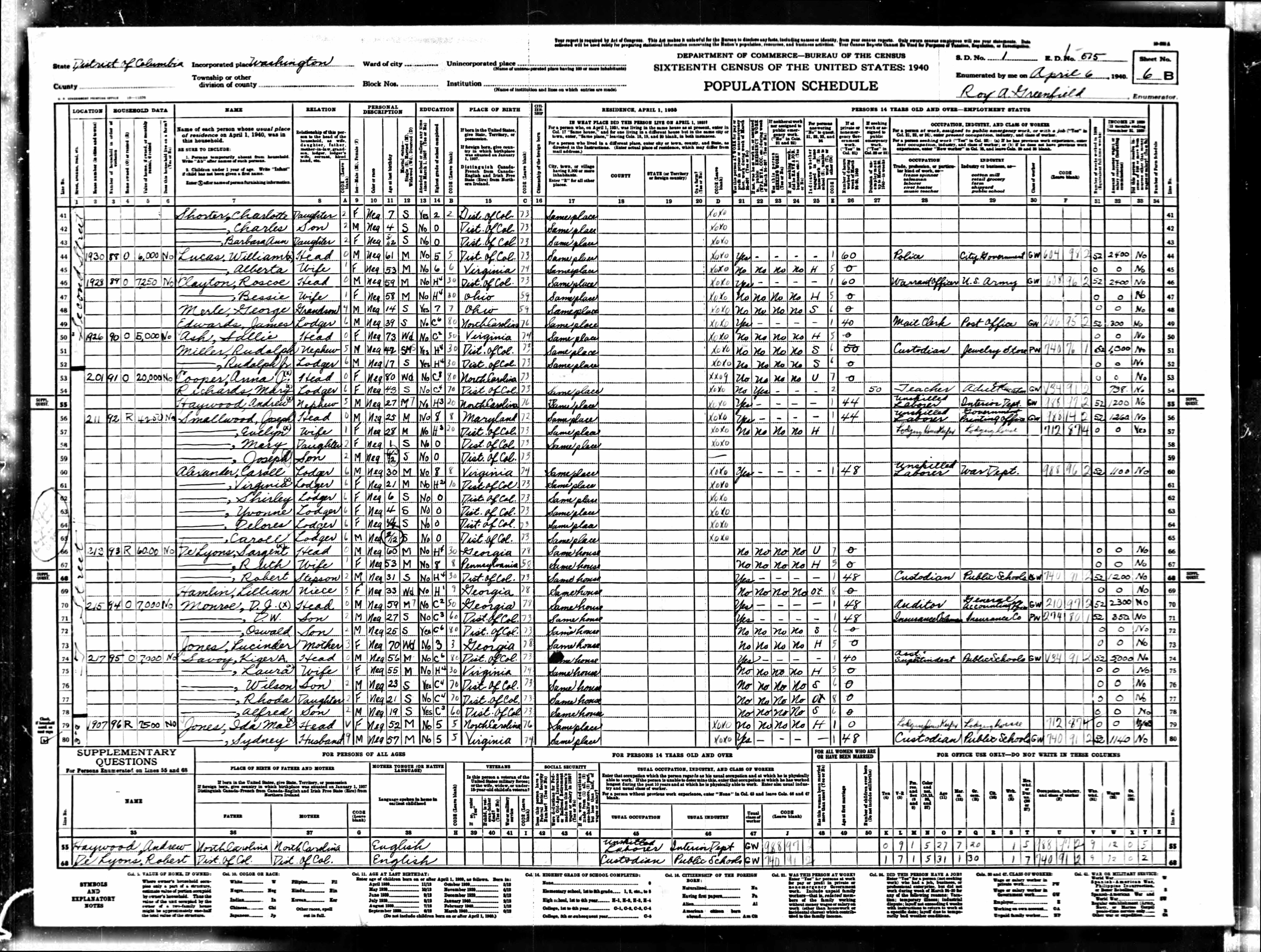
U.S. Census records are kept confidential for 72 years, meaning that the 1940 Census went public yesterday. Whereas previous census ledgers were difficult to find online for free, the U.S. Archives released the full 1940 Census online. We have started perusing the pages to look for famous figures and interesting patterns in LeDroit Park, which is covered by enumeration districts 1-514 through 1-516.
A few things stand out. First, nearly the entire population of LeDroit Park in 1940 was black, illustrating the sharp racial segregation at the time. Second, nearly every house was packed with residents and many residents took on lodgers. Our house, a modest two-bedroom built in 1907, housed 13 people!
* * *
We will publish some interesting records as we find them, but let’s start off with the listing for Anna J. Cooper (née Haywood), her lodger, and her nephew, who lived at 201 T Street (pictured below). The Cooper household is listed as entries 53 – 55 in the ledger at the top of this post.

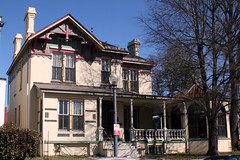 Cooper was the principal of the M Street High School, she was an author, a feminist, and a teacher. The census only collects unambiguous personal statistics, so there is actually a longer story behind every column entry.
The first column in the snippet above states the value of her home as $20,000, a high sum compared to other LeDroit Park homes.
The 11th column lists “C8”, meaning that she received eight years of a college education. What the record doesn’t state is that she received a PhD from the Sorbonne in 1924, making her among the first black American women to receive a doctorate.
The 8th column states her age as 80 (she was actually 81) and the 13th column simply states that she was born in North Carolina. What the record doesn’t state is that she was born in North Carolina in 1858 into slavery.
The rest of the record not pictured in the above snippet states that by 1940 she was unable to work, though in reality she was likely still running a small night school.
She died in 1964 at the age of 105. The circle at 3rd and T Streets is named in her honor, she is featured on a postage stamp and on pages 26 and 27 of the U.S. passport.
Duke Ellington immortalized in stainless steel
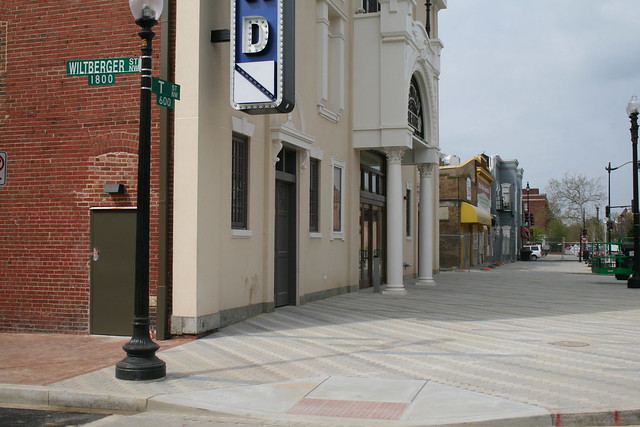
The Howard Theatre is nearly complete. You may have noticed that the sidewalk on the north side of T Street is now open, giving residents a close-up view of the new façade. More importantly, the plaza at T Street and Florida Avenue is now open and the new sculpture of Duke Ellington stands prominently at the vegetated plaza. The sculpture depicts Ellington seated on a treble clef while playing a piano keyboard.
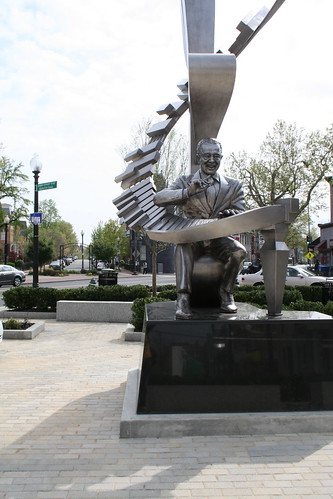
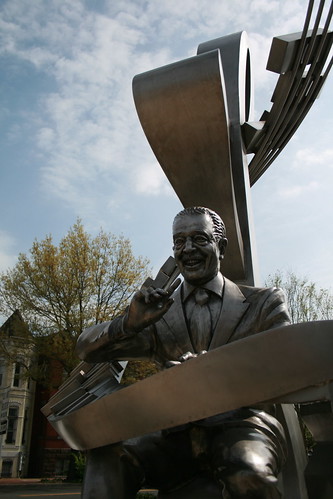
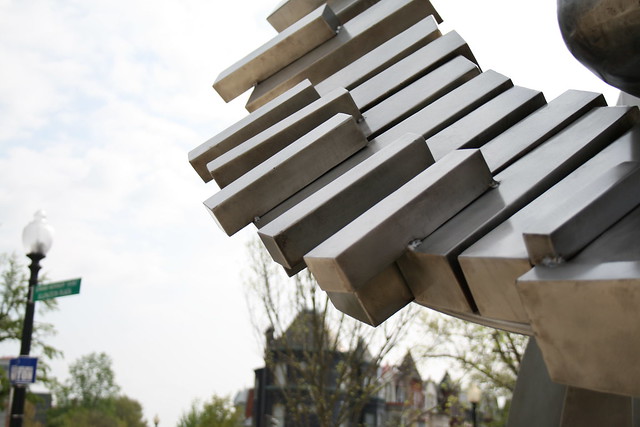
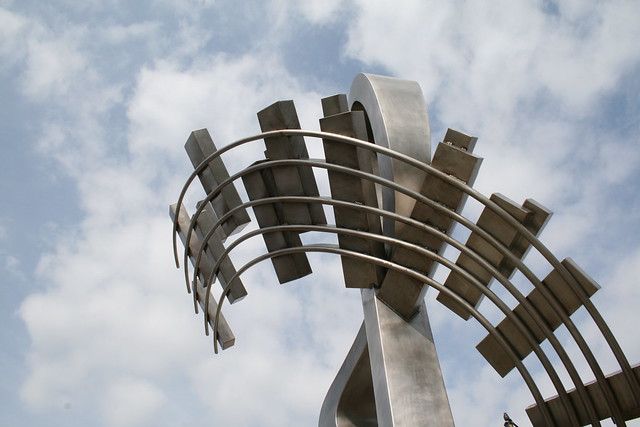
The most delightful feature of the sculpture is the energy it portrays. As Ellington plays, the keys appear to fly off the keyboard and into the sky behind him, signifying a magical quality to his music.
Duke Ellington grew up in Washington and even lived on Elm Street in LeDroit Park for a year. He played at the Howard Theatre and frequently visited the adjacent Frank Holliday’s pool hall, most recently known as Cafe Mawonaj.
The hall was a popular gathering spot for Howard scholars, jazz musicians, and city laborers alike. Duke Ellington captured the scene at the pool hall:
Guys from all walks of life seemed to converge there: school kids over and under sixteen; college students and graduates, some starting out in law and medicine and science; and lots of Pullman porters and dining-car waiters.
And now Ellington’s statue sits on the same storied block.
Florida Avenue project advances slightly
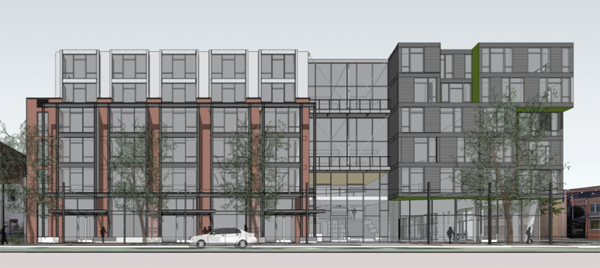
The JBG apartment project on the 700 and 800 blocks of Florida Avenue NW moved forward last week when the Historic Preservation Review Board (HPRB) gave partial approval to the project. The modernist design will likely have to endure a few more refinements before the board grants its final approval for the site.
Building alterations, additions, demolitions, and construction in historic districts are subject to review by the Historic Preservation Review Board. Since the site sits in the U Street Historic District, it must also gain HPRB approval before it can receive building permits.
Though we are supporters of historic preservation, we can see why this extra level of review frustrates builders and property owners. The main problem is that historic review requires property owners, architects, and developers to adjust their designs based on subjective judgments of historic compatibility.
The historic review process is less predictable that the typical building process, which simply requires that a builder meet unambiguous zoning regulations and building codes. For instance, the JBG site is zoned C-2-B, which permits residential projects to rise to 65 feet or to rise to 70 feet if they include affordable housing.
Distances are easy and unambiguous measurements, but how does one determine if a proposed design is historically compatible?
As in most cases where subjectivity needs analysis, you can easily define the extreme cases. The Weaver Building (HUD’s headquarters) is undoubtedly incompatible with the Victorian rowhouse architecture of the U Street area. Likewise, a good number of preservationists despise projects that attempt precise replication of historic structures. The right answers lies somewhere between aping historic forms and shunnig them all together.
For its Florida Avenue sites JBG project solicited design proposals from architecture firms nationwide. The winner, Seattle-based Miller Hull, designed a truly modernist project.
Modernism, a 20th century invention, can work well in historic districts if done right and Miller Hull has worked to refine its designs to pass HPRB muster.
Though the HPRB asked for further refinement that will have to go to the board again, the board did support the design on six features so far:
- Relocation of the front, original section of 1933-35 9th Street to the southern portion of the site, adjacent to the row of similarly-sized and scaled historic buildings, and removal of the later rear additions
- Reconfiguration of the alley on the western parcel to exit on 9th Street
- Subdivision to allow lot combination on both the west and east sites
- Overall site organization of the new construction
- Height and massing along Florida Avenue
- General architectural direction, subject to further development and material selection.
Here are the concept designs the board reviewed when it reached this decision:
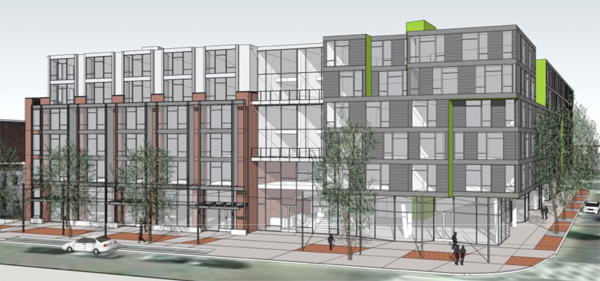
Looking west from 8th Street
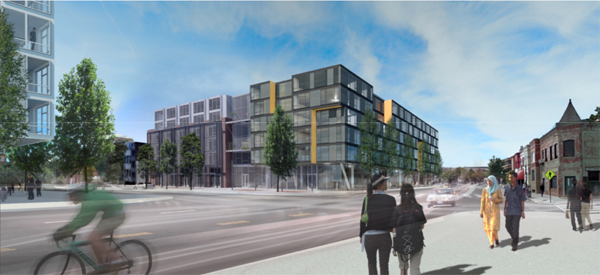
Looking southwest from Florida Avenue
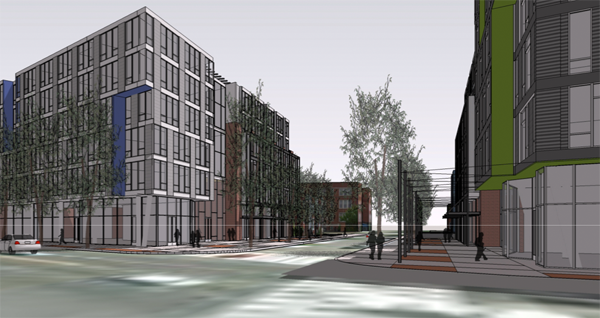
Looking south along 8th Street from Florida Avenue
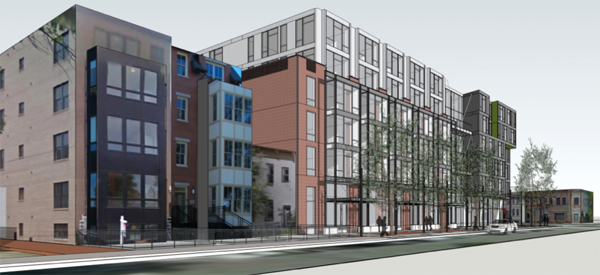
Looking northwest along 8th Street
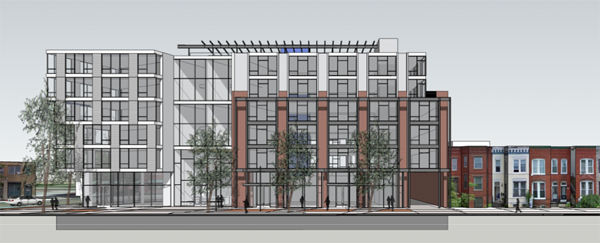
Looking east from 8th Street
Howard Theatre encourages private parking
To reduce the liklihood that patrons will park on residential streets around the Howard Theatre, the theatre will sell prepaid private parking through Ticketmaster. The passes are for private lots owned by Howard University and other private owners.
In fact, we were looking on Ticketmaster at prices and availability for April’s Wanda Sykes show and spotted this prominent parking add-on at the bottom:
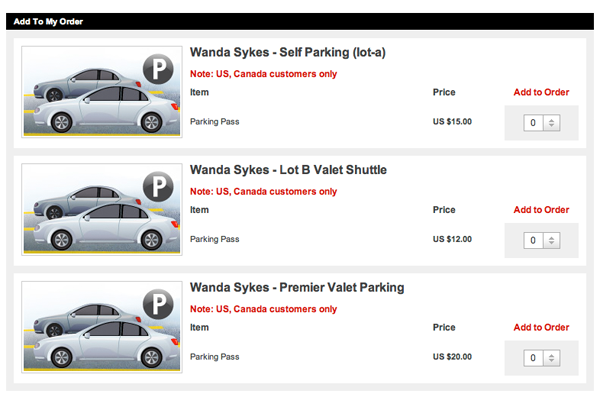
The lots described above are as follows:
- Valet shuttle Lot B – Howard University’s large parking lot at Georgia Avenue and W Street.
- Self-parking Lot A – Howard University’s HURB-I parking lot at 7th & T Streets.
- Premier Valet – private triangle lot at T Street and Florida Avenue, across from the theater.
When Progression Place, the office and apartment project at the Shaw Metro, finally opens, the theatre will lay claim to a significant number of the project’s underground parking spaces during nighttime hours, thus adding a another option.
All Souls in the news
Channel 7 ran a short story on the fracas over the All Souls tavern license we reported earlier.
Unfortunately we weren’t able to make the Alcoholic Beverage Control (ABC) Board hearing on Wednesday, but we heard secondhand that it was quite a show.
A commenter from a previous post pointed us to an article sympathetic to the opposition.
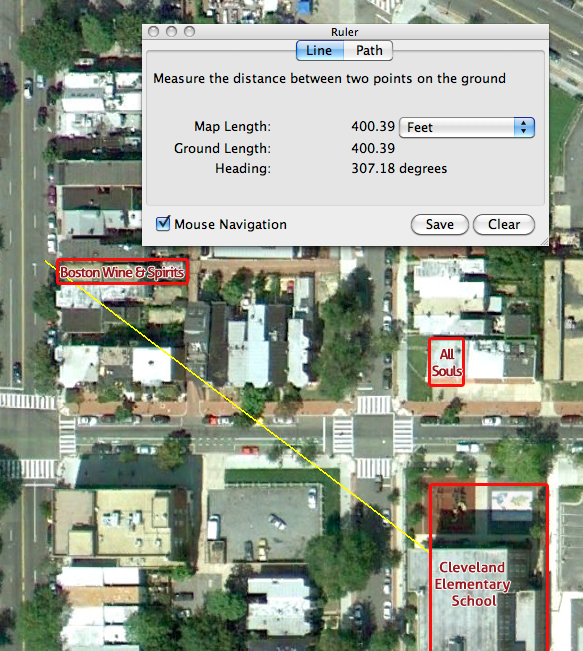
The article notes that the ABC Board does not typically grant alcohol licenses within 400 feet of a school unless there is already another alcohol license within 400 feet of the school. In this case, All Souls would qualify since Boston Wine & Spirits (1905 9th Street) is within 400 feet of the school.
We looked up on Google Earth the distance between Boston Wine & Spirits and Cleveland Elementary School and marked a 400-foot yellow line in the map below. We were able to spot-check the relative accuracy of the program by measuring the right-of-way distances in Google Earth and comparing them to the numbers in the Baist Real Estate Atlas of the area. By a more generous measure, where we measure from the school building instead of the school’s property lot (outlined in red) to 9th Street in front of and thus beyond Boston Wine & Spirits, it appears that Boston Wine & Spirits is within the 400 feet.
Here is another interesting tidbit from the article:
The parent group who is behind the protest of the bar conducted a survey. According to the survey, 45% of Cleveland Elementary School teachers would be reluctant to attend evening activities at the school and 33% of parents would remove their children from the school should the bar open up across the street…
It seems the frequent, blatant, and public drug-dealing and urination a block away have not deterred these hardy souls from attending Cleveland, but the thought of a 5 pm happy hour across the street will.
Metro station names get a little more rational
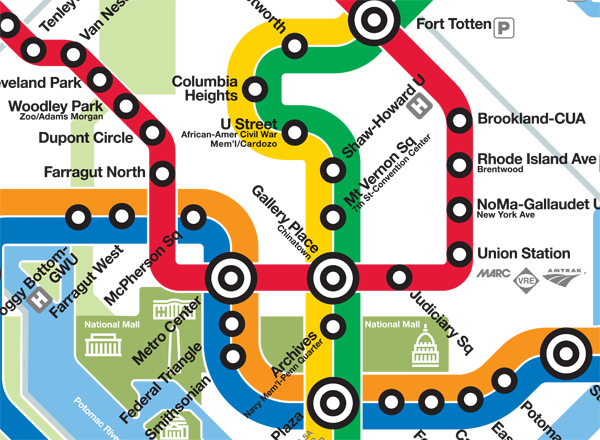
WMATA decided to revise our iconic Metro map to include the Silver Line and account for slight changes in rush-hour service on the Orange and Blue Lines. The new design, pictured above, ameliorates one of the agency’s usability problems: name sprawl. The new map wisely rearranges several station names to move the less important parts of sprawling names onto smaller subtitles.
When the system was built, station names were originally designed to be short and represent geographic places. Due to politics, local boosterism, and unwise interference from local politicians, some names have exploded in length. The U Street station name, “U Street/African-American Civil War Memorial/Cardozo”, is often cited as the poster child of clunky name sprawl. It wasn’t supposed to be this way. U Street as a place has a history and regional recognition strong enough to stand on its own. The station was originally listed as “U Street”, but then “Cardozo” got tacked on. Worse yet, in 1999 the DC Council voted (and paid) to change the name from “U Street-Cardozo” to the ridiculously longwinded “U Street/African-Amer Civil War Memorial/Cardozo” in honor of the new memorial at the 10th Street entrance.
Since shortening a station name is fraught with political peril— imagine the accusations if you tried to remove “African-American Civil War Memorial” from U Street’s name— WMATA is simply rearranging long names to create primary names and subtitles. U Street isn’t the only station getting this much-needed reordering. Woodley Park (Zoo/Adams Morgan), Gallery Place (Chinatown), Mt. Vernon Square (7th St – Convention Center), and Archives (Navy Memorial – Penn Quarter) are among the other station names that will become less graphically imperious on the map.







Recent Comments