
The Streetcars Have Landed
We wrote earlier about the rebirth of DC’s streetcar system and even suggested our own alignment for a full-length Rhode Island Avenue line.
As we reported, the city’s three streetcars were collecting dust in the city of Plzeň in the Czech Republic, where they were manufactured. Today they completed their transatlantic voyage and landed at the Port of Balitmore. DDOT recorded the event:
The streetcars will be transported to the Greenbelt Metro railyard, where WMATA staff will maintain them until the tracks are ready.
Speaking of tracks, DDOT has finished laying down the streetcar tracks along Benning Road in Northeast.

DDOT took this photo on Benning Road NE at 17th Street NE, just two blocks outside the L’Enfant Plan, where overhead catenery wires are prohibited by law— another issue DDOT will have to resolve.
DDOT is ambitiously moving ahead with the streetcar plan, but Councilmember Jim Graham (D – Ward 1) told us that though he may not see the streetcars in his lifetime, I’d see them in mine (you’re writer is 25). Not fully reassuring, but better than nothing.
Fractal District

A fractal is a shape that is composed entirely of smaller versions of itself. While glancing at a map of Shepherd Park yesterday, we discovered the shape of the District within the District.
The area is bounded by North Portal Drive (corresponding to Western Avenue), Rock Creek Park (corresponding to the Potomac), Alaska Avenue (corresponding to Southern Avenue), and Eastern Avenue (as itself).


Howard Town Center
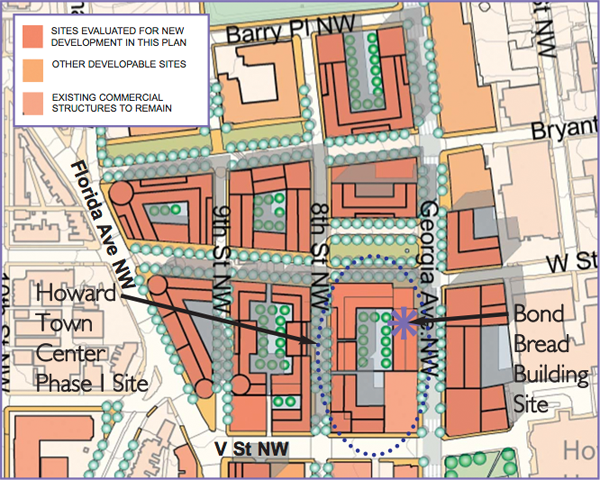
The DUKE Plan for Howard Town Center, approved by the City Council
We haven’t written much on Howard Town Center (pictured above), but we found a good article on it at Greater Greater Washington.
Several years ago the Office of Planning released, and the City Council approved, the DUKE plan, a development framework for the U Street corridor and Howard Town Center. The section covering Howard Town Center rightly calls for development to “[e]xtend streets in an east-west system to connect the area to the center of Howard University’s campus,” specifically directing to “[c]onnect W Street on both sides.”
There are several streets running north-south in the Town Center area, but few running east-west. The purpose of this requirement is to break-up what planners call superblocks, large city blocks that tend to sap street vitality and limit neighborhood connectivity. Superblocks were popular with postwar modernist architects, but they have since been discredited as bad planning. Small city blocks, as urban observer Jane Jacobs noted, allow more paths for passing through a neighborhood and break the monotony that accompanies mega-buildings.
Though the initial plan by CastleRock Partners for the Phase I Site would bring a grocery store and housing, the Greater Greater Washington article notes that the CastleRock plan violates the east-west connectivity guideline of the DUKE plan in that it proposes placing a garage ramp where W Street should be.
Connecting the isolated sections of W Street would enhance access between LeDroit Park and the U Street corridor and the CastleRock proposal disregards this goal of the DUKE plan. Despite this, we will still be glad to shop at the grocery store once that opens up. Groundbreaking is set for next fall.
Business is Picking Up
If last night’s ANC meeting is any judge, the economy is picking up. Two separate petitioners sought approval for liquor licenses for their upcoming businesses on U Street and one petitioner presented plans to renovate a vacant building into a restaurant.
Marvin
The colorfully-dressed owner of Marvin (2007 14th St NW) sought and received support for two minor modifications to his voluntary agreement. One amendment will allow him to keep an upstairs door open and the second will nix the requirement that he keep decibel readers in the restaurant.
The latter amendment, he stressed, does not exempt Marvin from the noise restriction, but merely relieves him from having to buy expensive (and fragile) volume-measuring equipment.
Cuckoo Marans
The newly renovated building at the northeast corner of 14th and U Streets has signed two tenants, one for the ground up and one for the basement. The proprietors of the future basement venue Cuckoo Marans (a type of hen) bill their nightclub (Retail Class C) as a “music and arts club” and envision hosting musical acts that might not be able to fill venues as large as the 9:30 Club. They added that though their business will focus primarily on music, they will feature other arts, too.
The ANC voted to oppose the license as a tactical measure until the proprietors of both the upper floors and the basement could come to a voluntary agreement with the ANC.
U Street Music Hall
The night’s other new license petitioner, a DJ and former Smithsonian employee, presented his plans for the U Street Music Hall to be located in the basement of 1115 U Street NW (the former location of the now-shuttered Cue Bar). The venue will offer free DJ classes to elementary and middle-school kids in the afternoon and will serve as a music venue at night.
The petitioner has asked for DCRA for a maximum capacity of 399 people, a number that department will likely reduce and a number at which Commissioner Brianne Nadeau balked. The petitioner is seeking the permission of ABRA to close at 4 am Friday and Saturday nights so as not to spill a crowd of drunken patrons onto the street at the city’s 3 am last call.
As with Cuckoo Marans, the ANC voted to oppose the license as a tactical measure until the petitioner could come to a voluntary agreement with the ANC.
Brixton Pub
At 901 U Street, across the street from Nellie’s, sits a building that has been vacant for twenty years. The petitioners presented plans to renovate the building into a restaurant and bar with a roof deck. Sitting on the elbow edge of the L’Enfant Plan, the building renovation requires approval of the Historic Preservation Review Board. The renderings, which we have not had a chance to scan yet, look pretty nice.
The petitioner is hoping to secure building permits next month for a construction process that will last about four months.
The ANC voted to support the petitioner’s conceptual design.
Building from the Ground Up
Watch this neat time-lapse video covering the entire construction of the Kenyon Square building at Fourteenth and Kenyon Streets in Columbia Heights.
I Saw the Sign
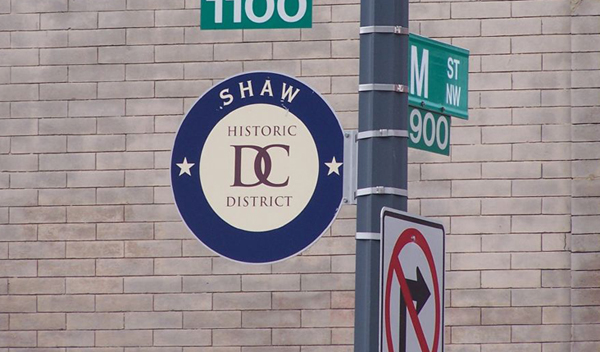
The DC Historic District markers adorning lampposts in Shaw, Anacostia, and Capitol Hill are coming to LeDroit Park— eventually.
The Office of Historic Preservation informed us today that the signs, for which the office has already paid, will adorn every historic district when DDOT decides to dust them off and install them.
LeDroit Fix-It
We got word that a representative from the mayor’s office will walk through the neighborhood on Wednesday, December 2, starting at 10:00 am at the corner of Fourth and W Streets. The purpose of this public walk-through is to compile a list of nuisances, graffiti, abandoned property, broken traffic signals and signs, etc., that the city should address.
If you cannot attend, please leave comments below and we will try to relay the issues to the mayor’s office.
Read their email for details:
This week the Mayor’s Liaison to the Office of Community Relations will be conducting a Fix-It on December 2nd at 10:00am at the following locations in your Ward:
- Meeting location: Corner of 4th and W Streets
- 200-400 blocks of T Street
- 200-400 blocks of U Street
- 200-400 blocks of Elm Street
- 200-400 blocks of V Street
- 200-400 blocks of W Street and the surrounding area on Florida Avenue.
We will be addressing the following issues: Abatement of all bulk trash, graffiti removal, abatement of rats, inspection of potential vacant properties, abandoned autos, street signage, street light audit. Please join us!!
Operation Fix-It is Mayor Adrian M. Fenty’s multi-agency initiative aimed at abating crime, blight, and compliance issues in communities throughout the District of Columbia. The Fix-Its are held weekly and the locations are generated directly from concerned citizens.
To learn more about Operation Fix-It and how you can join us on our next project in Ward 1, please contact the Ward 1 Helpdesk at 202.727.6224.
Crime Prevention Meeting
The Metropolitan Police Department, Councilmembers Jim Graham (D – Ward 1) and Harry Thomas, Jr. (D – Ward 5), and the local ANC commissioners are hosting a public safety meeting tomorrow (Tuesday) night at 7 pm at the Mt. Pleasant Church at Second Street and Rhode Island Avenue.
The meeting will address some of the recent violence in the two neighborhoods.
The Space Between
While composing the previous post, we wondered whether there should be a space between the Le and the Droit in the name LeDroit Park. Many old maps spell the neighborhood with a space, but more recent references exclude the space.

In 1877 real estate speculator Amzi Barber published a pamphlet entitled LeDroit Park Illustrated to promote his fledgling suburban neighborhood. The highly stylized typeface and arched layout of the pamphlet’s title make it harder to decipher whether or not there is a full space between the Le and the Droit. However, the space between Le and Droit is nothing like the ample, ornamented space preceding the word Park. Thus, one is inclined to assume that LeDroit was one word.
However, the bottom of the pamphlet lists the author as “A. L. BARBER & CO., PROPRIETORS OF LE DROIT PARK”— space included— and this space also appears in other early references to the area.
Today, the answer leans overwhelmingly toward excluding the space: we exclude it in our title, the LeDroit Park Civic Association excludes the space on its site, the Washington Post excludes the space, as does the D.C. Office of Planning, and the entry gate at 6th and T Streets (pictured in the header above) makes no room for it either.
Interestingly, the world’s two largest digital street cartographers are divided. The Dutch company Tele Atlas, which serves as the source of Google Maps, includes the space, whereas Chicago’s NAVTEQ, the source of bing maps and Mapquest, excludes it.
Including the space is not really “wrong”, but feels like a quaint historic artifact, like the human appendix or the English monarchy.
* * *
While living in P.G. County for four years, we once came upon an official document that read “County of Prince George’s”, which appeared grammatically incorrect since the possessive word 0f obviates the need for the possessive ‘s at the end. Nonetheless, everyone has come to know the place with the apostrophe since County usually follows rather than precedes the name.
John Kelly in the Post uncovered the history of the apostrophe in the name Prince George’s County:
But in 1952, Maryland state archivist Morris L. Radoff insisted the apostrophe was correct. Yes, some early records had been found without the apostrophe, “but it just wasn’t used often in the 17th century,” he told The Post. He admitted that the original engrossed acts of the General Assembly were destroyed by a fire in the State House in 1704.
What’s clear is that for most of the 20th century it was Washington Post style not to use the apostrophe. In fact, in a 1947 article about efforts by the newly formed Prince George’s Press Association to encourage publications to use the apostrophe, The Post left the apostrophe out, referring to the “Prince Georges Press Association.”
Having disappeared from print, the apostrophe is back and we suspect it’s back for good— unless a sudden influx of francophones rechristen the county with the French version of George, i.g. Georges.
Old Street Names
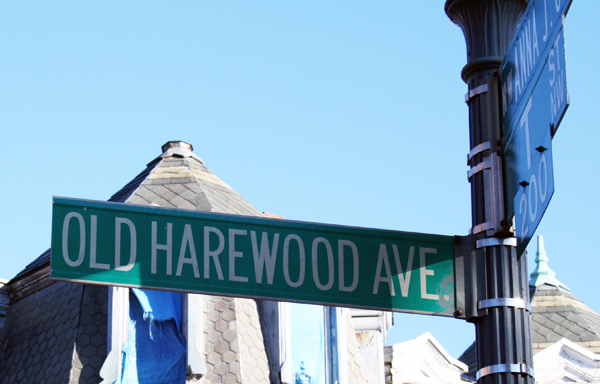
Careful observers occasionally spot the old street signs adorning a few of the light poles in LeDroit Park. When the neighborhood was originally planned, most of the streets were named after trees. LeDroit Park’s street system didn’t fit with the L’Enfant Plan in either name or alignment—much to the dismay of the District commissioners—and the street names were eventually changed to fit the naming and numbering system.
A perusal of old maps reveals that the street names changed over time, not all at once. Elm Street is the only street that has retained its name. Since your author lives on Elm Street he has learned to respond to puzzled faces that know that Elm doesn’t fit the street naming system: “It’s kinda like U-and-1/3 Street”.
Anna J. Cooper Circle didn’t have a name at all until 1983, when it was restored to its circular form after a decades-long bisection by Third Street.
Just outside of LeDroit Park, the city renamed a few streets as well: 7th Street Road became Georgia Avenue and Boundary Street, the boundary of the L’Enfant Plan, became Florida Avenue.
Here is a table matching the current street names with their previous names.
| Old Name | Current Name |
| Le Droit Avenue | 2nd Street |
| Harewood Avenue | 3rd Street |
| Linden Street | 4th Street* |
| Larch Street | 5th Street |
| Juniper Street | 6th Street |
| Elm Street | (same) |
| Boundary Street | Florida Avenue** |
| 7th Street Road | Georgia Avenue** |
| Oak Court | Oakdale Place |
| Maple Avenue | T Street |
| Spruce Street | U Street |
| Wilson Street | V Street** |
| Pomeroy Street | W Street** |
| (unnamed before 1983) | Anna J. Cooper Circle |
| * For a short period, 4th Street was called 4½ Street. ** Though these streets were just outside the original LeDroit Park, we have included them for reference. |
|
Signs bearing the old street names have reappeared in the neighborhood, and according to the Afro-American, were put up in 1976: “The LeDroit Park Historic District Project was instrumental in getting the D.C. Department of Transportation to put up the old original street names for this Historic District Area under the present street name signs”.1
Unfortunately, some of the signs are showing their 33 years of weather, as this sign at Third and U Streets shows.

Eventually these signs will have to be replaced, but rather than placing the old names onto modern signs using a modern typeface, we suggest something that evokes the history without being mistaken for the current street name:

White text on a brown background is the standard for street and highway signs pointing to areas of recreation or cultural interest. Seattle started using the color scheme to mark its historic Olmsted boulevards and New York has long used the combination for street signs in its historic districts. The adoption of this style of sign would alert visitors and residents to the neighborhood’s historic identity while the different color and typeface would prevent confusion with the actual street names (U St NW in this case). Typographers would be pleased by the use of Big Caslon Medium, a serif typeface based on the centuries-old Caslon typeface.
- Hall, Ruth C. “Historic Project”. Washington Afro-American. 1 May 1976.







Recent Comments