
Civic Associations Past
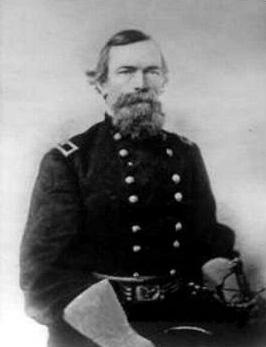
Gen. William Birney lived in the mansard-roofed duplex on Anna J. Cooper Circle.
The LeDroit Park Civic Association meets tonight, following a long tradition of meetings to improve the neighborhood. Take a look at this newspaper article from the National Republican published on March 26, 1881:
Improvements Proposed by the Property Owners.
In response to a call issued, there was a very full attendance of the members of Le Droit Park Property Owners’ Association last night in the park. The meeting was called to order by Mr. W. Scott Smith1, the president of the association, who proceeded to state what had been done since the last meeting to promote the interests of the park and the large number of residents living therein. The first business before the association was the election of officers for the ensuing year. On motion of General W. W. Birney2, Mr. W Scott Smith was unanimously re-elected president of the association, Colonel O. H. Irish3 was nominated and elected vice-president; James H. McGill4, secretary; J. J. Albright5, treasurer, and E. B. Barnum6 the additional member of the executive committee. The president said he had recently had an interview with the District Commissioners, and the lighting of two additional gas lamps in the park had been ordered. He had seen the Major and Superintendent of Police about giving the park better police protection, and had received assurances that the matter should receive prompt attention, and an officer detailed specially for night duty in the park.
General Birney submitted a motion, which was adopted, that a vote of thanks be extended to the president of the association for his active efforts during the past year in behalf of the park.
The question of opening a new street on the east side of the Park, running from Boundary street [now Florida Avenue] through to the Soldiers’ Home, then came up, and gave rise to considerable discussion, all concurring in the opinion that such a street was needed. A resolution was the offered and adopted that the members of the association will co-operate heartily with the District Commissioners in securing the opening of such a street and road, and instructing the executive committee to take steps to make effective such co-operation. Attention was directed to the fact that all the houses and a large amount of property in the Park were greatly exposed and jeopardized in case of a fire by the action of the water department in shutting off the pressure of water between the hours of midnight and five o’clock a.m., and thus practically preventing the flow of water in the park. The executive committee were directed to look in the matter and endeavor to have it remedied as soon as possible. The need of a fire-engine in the northern section of the city was regarded as very pressing. After discussing various other matters and directing that rules be prepared for the government and guidance of the special day-policemen, the meeting adjourned.
References
- Private secretary to the Secretary of the Interior; resident of 525 T Street NW. Halford, A. J. Official Congressional Directory. Washington: GPO, 1900.
- Civil War general; resident of 1901 Third Street NW. Read more at Wikipedia.
- Head of the Bureau of Engraving and Printing among other accomplishments; resident of 1907 Third Street NW. National Republican. Washington, Jan. 13, 1879 and Richardson, F. A. Congressional Directory. Washington: GPO, 1880.
- Architect of LeDroit Park.
- Wealthy coal distributor. Cutter, Library Journal. Vol. 17. New York: ALA, 1892.
- Tailor and clothier, E. B. Barnum & Co.; resident of 1883 Third Street NW. Boyd, William Henry. Boyd’s Directory of the District of Columbia. Washington: Boyd, 1887.
Civic Association Meets Tuesday
The LeDroit Park Civic Association meets tomorrow, Tuesday, May 25 at 7pm in the basement of the Florida Avenue Baptist Church.
- LeDroit Park-Bloomingdale Heritage Trail update.
- Columbia Elks Lodge #85, 1844 3rd Street NW—Application for renewal of Retail Class CX club license
- Gage Eckington Park update.
We hope to see you there.
LeDroit Park in 1921
We were paging through the excellent online map collection of the Library of Congress and downloaded the 1921 Baist Real Estate Atlas of Washington, DC. This meticulous city atlas marked all the water mains, sewers, streets, squares, lots, and buildings. Buildings were shaded to indicate their construction materials (red for brick, yellow for wood). Subdivision names as well as the names of certain proprietors made their ways into the Baist maps, too.
We’re actually studying this atlas to do some research for an upcoming post on the zoning code, but for your convenience we’ve stitched together the three pages of the atlas covering LeDroit Park and Bloomingdale and published it as a single PDF document. Here are a few highlights.
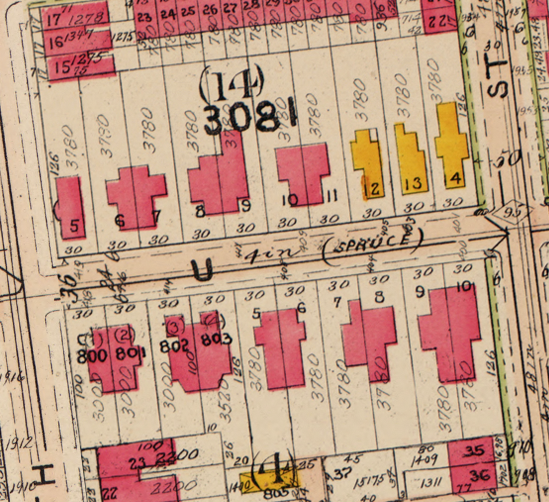
The 400 block of U Street, famous for its houses designed by Washington architect James McGill, reveals that the lots 12, 13, and 14 in square 3081 are wood houses, while all the other McGill houses on the block are brick.
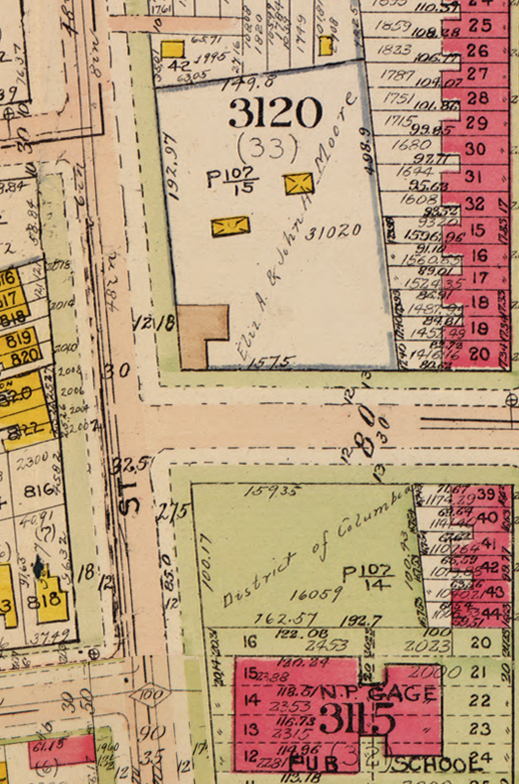
Here’s the original Gage School, now a condo building, on Second Street. Notice the Moore property, which predates the establishment of LeDroit Park, extending all the way south to Florida Avenue.
The current site of the United Planning Organization on Rhode Island Avenue was the estate of engraver David McClelland. As we wrote before, the U.S. War Department confiscated Mr. McClelland’s map of the District at the outbreak of the Civil War. The Elks later purchased the McClelland estate and eventually sold it and moved into their current building on Third Street (marked as Harewood Avenue below).
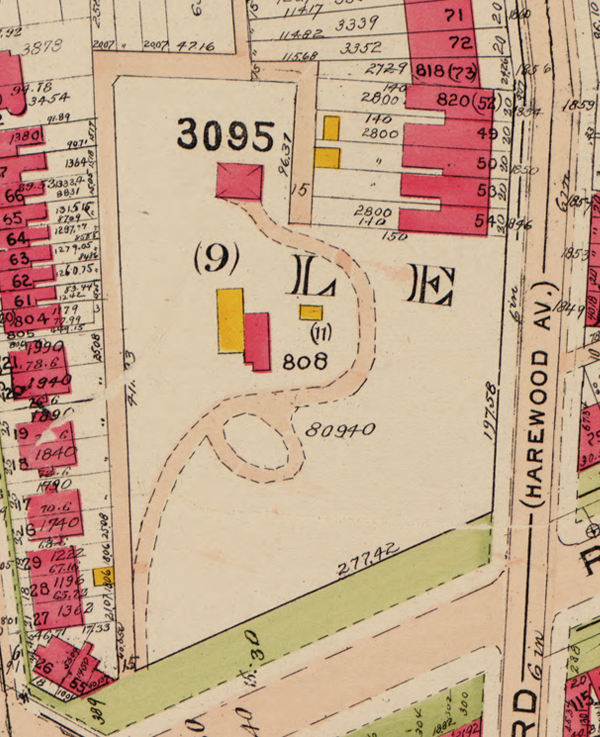
In the 1970s, the city razed all the area shaded in green below to make way for Gage-Eckington Elementary School, which was itself razed just last year after years of declining enrollment.

Carless in LeDroit
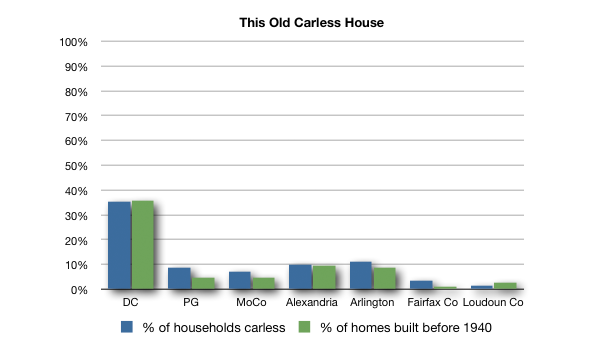
Source: U.S. Census Bureau
Among the nicest features of LeDroit Park are its walkability and its proximity to downtown. We can bike downtown to work in 15 minutes, or if it’s raining, take the bus or the metro and be there in 25 minutes. The restaurants, shops, and bars along U Street are only a short walk away.
The notion that it is easy to live in LeDroit Park without a car consistently confounds many suburbanites, but our variety of transportation options is no accident.
Our neighborhood is just outside the original L’Enfant city. In L’Enfant’s time, the main form of transportation was the human foot, so a city designed from scratch, like Washington, had to be relatively flat, like Washington, and compact, like Washington. Horse-drawn streetcars made commuting across the city easier, and electric streetcars eased the daily climb to neighborhoods like Columbia Heights and Mount Pleasant.
After World War II, housing construction exploded, particularly suburban housing construction. The suburban housing model was— and, for the most part, still is— based on several main principles, most significantly, the uniformity of housing sizes (usually large) and the separation of residential and commercial uses. Both larger lots and the separation of uses create longer distances between any two points, requiring a greater effort to go between home, work, and the grocery store.
These longer distances between daily destinations made walking impractical and the lower population densities made public transit financially unsustainable. The only solution was the private automobile, which, coincidentally, benefited from massive government subsidies in the form of highway building and a subsidized oil infrastructure and industry.
LeDroit Park was founded in 1873 and the first wave of single-family and duplex houses designed by James McGill soon followed. The second housing wave brought rowhouses to LeDroit Park, but most of the neighborhood was finished in the early twentieth century long before the dominance of the automobile.
Notice this 1908 photo of the 400 block of U Street in LeDroit Park. You’ll see four people, but only one car.

It’s no coincidence that our neighborhood’s founding, long before the automobile age, relates to its walkability and abundance of transit options. In fact, when we look at the regional Census data, we find a strong relationship between the age of the housing stock and the rate of households without a car.
The only other factor that might influence the rate of carlessness is income, but the closeness of the carless rate and the pre-war housing stock rate is too glaring to ignore. There are plenty of middle-class people in Washington who choose to forgo a private car and the age of the neighborhood may be a strong indication of just how easy it is to live without a car.
New Farmers Market at the Hospital

Howard University Hospital is hosting a farmers market twice a week on the plaza at their Georgia Avenue entrance. The market will run Tuesdays from 3 p.m. to 7 p.m. and Fridays from 10 a.m. to 2 p.m.
We’re excited to have fresh produce for sale so close to home and we hope the prices compare (or beat) Safeway and Giant.
1881 Ad for LeDroit Park
The Library of Congress keeps an online collection of old newspapers to chronicle American history. Look at this 1881 ad for “cottages” in LeDroit Park:

Le Droit Park.—Cottages of six and eight rooms; all the modern conveniences; north and south front; $25 to $30. A. L. Barber & Co., Le Droit building.
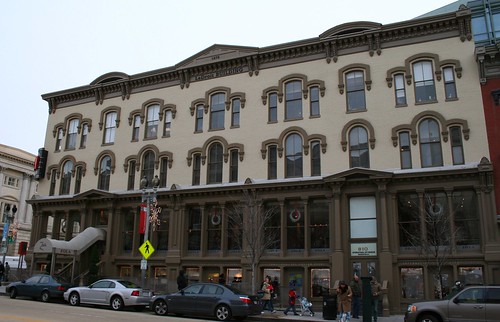
Amzi Barber’s office was downtown in the LeDroit Building, which still stands today at 800 F Street NW:
Barnes Dance Barn Dance
Several whimsical Washingtonians staged a Barnes Dance Barn Dance at Seventh and H Streets in Chinatown on Friday. (see video above)
DDOT installed the new Barnes Dance crossing late last week and is studying the effectiveness of installing such configurations at some of the city’s busier intersections.
The setup in Chinatown provides three light cycles: one for H Street, one for Seventh Street, and one cycle during which pedestrians may cross whichever way they choose, even diagonally through the intersection. The Chinatown Barnes Dance differs slightly from a traditional Barnes Dance in two ways:
- Cars may not turn at any time. A traditional Barnes Dance provides right-turn arrows during the streets’ respective green cycles.
- Pedestrians in Chinatown may cross with traffic in addition to the all-pedestrian cycle.
These variations prioritize pedestrian crossings, a priority in line with DDOT’s goal of enhancing pedestrian transportation in the District.
Some in Georgetown are hoping the DDOT installs a similar “dance” at Wisconsin Avenue and M Street. Greater Greater Washington disagrees with that potential site, as several unique factors render that part of Georgetown unsuitable for a Barnes Dance.
Where Have All the Craftsmen Gone?
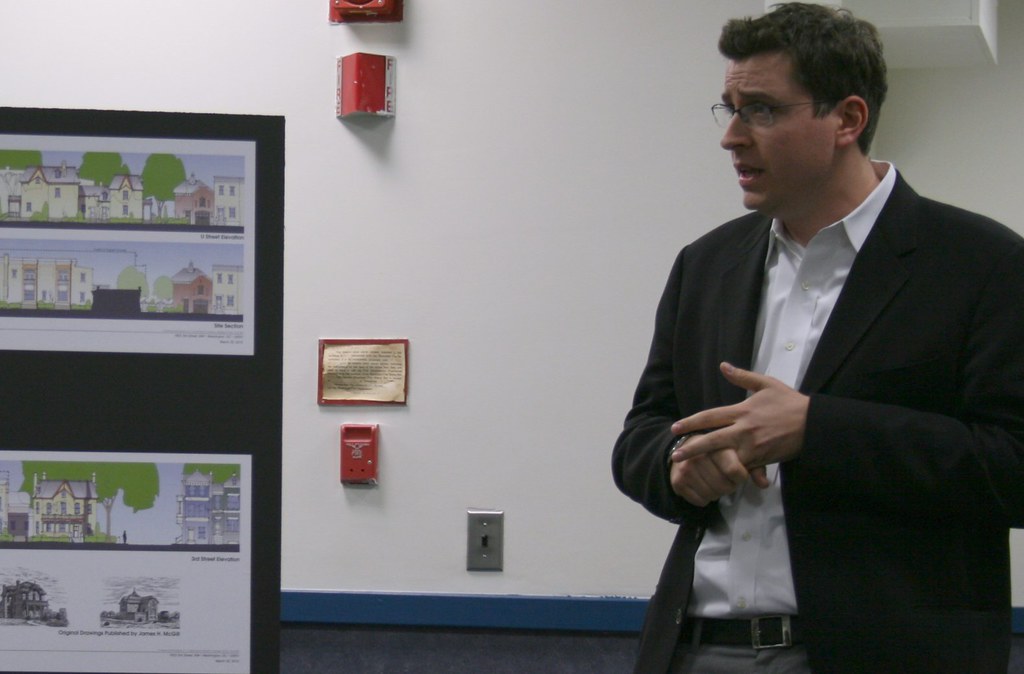
DC development blog DCmud interviewed Grant Epstein, who recently withdrew his proposal for 1922 Third Street NW. Mr. Epstein’s development company focuses primarily on adaptive reuse of historic properties.
One part of the interview caught our eye, as Mr. Epstein confirms what we have long suspected: ornate houses are difficult to build today because it’s harder to find skilled craftsmen to built custom ornaments:
It’s amazing the amount of craftsmanship that went into these houses on [Capitol Hill]. Detail that it’s very hard to replicate today. So the old townhouses, they inspire me. We’ve lost a lot in our new buildings, in the construction of them. It primarily has to do with the number of pieces that go into a house. There aren’t many craftsmen that know how to do the details.
….
[T]he people don’t exist anymore… the trades don’t exist. For instance, iron staircases. Two or three guys in the area do iron staircases the right way. Two or three guys! Back in the early 1900s there were forty! It’s a big difference. At M Street we found the iron treads from an old turn of the century house and recast the iron posts in order to use the same style that was supposed to be there, but was missing. There were only a couple of guys who knew how to do that.
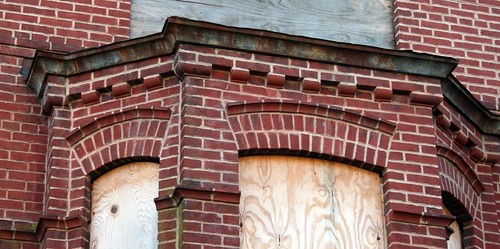
While walking around LeDroit Park, we frequently notice detailed architectural ornaments that never adorn contemporary buildings. How many bricklayers today have the experience and skill to lay bricks as was done at the Mary Church Terrell house when it was built?
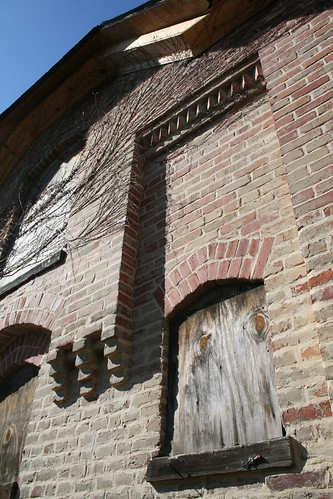
And how many bricklayers have the experience to construct a façade like this one on the McGill carriagehouse at 1922 Third Street?
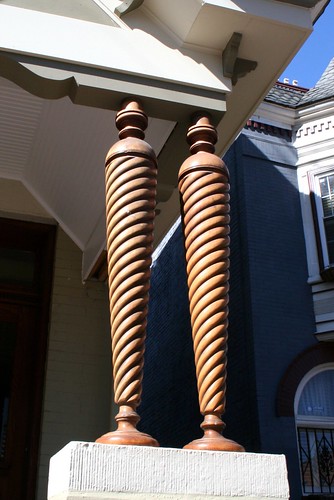
The owners of this house on Third Street told me how impossible it was to find somebody to replicate these columns:
Rarely will you find anything like the gingerbread on the Anna J. Cooper house:
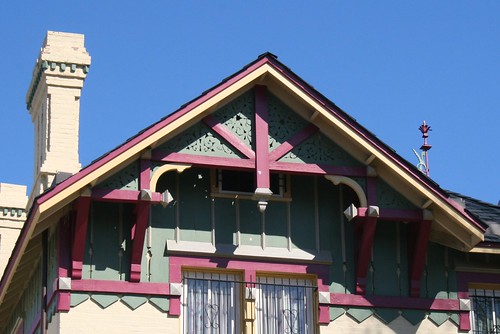
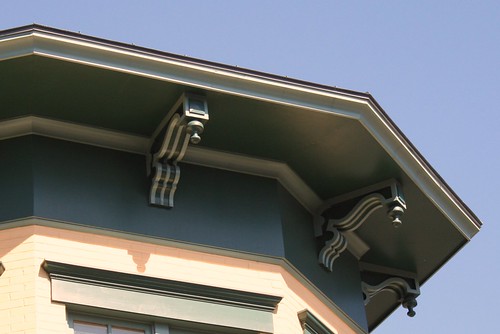
Brackets like these require a good amount of craftsmanship to carve and paint:
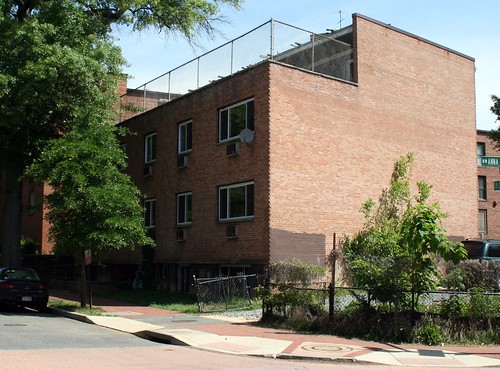
Contrast these houses with the vacant apartment house at 1907 Third Street NW:
Heritage Trail for LeDroit Park and Bloomingdale
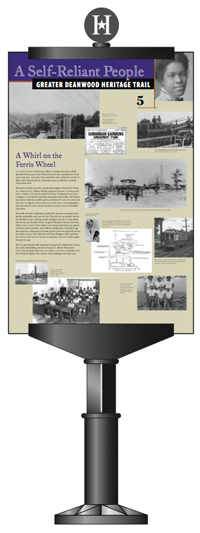
You’ve seen them around DC. Those tall signs with historic photos and narratives explaining what happened in that neighborhood 70 or 200 years ago. Several neighborhoods in DC have heritage trails, courtesy of Cultural Tourism DC.
We in LeDroit Park and Bloomingdale are on our way to getting our very own heritage trail, but the LeDroit Park-Bloomingdale Heritage Trail Working Group needs your help.
The Working Group will meet on Wednesday, May 12 at 7 pm at St. George’s Episcopal Church (Second & U Streets) to collect stories, old photos, and to plan how to interview our neighborhoods’ long-time residents.
Do you have an old photo or an old story to tell or are you interested in local history? LeDroit Park has hosted many notable residents from Civil War generals, to Duke Ellington, to Walter Washington, and even Jesse Jackson!
Come join us Wednesday night and learn how you can help.
Wednesday, May 12
7 pm
St. George’s Episcopal Church
Second & U Streets NW
Casino Conviction
Last summer reports surfaced of a gambling house on Fourth Fourth Street between Elm Street an Oakdale Place. After a months-long investigation, the MPD finally swooped in and arrested two residents of the house in late January. After the arrest the MPD informed the neighborhood that they also found sound-proofing material attached the interior walls to reduce the noise emanating from the house. Whether this was out of respect for the neighbors or fear of getting caught, one cannot know.
Last month the police and U.S. Attorney obtained a conviction and Lt. Alberto Jova informs us that an eviction is also pending.







Recent Comments