
Meet your neighbors tonight at Nellie’s
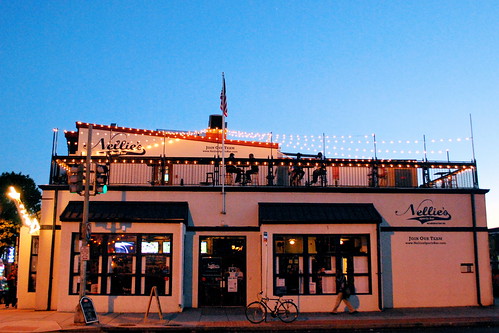
Photo by M.V. Jantzen on Flickr
Come for drinks, appetizers, and chat with your neighbors tonight from 6 to 8 at Nellie’s (9th & U Streets NW). The LeDroit Park Civic Association has started organizing monthly happy hours at Nellie’s, whose owner, a LeDroit resident, has kindly donated appetizers and space at the upstairs bar.
The civic association has reached out via Twitter to residents in Bloomingdale and Shaw to join us.
“LE DROIT PARK. What Three Years Have Done.”
We came across this 1876 article documenting the initial improvements to the nascent LeDroit Park.
LE DROIT PARK. What Three Years Have Done.
National Republican
September 4, 1876Mr. James H. McGill, architect, has forwarded to the inspector of buildings, Mr. Thos. M. Plowman, a communication, in which he furnishes interesting information in relation to the improvements made in LeDroit Park within the last two years. He states that the different tracts of land composing the park were purchased at different times from June, 1872, to March, 1873, by Messrs. A.L. Barber & Co., and united by these gentlemen into one tract, which has been carefully surveyed and recorded. This park is in the form of an equilateral triangle, with one side resting on Boundary street [now Florida Avenue] and reaching from Seventh street eastward to Second street, and contains fifty acres. Until its subdivision by the present proprietor the eastern tract had been used for private residences and grounds, and the western portion had laid uninclosed for several years, and had been used as a public common. Improvements were soon commenced on a liberal scale; a handsome pattern of combination wood and iron fence was adopted and built all along the entire front and a board fence all along the rear, making one inclosure. All the interior fences were removed, and the lots thrown in together, affording a continuous sward. Streets were graded, graveled and guttered, brick sidewalks were put down, and gas, water and sewer mains laid.
The erection of buildings was commenced in July, 1873, since which time eight large brick residences have been erected on the north side of Maple avenue [now T Street] and two on the south side, costing from $4,000 to $12,000 each; ten houses on the north side and ten on the south side of Spruce street [now U Street], at an average cost of $3,500; two houses on the north side of Elm street, costing $3,000 each; four houses on east side, and five on the west side of Harewood avenue [now 3rd Street],costing from $4,000 to $10,000 each. A very superior stable and carriage-house has been completed for A. Langdon, esq., and another is in course of erection for A. R. Appleton, esq. Up to this date forty-one superior residences and two handsome stables have been constructed, at a cost of about $200,000. These houses are either built separately or in couples; are nearly all of brick; of varied designs, no two being alike either in size, shape or style of finish, or in the color of exterior. About $4,000 has been expended in the purchase and planting of ornamental shade trees and hedges, and about $50,000 in street improvements. About 4,500 lineal feet of streets have been graded and graveled, 9,000 feet of stone and brick gutters laid, 5,000 feet of brick pavement, 4,000 feet of sewer mains, 3,550 feet of water mains and 3,800 feet of gas mains laid. All of this expense has been by the proprietors of the property without a dollar from the District or authorities, and all the work has been done in the best and most liberal manner, under the direction of Mr. McGill. The plan contemplates the finishing of all its streets and the erection of two hundred tastefully-designed, conveniently-arranged and well-built detached and semi-detached residences, and when completed cannot fail of being a credit to all concerned. During the time stated the value of improvements constructed in other portions of the county amount to upwards of $100,000.
Census data for LeDroit Park
In preparation for redistricting Ward 1’s ANCs, the DC Office of Planning has released block-by-block demographic data for the District. We have combined the data for the blocks that comprise LeDroit Park to create a LeDroit Park census.
Analyzing U.S. Census data for LeDroit Park proves difficult because the of the way census tracts are drawn. Our census tract, 34, combines LeDroit Park and Howard University. Dorms on the northern end of the campus, far away from LeDroit Park, account for 717 of the tract’s 4,347 residents, thus skewing tract data. Furthermore, the tract also inclues several blocks bounded by Rhode Island Avenue NW, Florida Avenue NW, and 2nd Street NW.
Fortunately, the Census Bureau provides data for each block, allowing us to combine the statistics for those blocks in LeDroit Park, while excluding the Howard University campus. In the map below, we have outlined the tract in blue and shaded the blocks for LeDroit Park in red.
View LeDroit Park Census in a larger map
Though LeDroit Park started out as an exclusively white suburban neighborhood, by 1910 the neighborhood was almost entirely black. Today, 100 years later, the neighborhood is 70% black and is continuing to diversify.
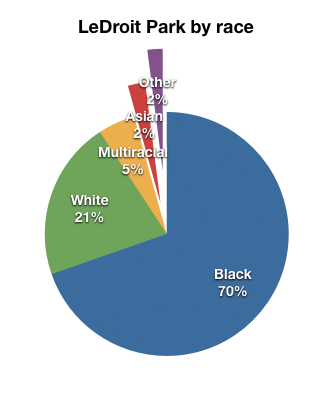
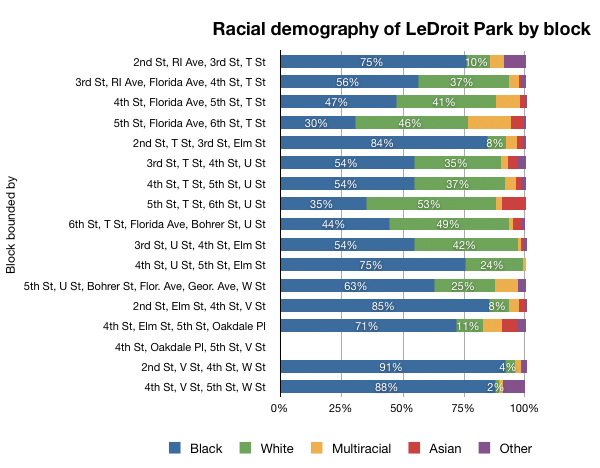
However, when looking at the numbers on a block-by-block basis, you see that the neighborhood demography, must like that of the District itself, is unevenly distributed.
The block bounded by 5th Street, T Street, 6th Street, and U Street is 53% white, the highest in the neighborhood. Likewise, the block containing the Kelly Miller public housing is 91% black, the highest percentage in the neighborhood. The block containing the arch and the Florida Avenue Baptist Church comes closest to black-white equilibrium at 44% and 49% for each group respectively.
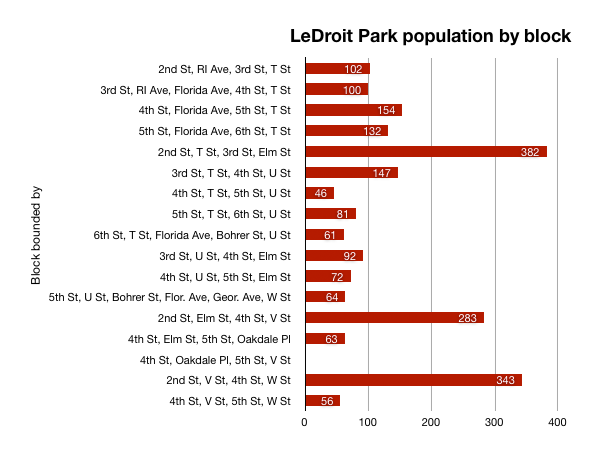
When looking at total population numbers for each block, you see that the two most populous blocks contain Howard University dorms. The block bounded by 2nd Street, T Street, 3rd Street, and Elm Street has 382 residents and contains Slowe Hall, which houses 299 students.
The second most populous block contains the new park. However, it also contains Carver Hall, which itself houses 173 students. Certainly these blocks are big, but the fact that their population numbers are off the chart has more to do with student dorms than with any inherent difference in housing density.
Finally, when we look at housing vacancy, we see that the block bounded by 5th Street, T Street, 6th Street and U Street has 38% of its housing units vacant. We’re not sure what’s causing this number, but we suspect that the apartment building at 5th and U Streets NW boosted the vacancy rate. The building has since been finished and is fully rented.
The block with the second-highest rate of vacancy contains the now-renovated Ledroit Place condo building at 1907 3rd Street NW.
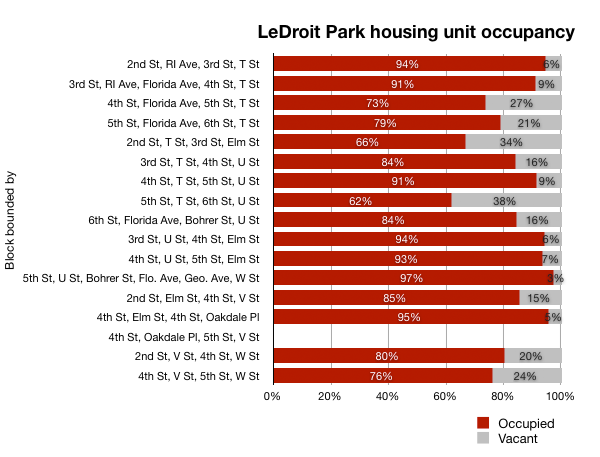
It would be interesting too look at other data, including household income, car ownership, and age distribution for the neighborhood. However, the Office of Planning’s spreadsheet only covered population numbers, racial distribution, and housing unit numbers, so those are the metrics we graphed.
Liquor violation keeps Shaw’s Tavern dry
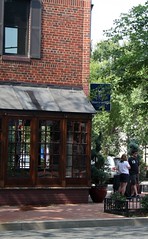 The much-anticipated Shaw’s Tavern at Florida Avenue and 6th Street finally opened on Friday, July 29. The restaurant, whose food neighbors have praised, is not serving alcohol, due to the fact they likely violated the District liquor laws before they even opened.
The City Paper reports that the restaurant, before it opened, hosted a private fundraiser for a local charity. The Alcoholic Beverage Regulation Administration (ABRA), which enforces the city’s liquor laws, accuses the restaurant of serving alcohol without a license during the event. Restaurants, bars, and other places of public accommodations, must have licenses to serve alcohol.
The restaurant contends that because it had not yet opened to the public, it was not “operating” and thus logically could not operate without a license.
Whatever the case, we hope Shaw’s will obtain its license soon. The culinary photos they post on Facebook would look even more delicious if paired with wine or beer.
While we welcome new restaurants to the area and appreciate the owners’ pricey investment renovating the property, it is important to uphold the rule of law and not excuse violations. Certainly any punishment should fit the severity of the crime, but to excuse some businesses while punishing others for the same violation is unfair.
McMillan Site gets video tribute
Bloomingdale resident Snorre Wik has produced this video of the shuttered McMillan Sand Filtration Site.
Several months ago the city decided to reset development plans for the site and do part of the preliminary traffic and groundwater studies itself. We will keep you posted as development plans for the site inch along.
Howard faces dilemma with mixed-use development

An earlier rendering of HTC. Source: DMPED
Plans for Howard University’s proposed mixed-use development project, Howard Town Center, have been dragging on for years. The university is making the tough call to hold out for the ideal project rather than build what it can in this investment climate.
Troy Stovall, Howard University’s chief operating officer, revealed Thursday that the difficulty in financing the project is not due to the retail and supermarket component, but due to the number of apartments slated for the site.
Rather than letting the developer proceed with building the garage, supermarket, retail shops and half the number of apartments originally planned, Howard wants the full project, including all of the apartments built into project at the same time.
When asked on the status of the retail component, Mr. Stovall said that the developer has received several letters of intent from supermarkets interested in the space. The problem, though, lies upstairs. The banks, Mr. Stovall stated, are less convinced about the financial viability of building so many apartments on lower Georgia Avenue.
U street developer JBG, however, has recently purchased several properties within a few blocks of the Howard Town Center site. JBG and Howard’s banks clearly differ in confidence in the area’s potential.
Is Howard letting the perfect become the enemy of the good? Neighbors appear to strongly support the arrival of a supermarket, especially since the closest one, a mile away, offers a paltry selection.
However, to abide by the banks’ requirements to reduce the number of units reduces the viability of the area’s retail revitalization. More residents, after all, means more potential customers, and thus more chances for success along Georgia Avenue.
It’s certainly debatable as to whether the delay in the arrival of a grocery store is worth the slowing of Georgia Avenue’s revival. One the one hand, Howard’s desire for delayed gratification will make the avenue’s retail revitalization more durable. On the other hand, holding out for the ideal project postpones a catalyst for the avenue’s revival.
Ben Taylor chronicles U Street
We’ve been really busy lately and we have a big post reviewing Howard University’s campus plan in the works.
In the meantime, have a look at this Post video of Ben Taylor, a U Street photographer.
Opposition to taxi medallions mounts
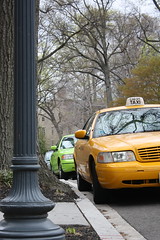 On Thursday, July 7, ANC 1B will discuss and likely adopt a resolution (appended below) opposing the proposed taxi medallion system recently proposed by several councilmembers. The medallion bill, written by lobbyist John Ray at the behest of some of the city’s big taxi magnates, seeks to halve the number of taxis in the city.
The issue came up in the ANC because many independent taxi owners live in the Pleasant Plains neighborhood and view the bill as a means by big taxi companies to force them out of the business.
The ANC 1B Transportation Committee held its inaugural meeting to discuss the bill and how it would impact taxi service for drivers and for passengers, i.e. the public.
Commissioner Tony Norman (ANC 1B10 – Pleasant Plains) proposed the committee adopt his draft resolution opposing the bill. Mr. Ray, the bill’s chief lobbyist, was invited to attend but did not.
The Transportation Committee did, however, agree that the industry needs reform, but that this particular medallion bill is fundamentally flawed to the degree that it will harm the public. The committee agreed to add to the resolution a clause expressing the need for meaningful taxi reform.
Radio reporter Pete Tucker, who hosts a radio show on taxi issues, recorded much of the meeting and aired select quotations on the June 19 episode of his program.
(Mr. Tucker himself became news at the DC Taxicab Commission meeting the week after the Transportation Committee meeting. The U.S. Park Police, at the behest of the commission’s Chairwoman Dena C. Reed, arrested Mr. Tucker and other journalists for recording at the commission’s June 22 hearing.)
* * *
Left for LeDroit sees the bill as a wolf in sheep’s clothing, conflating real taxi reform with a severe reduction in the number of taxis. The bill places costly barriers to entry for independent cab drivers and will likely lead to one or two cab companies holding all of the medallions.
Real reform includes mandating and enforcing a minimum quality of service. This means ensuring the cabs are clean and air conditioned and that they accept credit cards. Furthermore, the city should consider GPS tracking to alert customers with smartphones as to the availability of nearby taxis. Furthermore, a centralized dispatching system should aid consumers looking to schedule a trip.
Medallions, however, are a deliberate attempt to limit competition. This is ultimately bad for the public. After New York, Washington is the easiest American city in which to hail a cab and the ability to do so aids our quality of life and increases our diversity of practical transportation options.
* * *
Here is the resolution the committee adopted and which the ANC will discuss on July 7:
WHEREAS: The Council for District of Columbia is contemplating an overhaul of the taxicab system by proposing a medallion system for taxicabs in the District of Columbia; and
WHEREAS: There is a clear and present need for the Mayor of the District of Columbia and the Council for the District of Columbia to review and propose objective reforms in the present taxicab system, in terms of taxicabs being modernized, i.e. energy efficient, gps, air conditioning, credit cards and drivers knowledge of best routes; and
WHEREAS: The present number of taxicabs in the District of Columbia is over 9,000, the proposed medallion system would place an arbitrary cap on the number of taxicabs at 4,000, this restricts the supply and creates barriers to competition; and
WHEREAS: The District of Columbia Chief Financial Officer’s Office studied in 2010 how the taxicab medallion system worked in other major cities and the study concluded that the system would result in windfall profits for a small group of people; an overall decline in service with longer waits and higher fares, create a system more amenable to corruption in the District of Columbia; and
WHEREAS: The substantial reduction of taxicab in the District of Columbia will have a negative effect on residents, in terms of the quality and quantity service, particularly in underserved low income areas, whom will have longer waits and face more service refusals; and
WHEREAS: The substantial reduction of taxicab in the District of Columbia will also have a negative effect on businesses: particularly small businesses, hotels, bars, night clubs and restaurants, as it related to customers quality and quantity of service, in terms of longer waits for an available taxicab; and
WHEREAS: The present proposals would result in loss of opportunity for would be entrepreneurs, most of whom would be low-income and/or minorities; and
WHEREAS: Over 900 hundred independent taxicab drivers (so far) have signed a petition to oppose the arbitrary regulations proposed to reform the taxicab industry;
NOW, THEREFORE BE IT RESOLVED, That ADVISORY NEIGHBORHOOD COMMISSION 1B requests that the Mayor of the District of Columbia and the Council for the District of Columbia reject the taxicab medallion system and adopt the findings of the District of Columbia Chief Financial Officer.
BE IT FURTHER RESOLVED, That ADVISORY NEIGHBORHOOD COMMISSION 1B requests that the Mayor of the District of Columbia and the Council for the District of Columbia review and propose objective reforms in the present taxicab system, in terms of taxicabs being modernized, i.e. energy efficient, gps, air conditioning, credit cards and drivers knowledge of best route.
Neighborhood meeting Tuesday
Mark your calendars. The LeDroit Park Civic Association’s final meeting before the summer recess is Tuesday at 7pm at the Florida Avenue Baptist Church (enter at the rear on U St).
This month’s agenda:
- Ward 1 School Board member Patrick Mara
- Representatives from Metro. Police and Fire to discuss safety/crime
- A discussion on the Howard University project, and how it will benefit our neighborhood
- A discussion about the living conditions at Kelly Miller and our call for action to DCHA
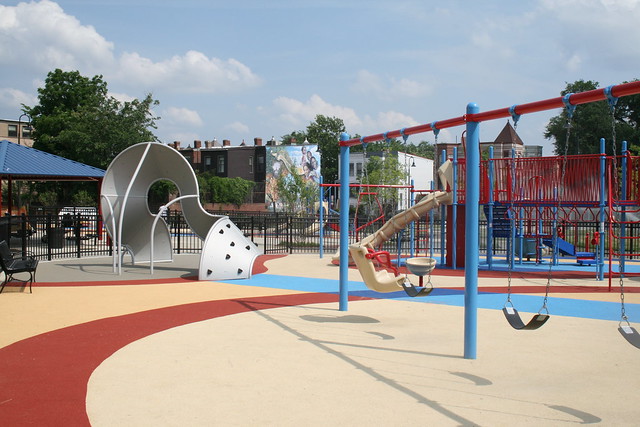
- An update on the new Park
Our park’s rain garden helps to save the river
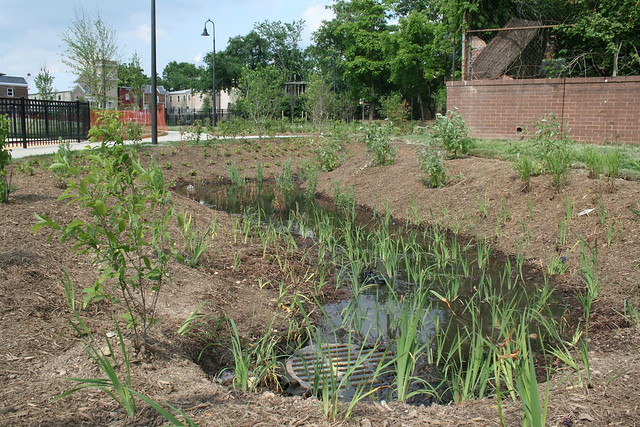
While strolling around our new park, you might have noticed this landscaped depression near the mural.
This is a rain garden. The storm drains within the park empty into this garden so the ground has an opportunity to absorb rainwater. Obviously there’s a limit to what the ground can absorb in a downpour, so the grate at the bottom of the photo carries the overflow into the sewers.
Under each street in areas of the city built before 1900 is a single pipe that carries both sewage and storm water. The problem with this combined system is that heavy rain storms force the combined system to overflow at 53 discharge points into Rock Creek, the Potomac, and the Anacostia.
Building these rain gardens helps alleviate the pressure on the sewer system during storms and thus helps protect the water quality of our rivers.








Recent Comments