
Bikeshare expansion passes over LeDroit Park
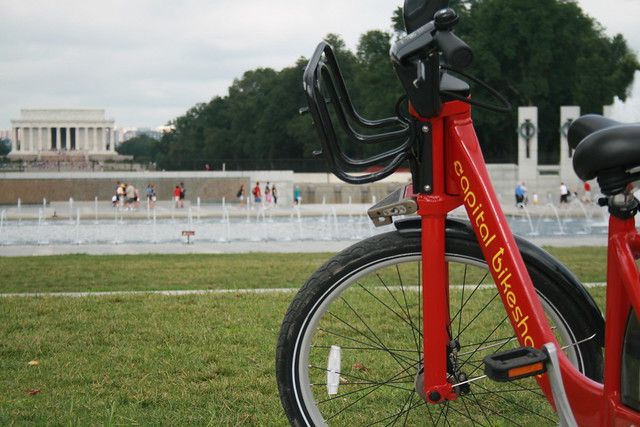
Capital Bikeshare, the District’s smashingly successful bikesharing system, will expand this fall. Unfortunately, the expansion plans for this fall exclude LeDroit Park.
The District and Arlington launched the system a year ago with 14 stations in Arlington and 100 in the District. This fall, DDOT will add 34 stations in the District. In our area, DDOT will add a station by the Shaw Library and another at 1st Street NW and Rhode Island Avenue NW in Bloomingdale.
These additions should help alleviate the pressure placed on the existing stations at 7th & T Streets NW in Shaw and at Florida Avenue and R Street NW in Bloomingdale. Currently, LeDroiters and Bloomingdalers compete to use these two stations and thus frequently leave the stations empty or full during rushhour.
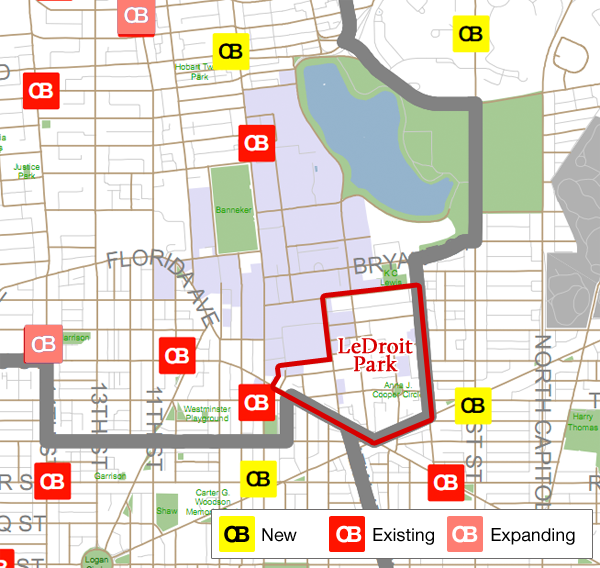
Last week DDOT Director Terry Bellamy announced that the district will add 50 stations early next year. We hope that in this new round DDOT focuses more attention on LeDroit Park and other neighborhoods in ANC 1B.
For instance, a Capital Bikeshare station could easily go in at the Park at LeDroit’s south entrance at 3rd and Elm Streets NW. This location is central to the neighborhood and could bring some extra eyes to the park throughout the day.
Outside of LeDroit Park, there is a noticeable station gap in the northern reaches of Bloomingdale and around Cardozo High School.
Capital Bikeshare is particuarly successful in our part of DC for several reasons:
- Car ownership is relatively low compared to the rest of the nation, region, and city. This inclines people to bike more.
- Parking is particularly difficult on many neighborhood streets, thus making cycling more attractive.
- The historical development of this area has permitted the close proximity of commercial uses to residential uses. This means trips to shops and restaurants are short and easily made by bike.
- Downtown is a short ride away and biking is often faster than taking the bus.
Street names changed in 1890

Two years ago we wrote about the old street names for LeDroit Park. Finding out just when the name change occurred is hard to pin down. Different sources, from address directories to newspaper articles, refer to old names and new names during the same period of time.
The mystery is closer to resolution, however, as we found what we believe to be the earliest reference to the name change:
New Names for Le Droit Park Streets.
Washington Post
July 31, 1890The names of the streets in Le Droit Park have been changed as follows: Le Droit Park avenue to Second street, Harewood avenue to Third street, Linden street to Fourth street, Larch street to Fifth street, Juniper street to Sixth street, and Maple avenue to T street.
There appears to be an error in the article as ‘Le Droit avenue’ never actually had ‘Park’ in its name.
Before the park, before the school, there were apartments

The Park at LeDroit was built on the site of the Gage-Eckington School. The school, built in the 1970s, was itself built over streets, houses and apartment buildings.
At the time, 3rd Street extended north of Elm Street and dead-ended just before reaching V Street. Oakdale Place extended eastward from its current terminus at the park to dead-end at what is now the eastern boundary of the park.
Two apartment buildings on the site, the Linden and the Harewood were named after local streets. Before the city changed the neighborhood’s street names, 3rd Street was Harewood Avenue and 4th Street was Linden Street.
We found this 1901 description of the apartments. What’s most notable is that the apartments are marketed to black Washingtonians and thus reflects the neighborhood’s turn-of-the-century transition from a white neighborhood to a black neighborhood.
THE LINDEN AND HAREWOOD FLATS
Le Droit Park—Corner of Harewood and Oak Streets.
The Colored American
January 5, 1901Mr. Banes the the real estate dealer has erected two of the most modern flats in Washington situated in Le Droit Park. The situation of these flats is an ideal one, on Third street, two doors from the Fourt street car line. The finish of the flats is elegant, and they have a preposessing appearance. They are three stories high, and each floor has three flats of four rooms each and bath. The whole flat is heated by steam, thus saving the necessary expense of buying fuel. Each flat has a parlor, dinning [sic] room, bed room, kitchen, and bath room and private hall rooms, and halls are heated by steam. The kitchens have a modern gas range, hot and cold water, cupboards, pantry attachment. These flats are no doubt, the best in the city. Persons having a large family can easily rent two adjoining flats saving the enormous rent of an entire house. They are thoroughly and artistically finished. The walls are papered and frescoed, and glasses of a large size, supported by a modern mantel piece are in each parlor. Le Droit Park has become a pleasant part of Washington in which to reside and these beautiful flats are a happy addition to the residences there. Mr. Banes has spared no pains in making these flats comfortable and inviting and already applications are being made for retals thereof. Colored people with first class reference who desire a beautiful part of the city in which to live, and at the same time occupy comfortable and improved apartments without renting a whole house, and paying high rent, can find a happy medium in these flats. The terms are easy. The buildings are open daily for inspection. For further information call at the office of Mr. Charles E. Banes, corner of 14th and G sts. n. w.
Council officially names park
It’s official. At its legislative session on Tuesday, the DC Council officially named our new park the Park at LeDroit.
Here is a short video of the bill’s passage:
LeDroit Park is the home of poets
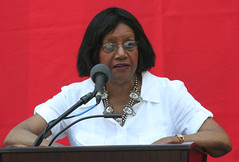
Dolores Kendrick. Photo by dbking on Flickr.
Paul Laurence Dunbar isn’t the only poet to have graced our neighborhood. Dolores Kendrick is DC’s poet laureate and, as the Post reports, grew up in LeDroit Park in the 1930s.
Kedrick has authored four books, including “Why the Woman is Singing on the Corner: A Verse Narrative”, a 2001 work that takes place here in DC. Kendrick has an Anisfield-Wolf Book Award and National Endowment for the Arts fellowship under her belt.
In the Post article Kendrick reflects on the changes she has seen in Washington:
I suppose the Washington that exists today had to come. The old Washington was segregationist and racist to the point where we couldn’t go downtown to get a hot dog. Our parents would fix us meals before we left so we would not have to endure that indignity. . . . But integration also brought its own problems. The black community somewhat disintegrated, and the seasons changed. It is a very different time, now.
Kendrick will speak at 1 pm on Sunday at the National Book Festival.
What Anna Cooper Circle looked like 100 years ago
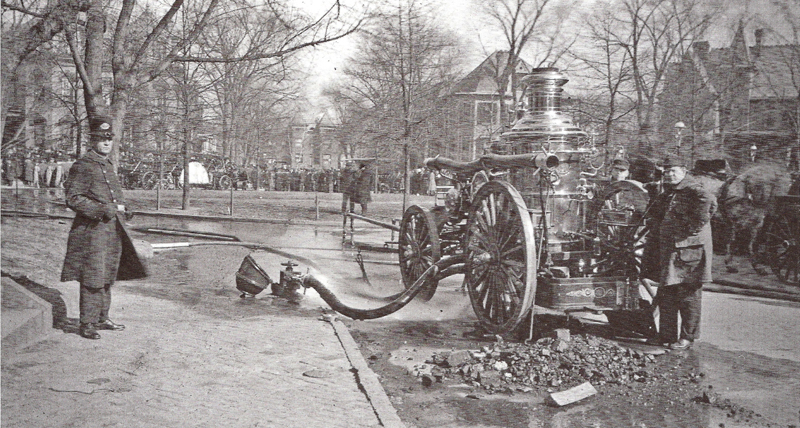
This photo, taken around 1910, shows the fire brigade on T Street just west of Anna J. Cooper Circle. The circle’s landscaping was much sparser then than it is today, but you will also notice that this was taken before the city altered 3rd Street to bisect the circle for several decades.
One will also notice the now-razed McGill house on the right side of the photo. That lot now hosts the rectangular brick apartment building that clearly never faced historic preservation review.
We haven’t been able to find any news stories explaining what exactly happened the day of the photo.
How do you pronounce ‘LeDroit’?
 We have studied the neighborhood’s name before, noting that ‘Le Droit’ evolved to ‘LeDroit’. But wait, there’s more! The neighborhood’s pronunciation is still debated today.
This became clear during the DC Council’s debate on the formal naming of our park when the two pronunciations emerged on the dias and on Twitter. Is it pronounced LEE-droyt and luh-DROYT?
Many residents and Councilmember Graham (D – Ward 1) pronounce it LEE-droyt. Other residents, this writer included, pronounce it luh-DROYT. A friend on Twitter jokingly asked, “Does anybody pronounce it Luh-Dwah, like a Frenchman?”
Ultimately how you pronounce it doesn’t matter, but we suspect Frenching it up as luh-DWAH might take it over the top.
Get a free historic tour of LeDroit Park
If you’re interested in the history of LeDroit Park and would like a free history walking tour, you’re in luck!
As part of the biannual WalkingTown DC, your favorite LeDroit blogger will host four free walking tours of the neighborhood.
- Saturday, September 24, 9 – 10:30 am
- Sunday, September 25, 9 – 10:30 am
- Saturday, October 1, 9 – 10:30 am
- Sunday, October 2, 9 – 10:30 am
Worthy Ambition: LeDroit Park/Bloomingdale Heritage Trail Preview (LeDroit Park Only)
Meet and end at the arch at Florida Ave. and T St., NW.Explore the unique architecture and historical figures of LeDroit Park durning this specail preveiw of the Cultural Tourism DC’s LeDroit Park/Bloomingdale Heritage Trail, which is currently in development. The neighborhood was developed in 1873 as an exclusive white suburban enclave just beyond the boundaries of the original city. Learn about the neighborhood’s transition in the early 19th century to home of Washington’s black intelligentsia. Neighborhood notables included Dr. Anna J. Cooper, Mayor Walter Washington, Sen. Edward Brooke, Rep. Oscar De Priest, Paul Laurence Dunbar, Mary Church Terrell, Duke Ellington, and Rev. Jesse Jackson, among others. See unique 19th-century houses built in the Second Empire, Gothic Revival, and Italianate styles. Many of these original house designs appear nowhere else in Washington.
Presented by Left for LeDroit and led by LeDroit resident, blogger, and Cultural Tourism DC’s LeDroit Park/Bloomingdale Heritage Trail working group member Eric Fidler.
WalkingTown DC will have free tours citywide.
Howard a cappella groups sings on NBC
We Love DC alerted us to Afro Blue, an a cappella group at Howard University, that recently competed on NBC’s The Sing Off.
Afro Blue sang Corinne Bailey Ray’s 2006 song “Put Your Records On“:
Get a rare glimpse of the McMillan Sand Filtration Site
This weekend we got a rare tour of the dormant McMillan Sand Filtration Site just north of Bloomingdale.
The site sits behind locked fences between North Capitol Street, Channing Street NW, 1st Street NW, and Michigan Avenue NW. The filtration site opened in 1905 to purify river water supplied to a burgeoning capital.
The filtration plant contains 25 acres of underground sand filtration cells. Water flows from the “castle” on McArthur Boulevard NW at the Georgetown Reservoir through an arrow-straight tunnel to the valve house on 4th Street at the McMillan Reservoir.
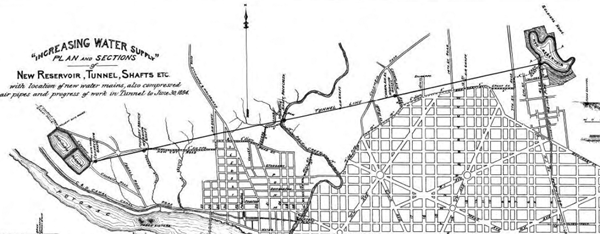
Diagram of the Washington City Tunnel, U.S. Army Corps of Engineers
The reservoir opened in 1902 and is actually a dammed stream valley. Since the reservoir stores untreated river water, the water must be cleaned before it can be distributed to residents’ taps.
At the turn of the 20th century, a debate ensued between proponents of chemical purification and slow sand filtration. Slow sand filtration won the debate and Congress provided money to build the sand filtration cells.
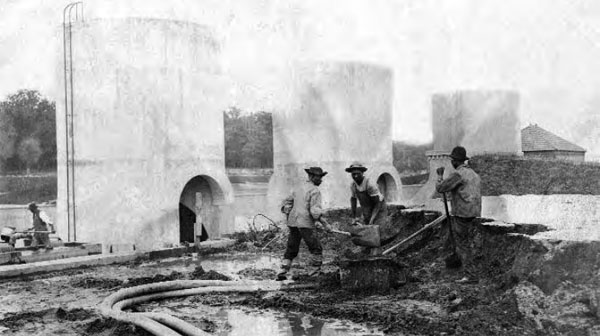
McMillan Sand Filtration Site under construction. Source: U.S. Army Corps of Engineers
The process of slow sand filtration is pretty simple. Water fills a cell that contains 2 feet of sand at the bottom— it’s like an underground beach.
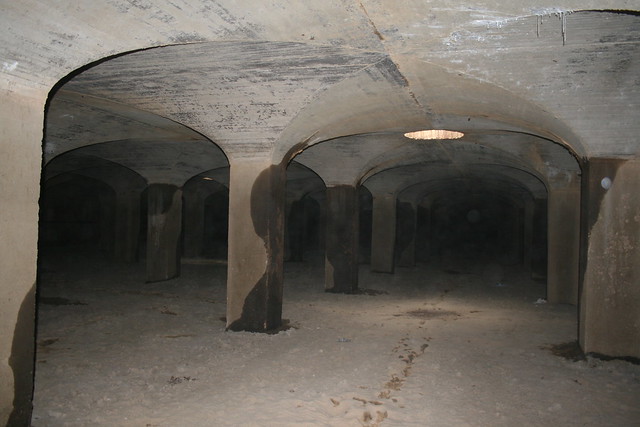
The water percolates through the sand leaving contaminants behind in the sand. When the water reaches the floor under the sand, it exits the cell and is distributed into the city’s water pipes.
The sand itself required routine cleaning to remove the contiminants. Clean sand was stored in the concrete silos that stand in rows on the site.
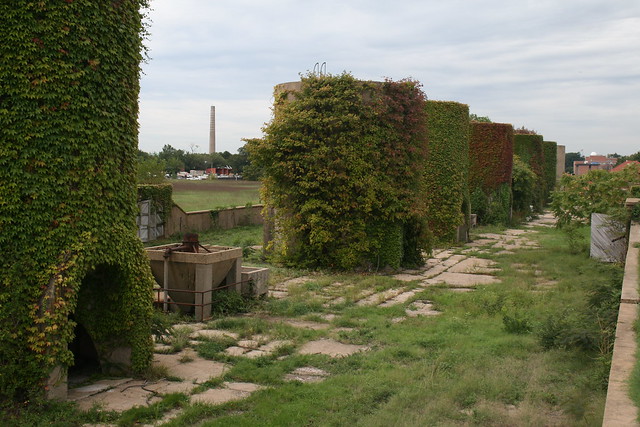
Workers replenished the cells by dumping clean sand through the various access holes on the roof of each cell.
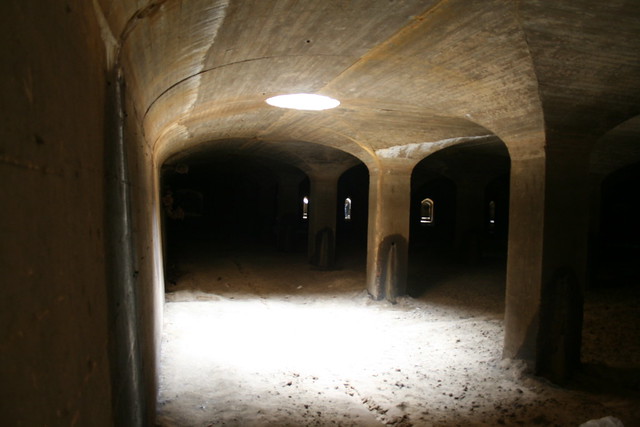
In fact, an early photo shows fresh sand dumped into a cell.
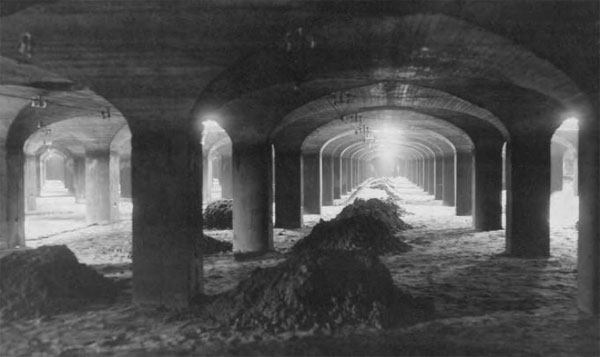
Source: U.S. Army Corps of Engineers
Regulator houses contained valves for regulating the flow of water through each cell.
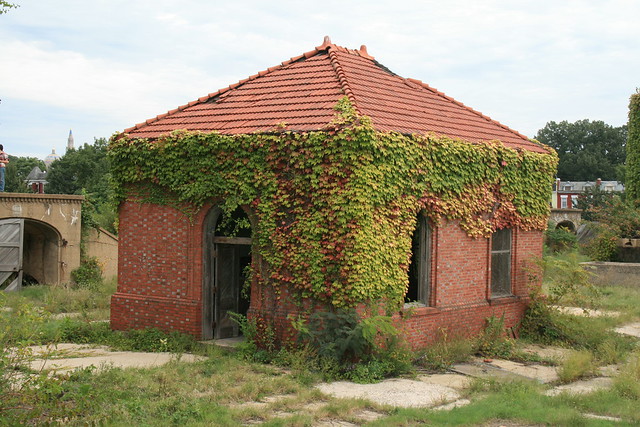
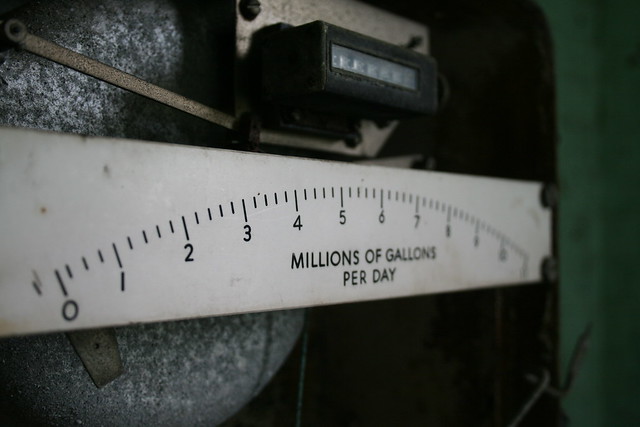
The top of the filtration site was turned into a park, as envisioned by Sen. James McMillan (R – Michigan), famous for his ambitious McMillan Plan to beautify Washington.
 Frederick Law Olmsted, Jr., designed the park grounds on top of the sand filtration cells. Since the park closed to public access during World War II, the park’s recreational features, including green lawns, park lamps, walkways, and staircases, sit decaying today.
In the 1980s, the U.S. Army Corps of Engineers build a rapid sand filter on the part of the reservoir west of 1st Street NW, thus obviating the need for the slow sand filters east of 1st Street. The western section today holds the active open-air reservoir and rapid sand filters that supply clean water to much of Washington.
That section, which is still an active reservoir and water treatment plant, is closed to the public. What’s most unfortunate is that the western section contains the most notable feature of the reservoir park.
Shortly after Sen. McMillan’s death, Congress and donors in his home state of Michigan decided to honor the senator with an ornate fountain to adorn the park that bears his name.
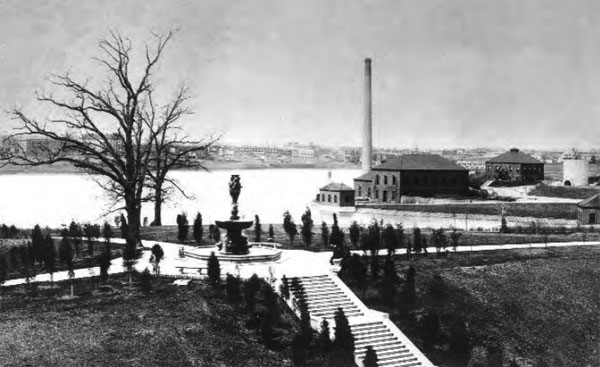
Source: U.S. Army Corps of Engineers
The 1912 fountain, designed by Herbert Adams, contains a bronze sculpture of 3 nymphs on a pink granite base. In 1941 the fountain was dismantled, left in storage and mostly neglected until the top portion of the fountain was returned to Crispus Attucks Park in 1983. In 1992 the top section was moved to its current location, at the active reservoir site, locked away from public access.
One can still see the top portion of the fountain by glancing through the fence on 1st Street NW.

The base of the fountain remains somewhere in Fort Washington National Park in Prince George’s County. Perhaps someday the District, the federal government, and neighbors can raise the funds to reunite and restore the fountain for public enjoyment.







Recent Comments