
The Lincoln vs. the Howard: What a difference operations make
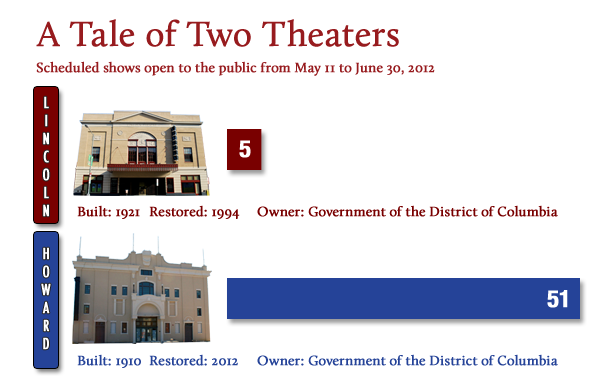
The revival of the Howard Theatre brought worry that our newly revived venue would follow the disappointing path of the Lincoln Theatre on U Street. After all, both theaters were built in the early 20th century, both are owned by the DC government, and both are located within a short walk of each other.
A glance at both theaters’ online schedules reveals that their fates have sharply diverged. From now until the end of June, the Lincoln Theatre has 5 events scheduled while the Howard has 51.
This glaring disparity shows the importance of selecting the right management team. The District chose the experienced Blue Note Entertainment Group to run the Howard while it chose the non-profit U Street Theatre Foundation to run the Lincoln. The mayor’s office rightly revoked U Street Theatre Foundation’s contract for the Lincoln as the theatre was careening toward bankruptcy at the end of 2011. The mayor has tasked the DC Commission on the Arts and Humanities with finding a new operator for the Lincoln.
The greater U Street area is a regional arts venue. The Howard Theatre, the 9:30 Club, U Street Music Hall, the Black Cat, Bohemian Caverns, Twins Jazz Club, and numerous performance-oriented bars provide an amount of live performance space most cities would envy. But when we compare the success of these venues to the fiasco of the Lincoln Theatre, it becomes clear that something is terribly wrong in the District’s stewardship of this resource. If all of these venues can thrive, so can the Lincoln.
Thousands of Bees Occupy a Porch on 3rd Street
WJLA reports that a swarm of 20,000 bees took over the front porch of a home on 3rd Street. An exterminator tried to get ride of the colony, but the bees are back.
The bees have displaced the house’s residents, so the prospect of free honey is insufficient consolation.
A moratorium will stifle new restaurants and lower service
We recently received a petition to oppose a liquor license moratorium for the U Street area. We weren’t sure why the petition came up, but it seems there is yet another movement afoot to establish a liquor license moratorium (and thus a restaurant moratorium) on U Street. The moratorium’s backer is a resident on 13th Street and she proposes the moratorium for all new liquor license applications within a 1,800-foot radius of Ben’s Next Door.
We wrote about this matter two years ago when Jim Graham floated the idea. Nonetheless, it’s worth revisiting why this moratorium is a bad idea:
It makes no distinction between responsible businesses and rowdy businesses.
A moratorium fails to differentiate between businesses that are quiet and cause no trouble for their neighbors, e.g. the Saloon, and those that cause raucous noise late into the night. ANCs and neighbors should protest irresponsible and disruptive businesses, but a moratorium is essentially a permanent, unconditional protest of all proposed restaurants and bars. Many new establishments are started by experienced restaurateurs whose previous businesses exist in harmony with their neighbors.
It’s effectively a restaurant moratorium.
Restaurants make their money on alcohol and relatively little on food. This is why Shaw’s Tavern, when dry, quickly shuttered. Prohibiting the issuance of new liquor licenses will essentially deny new restaurants the ability to earn enough to pay rent. A liquor license moratorium is a restaurant moratorium.
It will reduce customer service.
A moratorium will limit the supply of restaurants and bars even while demand rises. This means restaurant prices will face upward pressure, seating may become scarcer, and service quality will likely fall. The population of the census tract covering the eastern side of the U Street corridor grew by 86% from 2000 to 2010 and will continue to grow as more residential buildings come online. If you think finding a table is hard now, a moratorium will make it worse.
It unfairly “picks winners”.
Placing a legislative cap on new business activity unfairly privileges incumbent businesses. To intervene so severely in the market as to artificially limit consumer choice means that current license holders will enjoy an oligopoly. This increased business, however, will not result from a restaurant’s merit, but will result from the fact that consumers will face limited choices. A business owner’s “merit” will simply be that he had the good luck open shop just before the regulatory door slammed shut behind him.
It’s arbitrary.
There are currently 107 licenses within the proposed moratorium area. There is no definitive proof that the 107 number is too high, too low, or just right. Unfortunately, moratoria disregard nuance and set arbitrary numbers as permanent limits.
Furthermore, it’s arbitrary to propose that the moratorium be based on a perfect circle, that the circle have a 1,800-foot radius, and that the circle be centered on Ben’s Next Door.
It will not resolve the stated problem.
Matters of crime, noise, and trash, which the City Paper reports as the main motivators for the moratorium’s proponent, will not be resolved by a moratorium. Restricting the issuance of alcohol licenses will not reduce crime, will not reduce noise, and will not reduce trash. It will, however, result in longer wait times for table, higher prices, and lower service.
It’s difficult to administer.
Laws should be simple to understand and administer. The proposed moratorium area is a circle and circles are harder to measure on land. In fact, we discovered this problem recently when measuring the distance between a liquor store and Cleveland Elementary School. Do you measure by the edge of the property line or by the edge or the building? Certainly we have the technology today to determine this distance, but it takes time and skill to do it accurately. The technical challenge is a hurdle for business owners and citizens alike to understand the impact of the law. A listing of city blocks would be far easier to decipher and would cause less confusion than a circle.
* * *
Instead of swinging a legal sledgehammer to stop all future restaurants, good and bad, we should judge each application on its own merit. Restaurateurs who have proven records of being good neighbors should by all means receive licenses and less reputable restaurateurs should be denied. We urge you to sign the petition to oppose the moratorium.
Injured driver crashes into Shaw’s Tavern
We got news this morning that a man had been found stabbed on the 500 block of Florida Avenue NW near Shaw’s Tavern. The story turned out to be a bit more complicated. A man driving a BMW crashed into the Florida Avenue side of Shaw’s Tavern early this morning. When police arrived, they found the driver with a stab wound in his neck. He was taken to Howard University Hospital where he later died.
The details are unclear at this point, but the driver may have been stabbed elsewhere and may have been trying to drive himself to the hospital for treatment.
Here’s the Fox 5 news report from early this morning.
This is not the first significant crash near 6th and Florida. In 2006, a drunk driver crashed into 605 Florida Avenue, destroying much of the house’s brick turret.
7th & Florida in ’68, ’88, and today
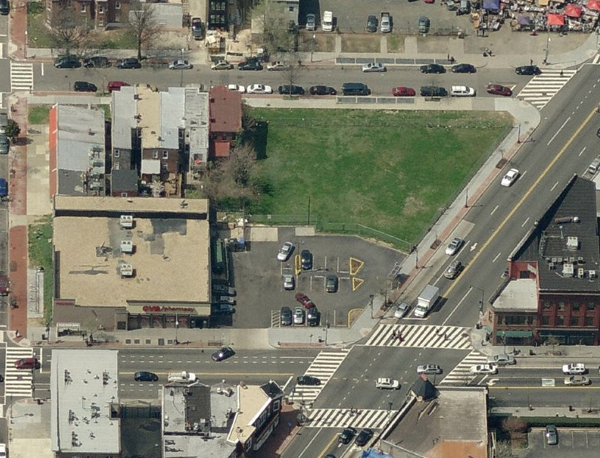
What happened to all the historic buildings at 7th Street, Florida Avenue, and Georgia Avenue? We all recognize the CVS and its adjacent parking lot. As we reported before, the adjacent grassy field is slated for a residential development by JBG, one of the region’s largest development companies.
But how did the CVS, the parking lot, and the grassy field get there in the first place? They are the consequence of the 1968 riots and of the construction of the Green Line tunnels.
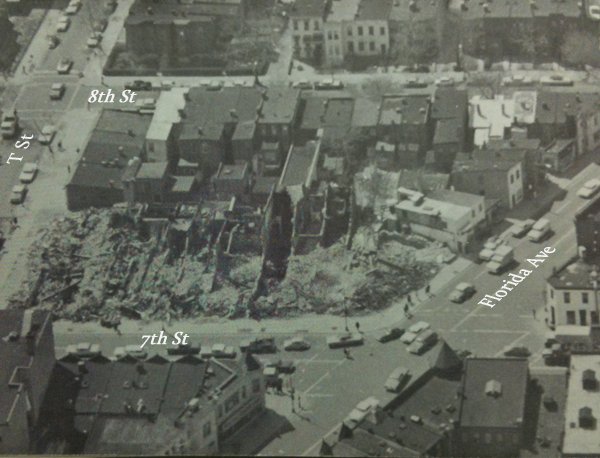
The riots of April 1968 destroyed many of the buildings along 7th Street. A few months ago we came across this photo in a Congressional report published in the wake of the riots. The west side of 7th Street from T Street to Florida Avenue was obliterated:
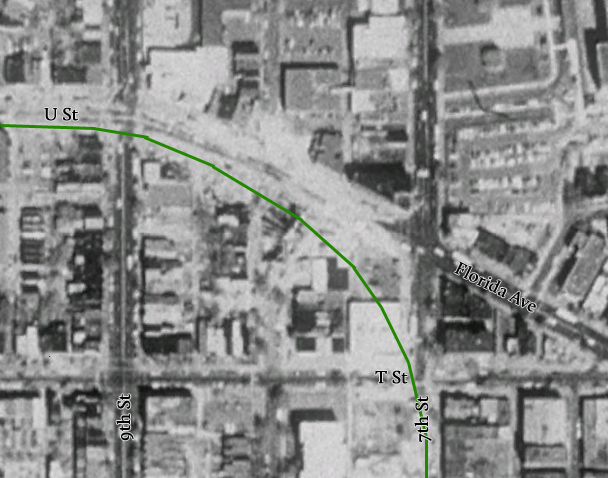
Decades later, the intersection sat at an elbow in the proposed Green Line tunnel. The subway line curves from 7th Street to Florida Avenue and then to U Street. Much of the line was constructed using the cut-and-cover method, which requires razing buildings, digging a trench, building a concrete box in the trench, and covering it back over.
Subway tunnels typically run under existing streets, but sharp changes in direction require cutting corners and thus the creation of tunnels where buildings often stand.
A 1988 photograph shows the construction of the Green Line tunnels, which pass under the CVS and adjacent lots.
What the riots didn’t destroy, the Green Line took care of.
Neighborhood history trail nearly complete
 LeDroit Park and Bloomingdale history buffs need to mark their calendars for Thursday night. The LeDroit Park-Bloomingdale Heritage Trail Working Group will meet to go over updates to the pending bi-neighborhood heritage trail.
You’ve seen these heritage trails elsewhere in Washington. The signs feature historical photographs and explanations of the areas’ historical significance.
At the last meeting we attended, we heard from residents who lived in the neighborhood that stood where the Gage-Eckington School was later built, neighbors who had to walk several extra blocks to school because Washington ran a segregated school system, and neighbors who remember seeing Eleanor Roosevelt visiting what is now Slowe Hall at 3rd and U Streets.
These are the oral histories that Cultural Tourism, which organizes these trails, documents for the historical record and includes in the signs. So much of Washington’s history, nay human history, is committed to memory that if we don’t record it, it risks being lost.
The trail, which is put together by Cultural Tourism DC, is close to completion, but the next few meetings are critical in determining final details and extra stories that may be incorporated. Even if you don’t have stories or original research to contribute, attending the meeting solely to listen will be worthwhile.
Thursday, April 19 at 7 pm
St. George’s Church (basement)
2nd & U Streets NW
Shaw’s Tavern dry no more
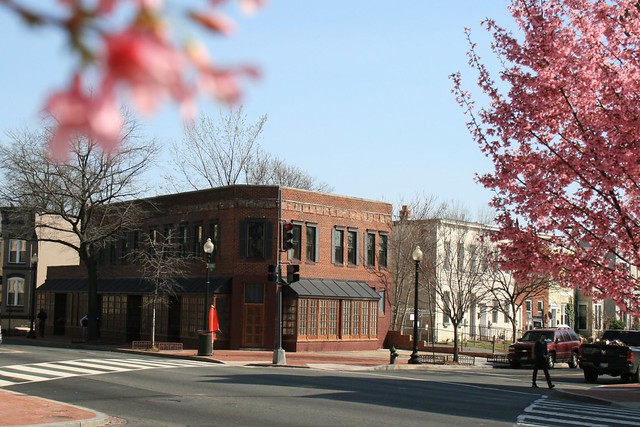
Shaw’s Tavern finally got its alcohol license approved and will open tonight for dinner. For this weekend they are only serving beer and wine.
If you’re curious, you might want to read our recent review of Shaw’s or see what the building looked like in 1937.
Here are the new hours:
Kitchen:
Monday – Thursday: Lunch 10am-3pm, Dinner 5pm-10pm
Friday: Lunch10am-3pm, Dinner 5pm-11am
Saturday: Brunch 9am- 3pm, Dinner 5pm-11pm
Sunday: Brunch 9am-3pm, Dinner 5pm-10pm
Bar:
Monday- Thursday: 10:00am-12:30am
Friday: 10:00am-2:30am
Saturday: 9:00am-2:30am
Sunday: 9am-12:00am
The Howard is open!
Last night the Howard Theatre held its grand opening concert featuring the musical talents of Trombone Shorty and the eminent George Clinton. After a 30-year hiatus, the century-old historic theater’s comeback has left everyone gobsmacked.
The interior is beautiful, featuring walnut panelling, tasteful lighting, and blown up shots of famous performers who made their names at the Howard. The lower floor is mostly an open concert floor, with booths and a bar on an elevated perimeter. The balcony level features a long bar, numerous tables, and banquettes that provide an superb view of the stage. Of all the articles we’ve read online, Brightest Young Things has the best photos of the interior.
The Howard’s schedule is packed with a variety of acts and with its location just a short walk from home, you have every reason to visit.
Review: Shaw’s Tavern
Restaurant review
Shaw’s Tavern
520 Florida Avenue NW
Rating: 5 arches (out of 5)
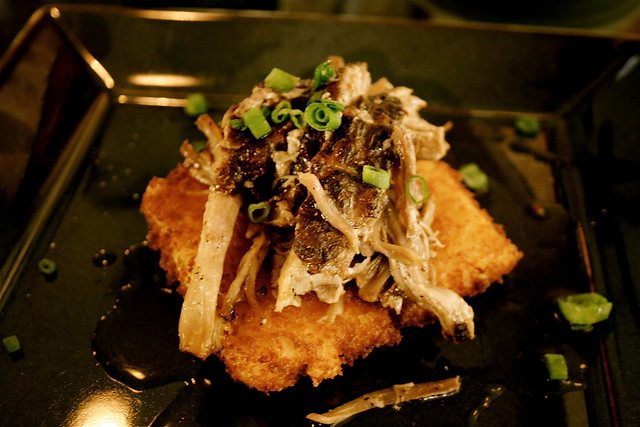
Recommendation: House-smoked pulled pork shoulder (pictured above)
Back in November 2010 we wrote about the renovation underway at the two-story brick building at the southeast corner of 6th Street and Florida Avenue. What a great place for a cafe, we opined.
Finally in July of last year, a restaurant called Shaw’s Tavern opened up in the space. Many neighbors expressed eager anticipation at the very rumor, mostly since Florida Avenue lacks a variety of decent sit-down options.
The excitement was short-lived. The restaurant’s management ran afoul of the District’s liquor regulations when it allegedly forged an alcohol license to purchase liquor from suppliers. Just before opening, Shaw’s hosted several events during which they served alcohol without the a license. The Alcohol Beverage Control (ABC) Board, rightly outraged, refused to grant the license.
Unable to serve alcohol, which is where restaurants make much of their money, Shaw’s quickly closed. New owners bought the business and have reopened the space for breakfast, brunch, and lunch. Shaw’s will finally serve dinner and thus expand their hours beyond the 4 pm closing when they get their alcohol license approved.
We dropped by Shaw’s Tavern recently to sample the food and the trip was well worth it. The food was excellent and refined and the atmosphere was pleasant.
We ordered the house-smoked pulled pork shoulder (pictured above), which is served on a patty of crispy jalapeño-cheddar polenta and cider vinegar jus. The waiter described the item as “killer” so we couldn’t possibly ignore such an endorsement.
It turns out the waiter was right. The pork, as he described, is smoked for 12 hours. It shows. The distinctly smokey and faintly tangy flavor of the tender shoulder meat makes the dish a signature item for Shaw’s.
The pork tops a polenta patty, which is cripsy like hash-browns on the exterior, but creamy like skillfully prepared scrambled eggs on the inside. In fact the filling is not egg at all, but jalapeño cheddar cheese with polenta, making it a close rival to the pork.
 For dessert we ordered spiced chocolate pudding. A dollop of cream and candied orange peel garnish the pudding. Don’t let that fool you, though. The pudding itself is not nearly as sweet as most American desserts and so the spice stands out.
The interior of the restaurant provides an unusual variety of seating options. There are high tables for four people and larger parties. The bar itself is as wide as a full table and provides ample space for dining. The outdoor patio on the 6th Street side just opened with several iron tables and chairs. The inside also sports several couches with coffee tables, each equipped with a book on the Civil War to honor the restaurant’s namesake, Col. Robert Gould Shaw, for whom the Shaw neighborhood is named.
There are few restaurants that really impress us, but Shaw’s Tavern was able to do it. When it opens up for dinner, we expect to return often.
Shaw’s Tavern
520 Florida Avenue NW
(Check their website for their hours)
Easter in LeDroit Park

Tulips on the 200 block of Elm Street NW
Nothing says spring like pastel tulips on a sunny Easter morning. Much to the benefit of passersby, one Elm Street resident caught tulipmania this year!







Recent Comments