
T Street renovations reveal old streetcar tracks
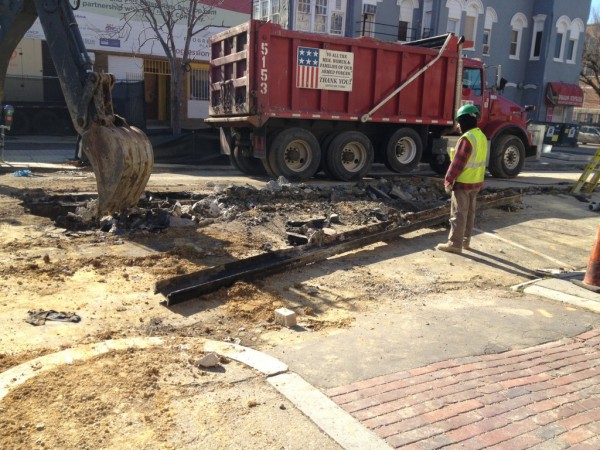
Old streetcar rails being removed from the 600 block of T St NW
The Howard Theatre is set to open in April. While construction crews are finishing the theater’s historic restoration, the District government is renovating the entire street in front of the theater. The streetscape project involves replacing the sidewalks, curbs, road pavement, storm drains, and lamp posts on the 600 block of T Street NW and along the one-block Wiltberger Street NW, which abuts the Howard Theatre.
Construction work started at the beginning of February. We were able to get this photo of construction crews removing the old streetcar tracks that were paved over after the streetcar system ceased operation in 1962. In fact the old tracks still lie under many of Washington’s streets; paving them over was cheaper than tearing them up.
Though the streetcars ran along 7th Street/Georgia Avenue and along Florida Avenue, a 1958 streetcar map shows that a short connector linked both of these routes along the 600 block of T Street NW.
DDOT’s plans for the block are ornate and are designed to complement the restored arts venue. The street will feature decorative pavement for both the sidewalk and the roadway. We certainly hope the decorative pavement can withstand the stress of traffic once the street reopens.
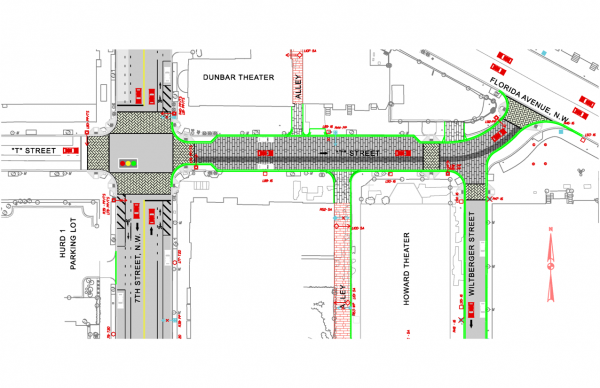
Below is the plaza section where T Street intersects Florida Avenue in front of Zenebech. Earlier today we noticed that the sculpture plinth is in place already. The deciduous tree will certainly be a welcome addition to what is now an uninterrupted expanse of concrete.


LeDroit residents tell their stories
 Who are your neighbors? In December, LeDroit Park resident Robert Sullivan launched a website Portait City that features audio and photographic profiles of several LeDroit Park residents. You may not know these subjects personally and perhaps maybe you have seen them in the neighborhood. Nonetheless, they each provide a fascinating mosaic of LeDroit Park.
Interview subjects include Bobby Donaldson, the South Carolina native who opened B&J Barbeque at Rhode Island Avenue and 3rd Street. You’ll find out what inspired him to open a restaurant and what people like in their barbeque.
LeDroit resident and former Ward 1 councilmember Frank Smith spent part of his youth as a civil rights worker in rural Mississippi. Mr. Smith recorded and reported civil rights abuses, such as bogus “literacy tests” that southern states used to prohibit black residents from voting. Here how he reacted to Marion Barry’s infamous arrest.
Hear from the Elks Lodge and their relationship with the neighborhood. You can also hear Elks reminisce about performances at the Howard Theatre back in the day.
The flamboyantly dressed “Hollywood” explains his eclectic attire and Bloomingdaler John Salatti sings the praises of his wife and Bloomingdale.
Finally, Robert was able to interview LeDroit residents Dolores Baylor and her daughter Mechelle just before Dolores died in December. Mechelle explains what it was like growing up in the neighborhood and Dolores recounts what it was like living through the riots of 1968.
The lives of famous figures in history are well-documented, but it is also important to record the experiences and views of the not-so-famous. Robert contracted your author, who is a professional web developer by day, to build the site. While building the site, we couldn’t help but notice that each story delivered its own unexpected poignancy.
Where have you been?

The blog has been quiet for the past few months and that will change. Since September, your author took up a four-month research fellowship in transportation technology and started a masters program in real estate development. In addition, the blog work on Greater Greater Washington kept your author busy, too, until he had to give it up to focus on school and work.
Now things are freeing up a little bit. During a stroll through the neighborhood this weekend, we saw the features that make LeDroit Park such a wonderful place to live: the friendly neighbors, beautiful historic architecture, and new businesses opening nearby. What great topics to write about!
Expect some more posts in the coming days and hopefully we can keep this going regularly.
That was fast!
[flickr id=”6241847449″ thumbnail=”small” overlay=”true” size=”small” group=”” align=”right”]
It was only earlier this year that work began on 1915 6th Street (right). The property stood as a vacant lot for years, but was snapped up by a condo developer.
After being on the market for just a few days at $299,000, the 1-bedroom, 1.5-bathroom basement condo at 1915 6th Street is now under contract.
LeDroit Park has seen a good deal of reinvestment over the past few years despite the economy. A new condo is nearing completion at 5th St and Oakdale Place (bottom left) after sitting as vacant lot for years. 1907 3rd Street (bottom right), after sitting as a vacant apartment building for many years, is now a condo building.
[flickr id=”5540974102″ thumbnail=”small” overlay=”true” size=”medium_640″ group=”” align=”none”] [flickr id=”5583332518″ thumbnail=”small” overlay=”true” size=”medium_640″ group=”” align=”none”]
NPR reporter Ari Shapiro and his husband are renovating the old McGill house at 1922 3rd Street (below).
[flickr id=”4413952443″ thumbnail=”medium_640″ overlay=”false” size=”small” group=”” align=”none”]
Weekend Metro closure may bring unintended improvement
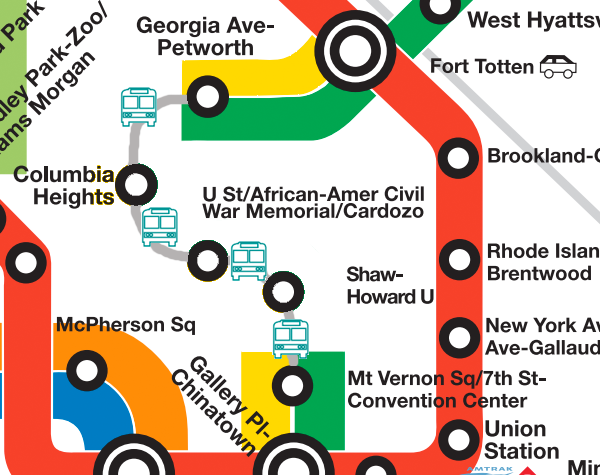
Temporarily closing a segment of the Green Line might ironically improve service for some this weekend. WMATA announced that it will close the Shaw, U Street, and Columbia Heights stations this weekend for scheduled track maintenance.
The stations will close at 10 pm Friday and won’t reopen until Tuesday morning’s normal opening time (Monday is a holiday). A similar closure will be in place on the Orange Line between East and West Falls Church stations as Metro works to connect the new Silver Line.
In the meantime, Metro will operate free shuttles along the route to ferry passengers through this service gap. Ironically, these shuttles may sometimes operate more frequently than the rail service would on a typical weekend.
Metro instituted a similar closure along a section of the Red Line on Labor Day weekend. On that weekend, we went to have brunch at a friend’s house in the Brookland neighborhood. During that time, Metro shuttles were running down his street every 2 minutes. Many of the buses were nearly empty, but for a moment we were jealous at the thought of transit service every 2 minutes.
Likewise, if WMATA keeps similarly short headways for the shuttles this weekend, the agency might actually enhance mobility between the Convention Center, Shaw, U Street, Columbia Heights, and Petworth.
One of Metro’s main shortcomings is that riding during non-rush periods, especially on weekends or at night, can entail waiting on platforms for as much as 24 minutes. This is an unacceptably low level of service, but our region lacks the political leadership to set a minimum level of transit service the way we do for utilities.
In DC, where 37% of households lack a car, the mayor and council chairman drive luxury cars at taxpayer expense, and other councilmembers receive free parking in front of the Wilson Building.
In the abstract, our leaders may appreciate the importance of frequent service, but nothing drives home the point like waiting on a Metro platform with 100 other people only to watch a packed train arrive half an hour later.
Though buses can’t match the speed and comfort of rail service, the frequency of bus shuttles this weekend might prove to be a significant, though temporary, transit improvement.
Howard still owns a few properties in LeDroit Park
In reviewing Howard University’s proposed campus plan, we started to take account of all of the property in DC that the university owns. Up until 10 years ago, Howard University was accused of being LeDroit Park’s biggest slumlord, owning numerous properties in the neighborhood and letting them lie vacant, blighted, and decaying.
Under the reign of university president H. Patrick Swygert, Howard made a significant and commendable effort to rehab and sell many of its vacant properties in the neighborhood.
For instance, the university owned all but one house on 400 block of Oakdale Place. It let these houses lie vacant, blighted, and boarded up. Under Pres. Swygert, the university renovated the houses and sold them to employees. Today the 400 block of Oakdale Place is fully occupied and a new condo building is nearing completion on the western end.
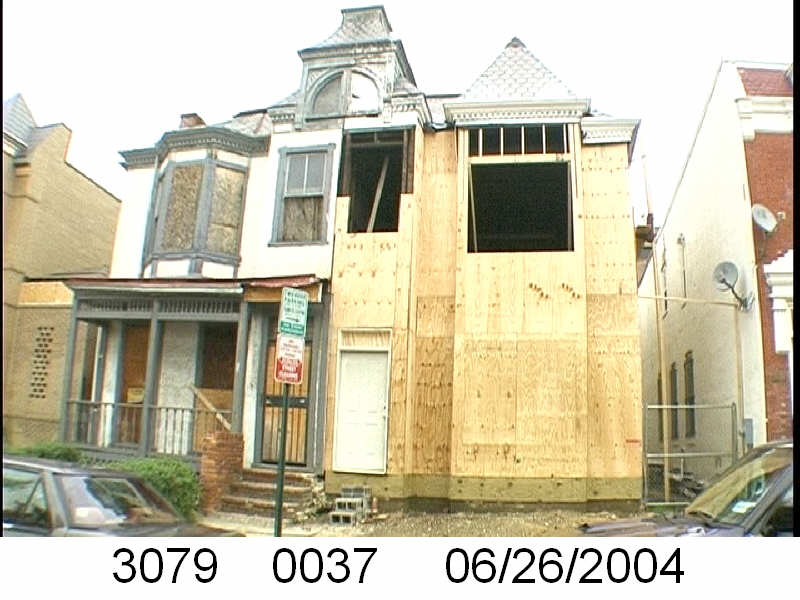
531 & 533 U St NW in 2004. Howard University renovated 531 (right) in 2004. Image from the DC government.
In other cases, the university renovated properties but has retained ownership. 531 U Street NW looked terrible in 2004 (right), but now looks very nice. We can’t quite tell if the house is occupied, but it consistently appears to be in good condition.
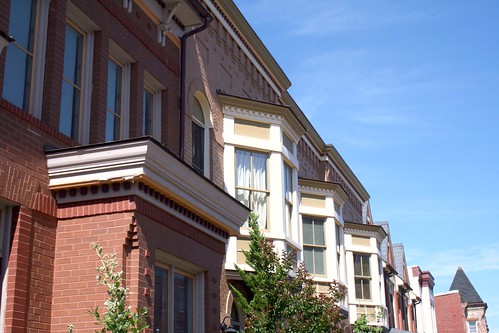
Elsewhere on the 500 and 600 blocks of U Street, Howard built historic infill houses (below) on vacant lots it owned on the north side of the street. The result is a block with with a continuous wall of housing on the street’s northern face. The houses’ façades are of high quality, with detailed brick work, ornate porches, and a variety of detailing.
The job is not entirely done, however, and Howard University retains ownership of a few properties that raise eyebrows. Let’s look at these three:

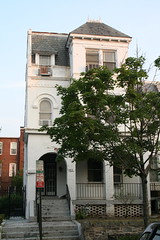
649 Florida Avenue (left) sits as a vacant lot, frequently collecting trash and debris. A university official told us that long ago Howard had considered using the lot to create a delightful pedestrian path to the university from the Shaw Metro. That never happened and now the lot sits vacant.
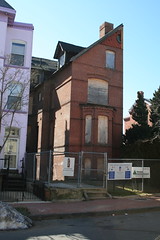
408-410 T Street (center) was the home of Walter Washington, DC’s first elected mayor. The university owns the property, and though it’s not blighted, it may be vacant. With some renovation work, this would make an excellent rental home for a Howard professor or anyone else for that matter.
326 T Street (right) is the Mary Church Terrell House, future home of the Robert and Mary Church Terrell House & LeDroit Park Museum and Cultural Center. Though it’s vacant and undoubtedly meets the District’s definition of blight, we are willing to cut the university more slack in this case since the eventual outcome will be a wonderful addition to the neighborhood. Unfortunately, the campus plan does not specify any additional Howard funding to restore the site.
In addition to the properties above, Howard owns a few more properties in LeDroit Park:
- Gravel parking lot at the SE corner of 5th and W Streets. (Square 3072, Lot 818). Campus plan does not mention any change to this lot.
- Carver Hall, 211 Elm St NW (Square 3084, Lot 830). Campus plan mentions the dorm’s decommission, but no reuse plans.
- Slowe Hall, 1919 3rd St NW (Square 3088, Lot 835). Campus plan mentions the dorm’s decommission, but no reuse plans.
- Howard University Hospital daycare, 1907-11 5th St NW (Square 3090, Lot 41)
- 420 T St NW – a house that appears to be occupied (Square 3094, Lot 800)
- Howard University Hospital (Square 3075, Lot 807)
- Parking garage bounded by 4th St, Oakdale Pl, 5th St, and V St. (Square 3080, Lot 73)
- Parking garage bounded by 4th St, V St, 5th St, and an alley. (Square 3072, Lot 52)
Though Howard retains a few problematic properties, it’s important to note the great strides the university has made in taking responsibility for its property portfolio in the neighborhood. A plan for these few remaining properties, even one in which the university retains ownership but leases, would put residents at greater ease.
LeDroit Park getting Zipcars soon
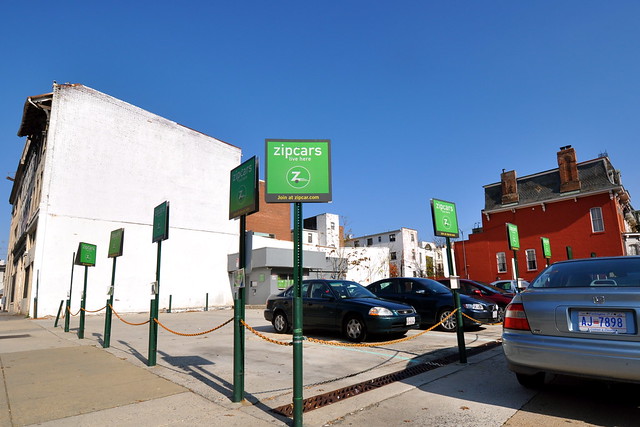
Cars on the Corner by M.V. Jantzen, on Flickr
LeDroit Park is getting two Zipcars soon. Though the District auctioned off many of the street spaces reserved for carsharing services like Zipcar, the vast majority of Zipcar’s spaces are actually in private parking lots, driveways, and garages.
Zipcar is always looking for more spaces. If you have a private parking space and would like to rent it to Zipcar, drop them a note online, call their office downtown at (202) 737 4900.
Neighboring heritage trail opening soon
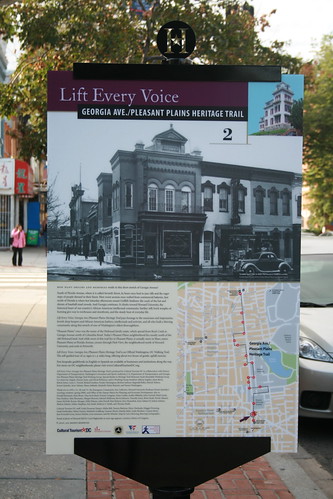 Cultural Tourism DC is finishing the installation of the signs for the Georgia Ave./Pleasant Plains Heritage Trail. Here is one we spotted outside the Dunbar Theater (now Wells Fargo bank) at 7th and T Streets NW.
The trail opening event will be on Saturday, October 15 at 11 am at the plaza in front of Howard University Hospital.
Work on the heritage trail for LeDroit Park and Bloomingdale has progressed greatly and we are on our way to having our own trail to honor LeDroit Park’s rich history.
Historic fountains rot away in a local national park
Two century-old DC fountains sit decaying and neglected in the woods of a national park in Maryland. The fountains had been missing from the 1940s until they were rediscovered in the woods of Fort Washington National Park in the 1970s.
The top portion of the McMillan fountain, pictured below, was returned to Crispus Attucks park in the Bloomingdale neighborhood in 1983. In 1992 it was moved back to the fenced-off grounds of the McMillan Reservoir just a few blocks away.
The fountain was installed in 1913 at the McMillan Reservoir as a memorial to Senator James McMillan (R – Michigan), who is more remembered locally for his his ambitious McMillan Plan to beautify Washington. The fountain was dismantled in 1941, when the reservoir was fenced off from the public.


Top of the McMillan Fountain today (left) and in 1912 (right).
Though the top of the McMillan Fountain had been restored to the reservoir grounds, a Bloomingdale ANC commissioner told me the base of the fountain was in the woods in Fort Washington along with the remains of the fountain that stood at the center of the now-razed Truxton Circle.
I went to Fort Washington in search of these discarded works of art. I asked a park ranger where the fountain was and she drew me a map, saying that it stood in the park’s “dump” and partly behind a fence.
I went to the picnic area nearest the site and walked into the woods a short distance where I found a fence. Behind it stood piles of bricks and other discarded building materials.
Beside the site is a dugout that serves as the back court to Battery Emory, a concrete gun battery built in 1898 to protect the capital city from enemy ships.
As I passed through the unfenced dugout, I immediately spotted few granite blocks that served as the cornerstones of the base bowl. Though they are strewn about the ground, a 1912 photograph can help us identify what pieces went where.


A cornerstone sitting on the ground (left) formed part of the fountain’s bottom basin (right).
The elements of the fountain were stacked like totem pole. The bottom element features carved classical allegorical heads from whose mouths water gushed into the carved bowls below.


Fence material and tree debris cover the carved granite (left) that stood as the fountain base (right).
The next element of the stack is the fluted base to the top bowl.


Upside down on the ground (left) is the fluted base for the top bowl (right).
Several other large granite stones are stacked and marked with numbers, presumably to help in reassembly.

The site also contains the rusting remains of the fountain that stood at Truxton Circle, which formed the intersection of North Capitol Street, Florida Avenue, Lincoln Road, and Q Street. The circle was built around 1901 and the fountain installed there originally stood at the triangle park at Pennsylvania Avenue and M Street in Georgetown.

Truxton Circle stood at Florida Avenue, North Capitol Street, Q Street, and Lincoln Road from 1901 to 1940, when it was demolished to aid commuter traffic.
A newspaper at the time described it as one of the largest fountains in the city. The circle was removed in 1940 to ease the flow of commuter traffic. At that time, the fountain, which may date to as early as the 1880s, made its way to Fort Washington to rust in the woods.


The metal pedestal (left) held up the fountain bowl whose rim rusts in pieces on the ground (right). Notice the classical egg-and-dart pattern.
The fountain was also noted for the metal grates that stood near its base. Now these grates sit rusting in the woods.


If you want to see the fountain remains for yourself at Fort Washington National Park, go to picnic area C. Beyond the end of the parking lot is a restroom building and behind that is the fountain “graveyard.” A fence encloses part of the site, but you can enter through the large gap down the hillside.
Rather than tossing aside our city’s artistic patrimony, we should aim to restore these treasures to the neighborhoods from which they came. Public art is part of what differentiates cherished neighborhoods from unmemorable places.
These works remind us of the accomplishments and civic-mindedness of generations past and urge us to carry on the tradition of civic improvement for generations to come.
Civic association conditions zoning support on vacancy
 At Tuesday night’s meeting of the LeDroit Park Civic Association, the association voted 11-2 to support the Howard University Campus Plan. Since several issues in the plan remain unresolved and unspecified, your author voted against supporting it.
Among many concerns are the several vacant properties that Howard University owns in the area. Though Howard has made a commendable effort to refurbish and sell many of these properties in LeDroit Park over the past decade, we are worried that the university, after it moves students out of Slowe and Carver Halls might leave these two dormitories vacant for several years.
The university has been very adept at finding excuses for keeping several of its properties vacant in decades past.
For current vagueness in the plan, university officials say they haven’t determined a use yet or that they haven’t found the financing or that everything is the economy’s fault.
That may be true, but vacant buildings attract trouble. They become safe-havens for criminals, vagrants, and rodents. Some vacant properties become truly blighted with windows covered up with plywood or metal covers. This blight drags down property values and lowers the quality of life.
For most private property owners, vacant properties (class 3) face a steep 5% annual property tax and blighted buildings (class 4) face a 10% annual property tax. These punitive tax rates are meant to urge owners of vacant and blighted properties to return their properties to good order and productive use.
As a university, however, Howard pays no taxes on its land, so a punitive 5% or 10% tax on $0 is still $0 . As such, the neighborhood needs a legal mechanism to ensure the university does not vacate Slowe and Carver Halls and then blame the economy as they board up the buildings for several years.
Whether the university keeps the buildings as student dorms or converts them to faculty housing is fine either way, but vacancy and blight threatens the progress the neighborhood has made over the past decade.
To prevent this, your author moved “To amend our support [for the campus plan] to prohibit vacancy of Slowe and Carver Halls for more than one year.”
The motion was property seconded and passed unanimously.
The civic association will submit this language to the Zoning Commission and urge the commission to attach it to the legally enforceable order that ratifies the campus plan. This will ensure that these two large dormitories do not sit vacant for an unreasonable length of time over the next decade.
Howard University’s campus plan is an ambitious and mostly good plan, but it’s important that point out its shortcomings and to ensure the university does not get away with undue burdens on neighborhoods and the District.
Exemption from property taxes is a privilege, not a right, and residents are wise to ensure this exemption is not abused to the detriment of the public interest.







Recent Comments