
City grants license for All Souls, slams opponents
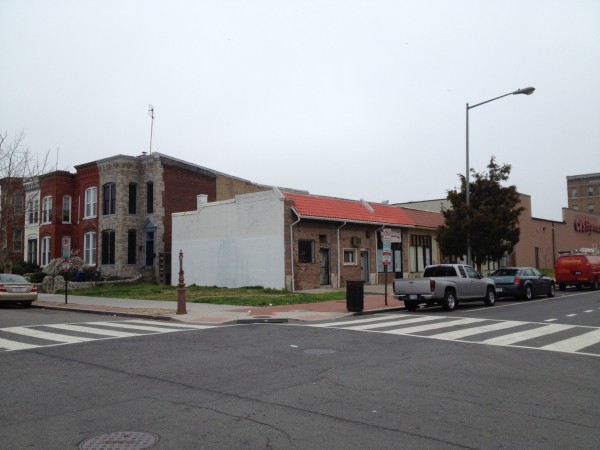
The Alcoholic Beverage Control (ABC) Board will grant a license for All Souls, the proposed restaurant to occupy the long-vacant storefront at 725 T Street. All Souls became a lightning rod for unexpected opposition in March, drawing crowds and TV news coverage to its liquor license hearing. The objections covered the usual grounds: too much noise late into the night, too many drivers looking for parking, too many chances for general disorder.
The proprietor had long before agreed to only serve alcohol inside and only serve after 5 pm.
The most unusual objection, however, was that it is harmful for children to look across the street and view adults consuming alcohol. The objection seemed like a quaint, Puritanical reaction incongruent with a diverse, secular city.
DC law does, however, recognize that alcohol-serving establishments near schools merit at least some level of extra scrutiny. In fact the law prohibits the issuance of liquor licenses
within 400 feet of a public, private, or parochial primary, elementary, or high school; college or university; or recreation area operated by the District of Columbia Department of Parks and Recreation (DC Code §25-314(b)(1)).
The protestors, legally referred to as “protestants”, thought this provision would damn the All Souls application. The same section of the DC Code, however, lists 10 exceptions to the 400-foot rule, including this important one:
The 400-foot restriction shall not apply if there exists within 400 feet a currently-functioning establishment holding a license of the same class at the time that the new application is submitted. (DC Code §25-314(b)(3))
The board found that the Mesobe market in the orange building at 1853 7th Street NW is indeed already within 400 feet of the school. The distance measurement, the board’s ruling stated, “‘shall be the shortest distance between the property lines of the places.’ 23 DCMR §101.1 (West Supp. 2012).”
The existence of Mesobe within 400 feet of the school provides a precedent that satisfies the exception for All Souls, the board decided.
With that argument down, the board addressed the general assertion that it is unsafe for children to view adults consuming alcohol. Here is where the board delivered its most scathing criticism of the objectors:
Finally, we reject the Protestants’ unsubstantiated assertion that the mere sight of the Applicant’s tavern will be detrimental to the students of Cleveland Elementary School… Indeed, if we accepted the Protestants’ argument that the mere sight of adults in a tavern consuming alcohol is harmful to children, the Board would similarly have to ban children from:
- entering restaurants that serve alcohol to patrons;
- attending sporting events where alcohol may be consumed by adult fans;
- eating dinner with their parents if wine is served with the parents’ meal;
- participating in religious ceremonies where wine is part of the service; and
- walking through neighborhoods with large concentrations of liquor-serving establishments during the daytime, such as Adams Morgan and U Street.
The board further described the objection as “unworkable, unreasonable, and not in accordance with current societal practices.”
There are a few important lessons from this case. The most important is that District boards don’t always cave to the flimsily argued demands of a vocal few. A common complaint, especially among the business community, is that DC’s various boards, such as Zoning Commission, the Board of Zoning Adjustment, the Historic Preservation Review Board (HPRB), the Old Georgetown Board, the ABC Board, etc., exercise their discretion in ways that are too often inconsistent or outright bizarre.
The most frustrating experience with these boards is encountering unsupported opinions. In cases before the HPRB, many opponents argue that a proposed building is “incompatible” with the historic district while they fail to elaborate why it is allegedly incompatible. Georgetown resident Topher Matthews explained this sentiment that I have also encountered when following historic preservation cases:
Time and time again, neighbors use the historic preservation design review process to object to the size of the project rarely out of any genuine concern for the preservation of the neighborhood’s historic character but rather because they simply just don’t like the project. The basis for the complaints would be no different than if the project were in a brand new development with no historic character: it blocks my view, it’s too big, you’ll be able to see into my garden, et cetera.
In the All Souls case, the school proximity argument failed to establish harm to students to a degree that would warrant killing off a local business. It is a non sequitur to many people that children are harmed by catching a glimpse of adults across the street sipping wine at 5 pm. Merely believing that something is true doesn’t necessarily make it true. In rejecting this claim, the ABC Board made the right decision.
The entire licensing process, which was unusually protracted in this case, certainly cost the proprietor of All Souls a hefty sum in legal fees. When the proprietor attended community meetings on his proposed license, he usually had his attorney with him to address the fine legal distinctions, especially as it applied to the somewhat complicated 400-foot rule.
In fact I pitied the man. All he wanted to do was open up his small businesses. His modest license request unleashed the histrionic vitriol of a few strident Furies who spoke as though he were defiling the sanctity of childhood itself!
The board ratified a voluntary agreement between All Souls and three neighbors uninvolved in the school-proximity protest. The text of this side agreement is not currently available, but if it is like most other voluntary agreements, it likely negotiated closing hours and restrictions on indoor music volume, not moral arguments about child psychology and societal vice.
The good news is that even the school-proximity opponents who lost their case actually won. Cleveland Elementary School is a great school and will continue to be a great school long after All Souls has poured its inaugural beer. The conversion of the vacant storefront into an occupied business will deter the loitering and drug dealing along that block of T Street and will remove a visible physical blight from the neighborhood.
The neighborhood and the school will both be better off once All Souls opens.
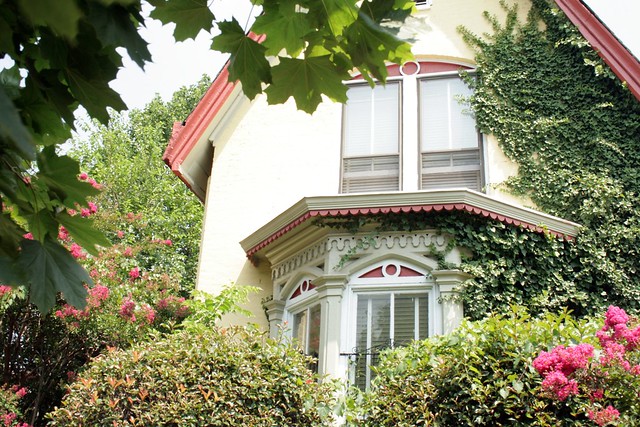
Can you identify LeDroit Park’s 12 distinct architectural styles?
The Washingtoniana Division of the M.L.K. Library contains a great collection of books on the history of Washington. Since all the material in the section is reference material, none of it can be checked out.
The kind librarians, however, permitted me to scan the entire book LeDroit Park Conserved, produced in 1979 for the DC government.
The book covers the historical development of the neighborhood, documents the different architectural styles, and offers suggestions to residents who wish to restore their properties with greatest historical accuracy.
Most surprising to me was the number of architectural styles represented in LeDroit Park. Let’s review:

Chateauesque
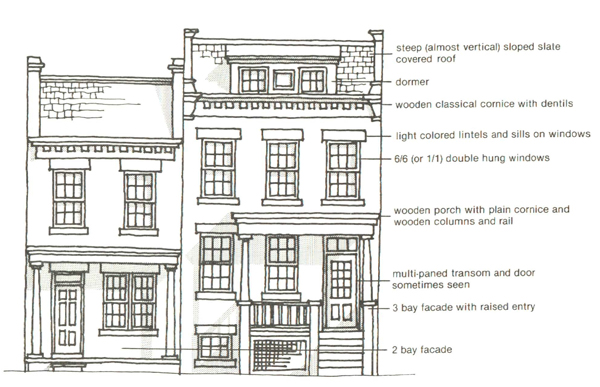
Georgian revival

Italian villa

Italianate

Queen Anne (brick row house)

Queen Anne (frame row house)
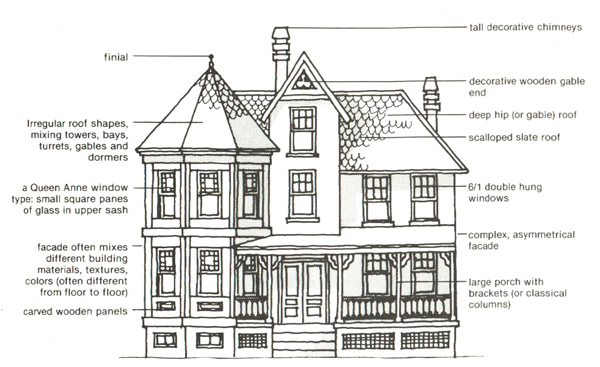
Queen Anne (free-standing)

Renaissance revival

Second empire
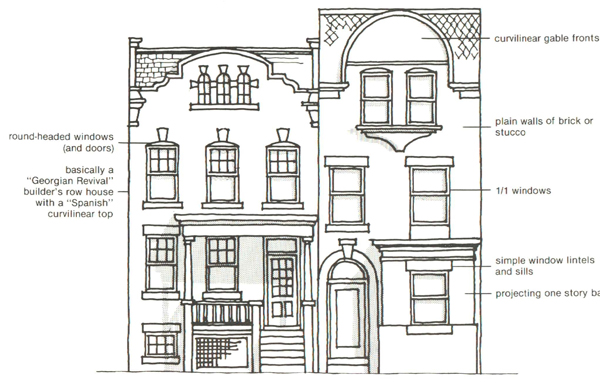
Spanish revival

Victorian gothic

Washington row house
View the entire book for all the details, photos, diagrams, and maps.
Just who was Ernest Everett Just?
An academic’s prestige is usually measured by the degree to which his peers admire his work. Any job where success depends on reputation is bound to be a difficult and political career. Howard biologist Ernest Everett Just (1883-1941), who lived at 412 T Street in LeDroit Park, faced a constant struggle for recognition for his groundbreaking work in biology in the early 20th century.
I occasionally give history tours of the neighborhood. My tour touches on two major themes: the neighborhood’s eclectic architecture and the prominent black Americans who lived in LeDroit Park. I had never heard of Just before moving to LeDroit Park, but in researching topics for my tour I came across a 1995 postage stamp commemorating him. This makes him the first of two LeDroit Park residents featured on postage stamps.
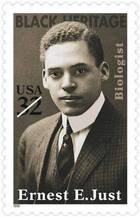
Two months ago, a neighbor who was a researcher at Howard University recommended Kenneth Manning‘s 1983 biography of Just. He assured me that the book, entitled Black Apollo of Science, detailed all the administrative problems at Howard that still exist to this day.
I picked up the book hoping to read historical accounts of LeDroit Park while Just lived in the neighborhood. Though there was very little about the neighborhood, the book provided interesting stories about Howard University’s administrative and financial troubles during the early 20th century.
The book was light on LeDroit Park and Washington because Just himself increasingly disliked teaching at Howard and the pervasive racism he faced living in the United States. In the 1920s, midway through his career, Just began to spend more time conducting research at research institutes in Berlin; Naples; and Roscoff, France. He deliberately avoided returning to the Marine Biology Laboratory in Woods Hole, Massachusetts, where he felt he was socially isolated because of his race. Just saw Europe as an escape from racism he faced at home.
In Europe Just could finally attend the same operas he had seen advertised in Washington’s whites-only venues and he could travel and book hotels without worrying that his reservations would be rejected due to Jim Crow.
Whether Just was pursuing his PhD at the University of Chicago or conducing research in Massachusetts or Europe, his wife and children remained in LeDroit Park at 412 T Street. But as Just eventually grew apart from the United States, he also grew apart from his wife. Just took several lovers in Europe during his research stints and he eventual filed for divorce from his wife Ethel in the late ’30s. This was a formality, though, as their love had died many years ago.
Though Just was in France at the time of the 1940 census, the census ledger lists him as the absent head of household at 412 T Street.

The Just family stood out for its educational attainment. Notice that in column 14, Just is listed as having completed eight years of college, an outstanding accomplishment even by today’s standards. His wife had finished six years of college, his son four, and his daughter Maribel, aged 17, was in her first year of college.
Out of pure luck, Just was listed on line 68, which was one of two lines per page that the Census Bureau selected for supplmentary questions.

Here Just stands out again. Though most LeDroit residents were listed as maids, porters, or laborers, Just’s profession is listed as “Zoology professor” at Howard University.
Just’s life was not easy. He grew up in poverty and his father died when Just was a child. Just’s mother was a teacher who valued his education dearly and she sent him as a teenager to a boarding school in New Hampshire. During his time at boarding school, his mother died, leaving Just orphaned but independent.
After boarding school, he proceeded to Dartmouth to study classics and biology, the field to which he devoted his entire career. Since few universities at the time would hire black researchers or professors, Just took a position at Howard University and in 1912 became the head of Howard’s Department of Zoology.
The Howard position was Just’s main source of income for the rest of his life and he used it, along with a few private grants, to fund his research in Massachusetts and Europe. Though Just kept his position at Howard until his death, he spent many semesters and summers studying marine biology far away from Washington. Howard, it seems, was only a source of income for Just, as he frequently battled with the university’s administration for more equipment, more funding, and more research time.
Howard’s presidents, especially Mordecai Johnson, demanded that Just focus less on research and more on teaching and building a graduate zoology program.
Johnson wasn’t the only person pressuring Just. White philanthropists who wanted to raise academic achievement and living standards of American blacks funded Just’s work with the goal that he would train aspiring black scientists and doctors. Their hope was that Just would train black biology students so they could study medicine and return to the rural south where white doctors would not treat black patients.
Just, however, wanted philanthropic funding to support his biological research efforts, not his teaching efforts. Just preferred research and appeared far more interested in advancing the human understanding of cell biology.
Old letters Manning uncovered reveal that Just held a low opinion of Howard undergraduates during his tenure. Just thought teaching biology to them was a waste of time and would distract him from important research.
To teach or to research? This is an old academic controversy. Many professors prefer to conduct research because they find it more intellectually satisfying and because it builds their careers, expertise, and reputations. At universities that rely heavily on tuition fees for their income, administrators realize that teaching is an important source of income.
For Just, the written correspondence between him and various philanthropies shows that because he was black, he was expected to carry the herculean task of advancing both the human understanding of biology and the welfare of his race— a burden his white benefactors did not place on white scientists. These expectations, though well intentioned, continually hindered Just’s career as his appeals for research grants rarely bore fruit. Various foundations and Howard administrators urged Just to spend more effort building a biology program and producing trained biologists.
Just found a warmer reception in Germany, Italy, and France, where scientists were more eager to collaborate with him and build on his work. While in Europe, Just dated several women. He even established residence in Latvia briefly so he could quickly file for divorce from his wife in Washington. He eventually decided to mary his German mistress and start a life in Europe, even if it meant resigning his post at Howard and living in penury in Europe.
Failing to win grants, though, Just held onto his Howard position as his sole source of income. Just’s time in Europe was productive. He published his most renowned works on cell biology and cell fertilization during this self-exile.
His new-found haven across the Atlantic didn’t remain peaceful for long. Though he had tried to escape racism in the United States, Nazi violence had made Berlin inhospitable. In Italy, Just’s appeals to Mussolini for research funding went nowhere and Italian biology conferences became fascist propaganda events.
Just’s final European post in France came under Nazi control and Just was ordered to leave. The advancement of fascism eventually made this European exile untenable. Sadly, everywhere Just went, some virulent -ism— racism, fascism, Nazism— eventually caught up with him.
Just returned to the United States with his new wife and newborn child. His new wife and child settled in New Jersey, but Just had to return to work for pay at Howard. Suffering from pancreatic cancer, Just stayed with his sister Inez at 1853 3rd Street, here in LeDroit Park. His health was in rapid decline and in October 1941 Just died.
Despite having overturned a ruling theory of cell fertilization, Just never fully received the professional recognition he desired and deserved. He was always tied to Howard, even though he wanted desperately to leave to focus solely on research. Howard tied him to Washington, a city whose segregation degraded him. Washington also tied him to a wife he no longer loved.
Manning’s book is very well researched and combs through many of Just’s letters to colleagues, mentors, friends, and lovers. It tells a fascinating account of race relations in America, the history of biology research, and one man’s unhappy task facing down all these problems.
Manning was able to weave these threads of science, race, academia, and Just’s personal life into a unified and compelling work accessible to the general reader. Happy endings are the work of fiction writers; Just’s story is more poignant because it recounts a life marked by great successes and great disappointments.
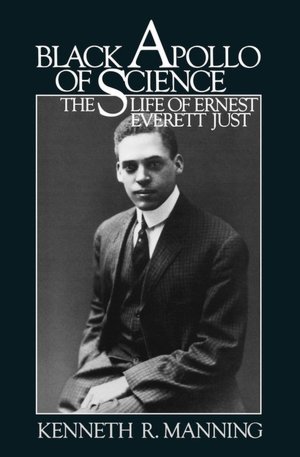 Black Apollo of Science: The Life of Ernest Everett Just
By Kenneth Manning
1983, Oxford University Press. 330 pages.
[Amazon] [DC Public Library]
Our zip code, now with some more white people
Every now and then the Census Bureau or some organization releases a report or new data showing that DC’s demographics changed. A recent analysis of census data found that the 20001 zip code, which covers LeDroit Park, Pleasant Plains, Bloomingdale, Truxton Circle, Shaw, and Mount Vernon Square, saw its non-Hispanic white population increase by 27.2 percentage points from 5.6% to 32.8%. In fact, 20001 made the list of “most-whitened zip codes” in the nation.
Our review of the 2010 census data found that LeDroit Park is 21% white, which is below the figure for the zip code.
What does this mean? Without more information, the report doesn’t mean much other than the unsurprising fact that neighborhood demographics change. This plain answer will dissatisfy some. In a city in which identity is inevitably intertwined with politics, many will feel compelled to read too much into the data for some larger narrative that confirms preexisting social or political views.
However, the reasons that people move into and out of a neighborhood are complicated and there are both push and pull factors, both voluntary and involuntary.
Why a person might leave a neighborhood:
- Your new spouse wants to live elsewhere.
- You graduated from the local university and intend to return to your hometown.
- You dislike too many of your neighbors.
- You got a new job far away.
- The rent has become unaffordable.
- You lost your job and can’t pay any rent.
- You want to retire closer to where your children live.
- Perceptions of crime.
- Divorce.
- Death.
- You want to send your children to school elsewhere.
- You’re pursuing a degree somewhere else.
Why a person might move into a neighborhood:
- You are born and that’s where your parents live.
- You found the perfect home.
- Friends and family are nearby.
- There are people like you nearby.
- You got a new job nearby.
- The area is familiar.
- You’re moving in with friends or relatives.
- Rent is cheaper here than in some other place.
- The neighborhood is visually appealing.
Each person’s story is different, but there is far more at work than the simplistic displacement narrative that gets so much press.
Meet Mayor Gray in LeDroit Park on Friday
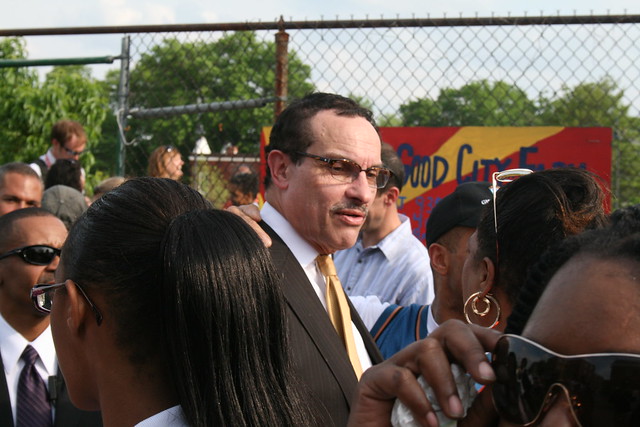
Mayor Vince Gray at the Common Good City Farm
Mayor Vincent Gray is visiting LeDroit Park on Friday night at 7pm. The LeDroit Park Civic Association has moved its June meeting to Friday, June 15 at 7 pm to accomodate the mayor’s visit. The mayor will address various questions from neighbors and about the neighborhood. The civic association has forwarded on to the mayor several questions regarding the park and regarding crime in the neighborhood.
Please join us for this special civic association meeting in the basement of the Florida Avenue Baptist Church. We are hoping the mayor will join us afterward for a brief neighborhood tour if his schedule permits it.
All residents are encouraged to attend.
Street closures for Chuck Brown’s viewing
Chuck Brown, the Godfather of Go-go, died on May 16. That night a crowd of fans celebrated his life and mourned his death in front of the Howard Theatre.
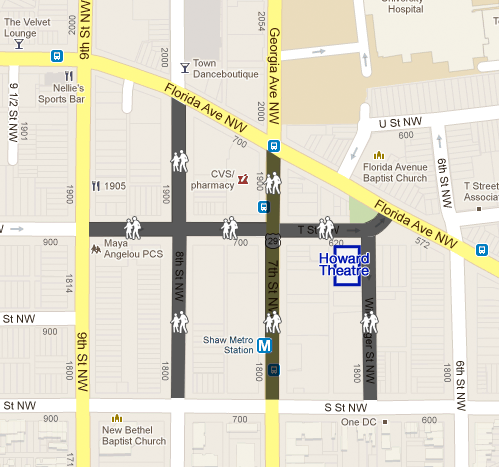
Brown’s viewing will be held at the Howard Theatre on Tuesday, May 29, from 11 am to 10 pm. To accomodate the expected crown of mourners, DDOT will close several streets to private automobiles on Tuesday. T Street from 7th Street to Florida Avenue will close from 3 am to midnight. The following streets will close from 9:30 am to midnight:
- T Street between 9th Street and Florida Avenue
- 7th Street between Florida Avenue and S Street
- 8th Street between Florida Avenue and S Street
- Wiltberger Street between T Street and S Street
You may still walk or bike along these streets, but if you’re driving, it will be best to avoid the area.
Battle ensues over control of Crispus Attucks Park
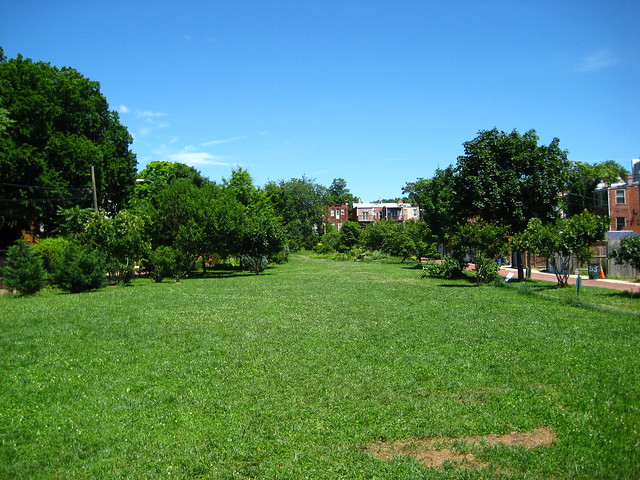
Crispus Attucks Park by rockcreek, on Flickr
The Post is running an article about the battle over control of Crispus Attucks Park in Bloomingdale. The park is a hidden gem in Bloomingdale. It’s embedded in the middle of the block bounded by North Capitol Street, U Street NW, V Street NW, and First Street NW.
The park is on land once owned by C & P Telephone, but which was transferred to a non-profit in the 1970s. But who controls the non-profit that controls the park? Aye, there’s the rub.
Will Florida Avenue become the next U Street?
A sign of things to come?
When perusing the excellent interactive DC zoning map, one thing stands out around LeDroit Park: all the properties fronting Florida Avenue are zoned to permit both residential and commercial uses. Even the rowhouses on the LeDroit side of Florida Avenue can be turned into restaurants, offices, or shops without any need for special zoning approval.*
We mention this not to alarm anyone, but to educate residents about the influence of zoning ordinances. Zoning is the invisible geography that quietly shapes the use and form of the built environment.

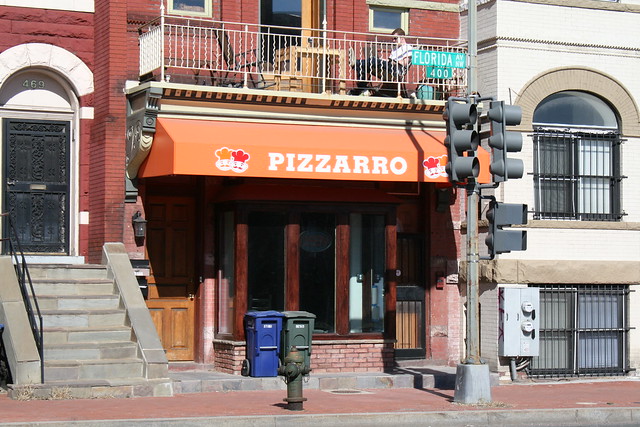
The north-side rowhouses on the 400, 500, and 600 blocks of Florida Avenue were clearly built as homes. About 100 years ago, many of these rowhouses hosted the offices of Washington’s prominent black doctors.
Neighborhoods change and businesses move and nearly all the rowhouses on our stretch of Florida Avenue reverted to their original uses as residences. Even the notable Harrison’s Cafe at 455 Florida Avenue is a residence with much of its former retail bay window bricked in.
Thai X-ing, a culinary outpost
A few businesses still dot Florida Avenue. While Shaw’s Tavern and Bistro Bohem are reviving the corner of Florida Avenue and 6th Street, they occupy buildings that are clearly commercial in form. Thai X-ing, however, has been located for several years in and old rowhouse at 515 Florida Avenue NW. Though it looks like an abberation, Thai X-ing may just be ahead of its time.
The properties fronting Florida Avenue are zoned C-2-A, which permits as a matter of right,
office employment centers, shopping centers, medium-bulk mixed use centers, and housing to a maximum lot occupancy of 60% for residential use and 100% for all other uses, a maximum FAR of 2.5 for residential use and 1.5 FAR for other permitted uses, and a maximum height of fifty (50) feet. Rear yard requirements are fifteen (15) feet; one family detached dwellings and one family semi-detached dwellings side yard requirements are eight (8) feet.
There is no need to worry about an old rowhhouse being torn down and turned into office blocks. First, the houses along the LeDroit Park side of Florida Avenue are within the historic district. Historic preservation laws prevent drastic alterations, especially alterations to such an cohesive section of architecture.
Second, the C-2-A zone is a low-density zone, permitting a floor-area ratio (FAR) of only 1.5 for non-residential uses. Most of the existing rowhouses already exceed 1.5 FAR since they were built before the current zoning code.
The opening and success of Shaw’s Tavern and Bistro Bohem demonstrate business success along our stretch of Florida Avenue. There is clearly a demand for commercial activity near LeDroit Park and we were happy to spend Sunday afternoon revisiting Bistro Bohem. Whether this demand translates into rowhouse conversions into restaurants and bars remains to be seen. Even still, don’t be surprised if Thai X-ing gets a few restaurant, pub, cafe, or boutique neighbors in the coming years.
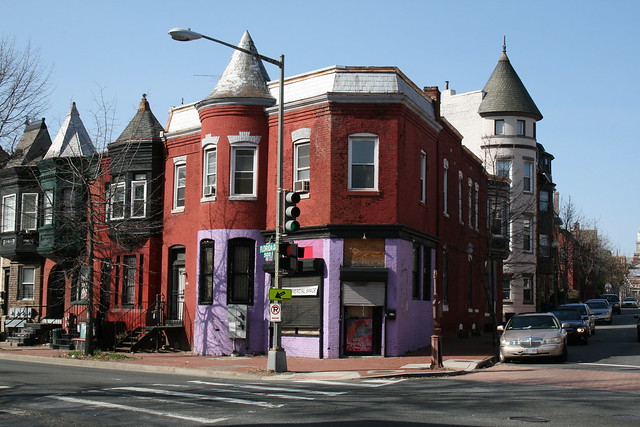
501 Florida Avenue
* Though one may open a restaurant without special approval in a commercial zone, a restaurateur must still follow the usual process for obtaining a license to serve alcohol.
Civic association elections, JBG development proposal tomorrow night

The LeDroit Park Civic Association will meet tomorrow night, Tuesday, May 22 at 7 pm in the basement of the Florida Avenue Baptist Church.
Tomorrow’s agenda includes the election of officers, an update on the JBG development for the 700 and 800 blocks of Florida Avenue, and a public safety update.
Please remember that only paid members may vote for officers or any civic association motion, so be sure to bring your $15 if you need renew your household’s membership.
Bistro Bohem expands outside and inside
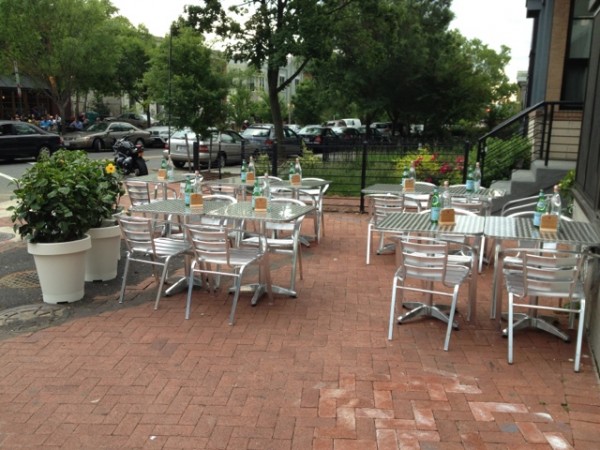
Our own bistro du coin
With the opening of Bistro Bohem, the corner of Florida Avenue and 6th Street is turning into a tiny culinary colony along Florida Avenue. Bohem’s popularity scuttled our plans for our first visit. It was 9 pm and we walked over looking to try it out. It was packed and there was a waiting list for both the tables and for the bar. All this on a Tuesday night!

A sign of things to come
After just a few weeks of operation, though, the restaurant is expanding into the old retail space that contained Zee’s, the Trinidadian restaurant that only lasted a few months. A sign on the window christens the space “Café Bohém”. On the 6th Street front, Bohem has added much-needed outdoor seating. We can imagine sitting there, sipping Bohem’s signature Bohemian margarita and watching the passersby. Many LeDroit Park and Bloomingdale residents walk by this intersection on their way to and from the Metro. On our visit, we spotted several neighbors returning from work.

Bohemian Margarita
The Bohemian margarita, by the way, was the best item we enjoyed on our recent visit to the restaurant. It’s not nearly as sweet as a regular margarita and benefits from the distinct taste of gin.
While the drink was noteworthy, the food needed some work. It wasn’t bad, but it wasn’t amazing either. Bohem offers a variety of “small plates” derived from the cuisine of Eastern Europe. The lightly browned mushrooms were served with a delicious garlic paprika aioli, but the mushrooms themselves suffered from being, well, mushrooms.

Lightly Browned Mushrooms
Mushrooms can be difficult to cook. They absorb water like sponges, resisting your best effort to dehydrate or saute them. Though the mushrooms were coated in breadcrumbs and fried, they were still disappointingly watery inside.
A popular dish is the pierogi, a typical eastern European dumpling stuffed with a potato cheese filling. Bohem garnishes the dish with caramelized onions.

Pierogis, one of Bistro Bohem's most popular dishes.
We hope it was a coincidence, but the pierogi dish contained a watery sauce, as evidenced by the photo. It’s decent, but like any pierogi dish, is simple in taste and perhaps better suited to snaking or breakfast. The caramelized onions were very… caramelized.
Tom Sietsema at the Post reviewed Bohem and recommends the chicken schnitzel, which he says “races ahead of the pack.” We will certainly try it on our next visit.
If you’re headed out for a serious meal, Shaw’s Tavern might be a better bet, but if you’re self-medicating the symptoms of a unpleasant job, Bistro Bohem’s drink menu will do the trick.







Recent Comments