
Howard promises to renovate the Terrell House
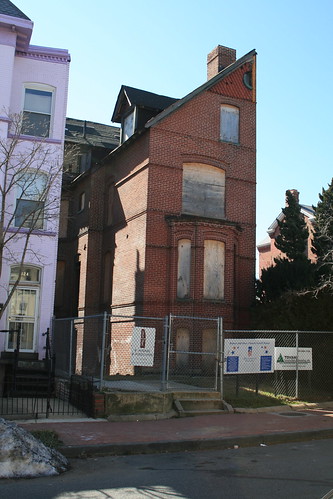 After years of neglect, Howard University has agreed to finish renovations of the Mary Church Terrell House (326 T Street NW).
Mary Church Terrell was a civil rights leader who lived from 1863 to 1954 and spent the last decades of her life in LeDroit Park. She was instrumental in lawsuit, D.C. vs. J. R. Thompson Co., Inc., that that led the U.S. Supreme Court to desegregate all restaurants in D.C. in 1953.
Mary Church Terrell and her husband Robert Terrell, D.C.’s first black judge, willed the house to their daughter and, upon her death, to Howard University, which took control of the house in 1998.
The university had long planned to renovate the house and turn into a museum focused on the Terrells and the history of the neighborhood. Those plans never came to fruition.
However, in a Feb. 26 meeting between community leaders, including me, and Howard University President Wayne Frederick, the president assured us that restoration work will start on the house within six months.
We have not seen the exact plans of the physical restoration the university will complete, but Dr. Frederick wants to revisit the concept of housing a museum as he perceives a lack of support for that specific use.
The president is well aware of the vast community support toward the house’s physical restoration. The LeDroit Park Civic Association voted in January to send a letter to the university’s leadership expressing disappointment at the state of the Mary Church Terrell House and the Walter Washington House (408-410 T Street NW), both of which are Howard properties in different state of disrepair.
A slew of hip retailers are opening near LeDroit Park
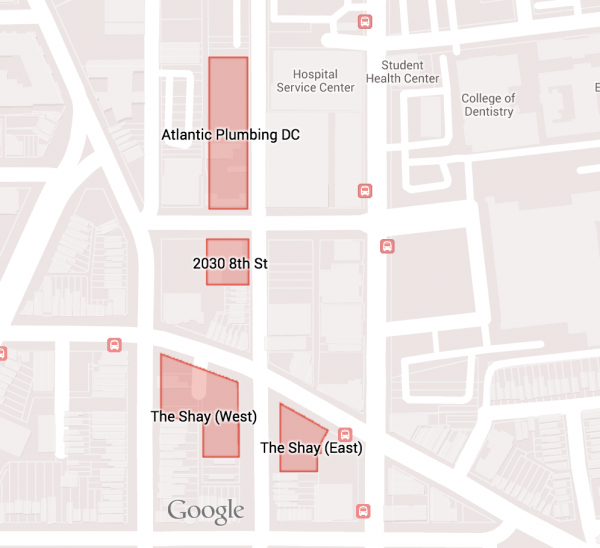
New shops are opening just west of LeDroit Park. Prolific Washington area developer JBG is nearing completion of the four buildings it is constructing just west of Georgia Avenue. Warby Parker, Compass Coffee, and restaurants from the people behind Birch & Barley and Daikaya will open soon.
The buildings, you may recall, have been in progress for several years. The northern two buildings, Atlantic Plumbing and 2030 8th Street sit on 8th Street on either side of V Street NW. The northern building, Atlantic Plumbing, is a 375-unit apartment building with ground-floor retail and a six-screen movie theater. The smaller southern building, 2030 8th Street is a 62-unit condo building.
The WBJ summed up the retail summed up the retailers coming to Atlantic Plumbing:
- Landmark Theatre – Six-screen theater featuring independent films.
- Hazel (probably) – A new restaurant from Neighborhood Restaurant Group, which currently owns Birch & Barley and Bluejacket.
- An unnamed ramen restaurant from the people behind Daikaya in Chinatown.
- Bazaar Spices – The second location for this independently owned herbs and spice shop, which also sells at Union Market.
- Cherry Blossom Creative – A graphic-design studio that will also offer original works for retail purchase.
- Foundry Gallery – An artist-run gallery that will move from Dupont Circle.
- Declaration Pizza – A new pizza shop from the owners of Lincoln and Teddy & the Bully Bar.
- Tasty Burger – The first DC-area location of this Boston-based burger chain.
- Typecase Industries – A locally-based letterpress and design studio.
- Washington Project for the Arts – The headquarters for a non-profit arts support organization.
On the 700 and 800 blocks of Florida Avenue, JBG is nearing completion of the two buildings, called the Shay, it has constructed above the Metro tunnel. Back in 2011, I documented the protracted saga to redevelop these two parcels. Though JBG had considered offering one of the buildings as condos, it has since chosen to keep both buildings as rentals, delivering a total of 336 apartments.
The WBJ reports the following retailers for the Shay:
- Warby Parker – Purveyor of hip spectacles.
- Freehand – A restaurant from Tim Ma, owner of Water & Wall in Arlington and Maple Ave. in Vienna.
- Compass Coffee – The second location for the coffee shop that currently operates on 7th Street in Shaw.
- Aesop – An Austrialian retailer of sustainable skincare, haircare and other personal care products.
- Benrus – The second U.S. locaiton of this watchmaker.
- Kit and Ace – Luxury clothing retailer.
- Read Wall – D.C.-based menswear retailer selling knits, outerwear, custom suits, and neckware.
- Steven Alan – Casual clothing for men and women.
A bicentennial map depicts LeDroit Park in 1975
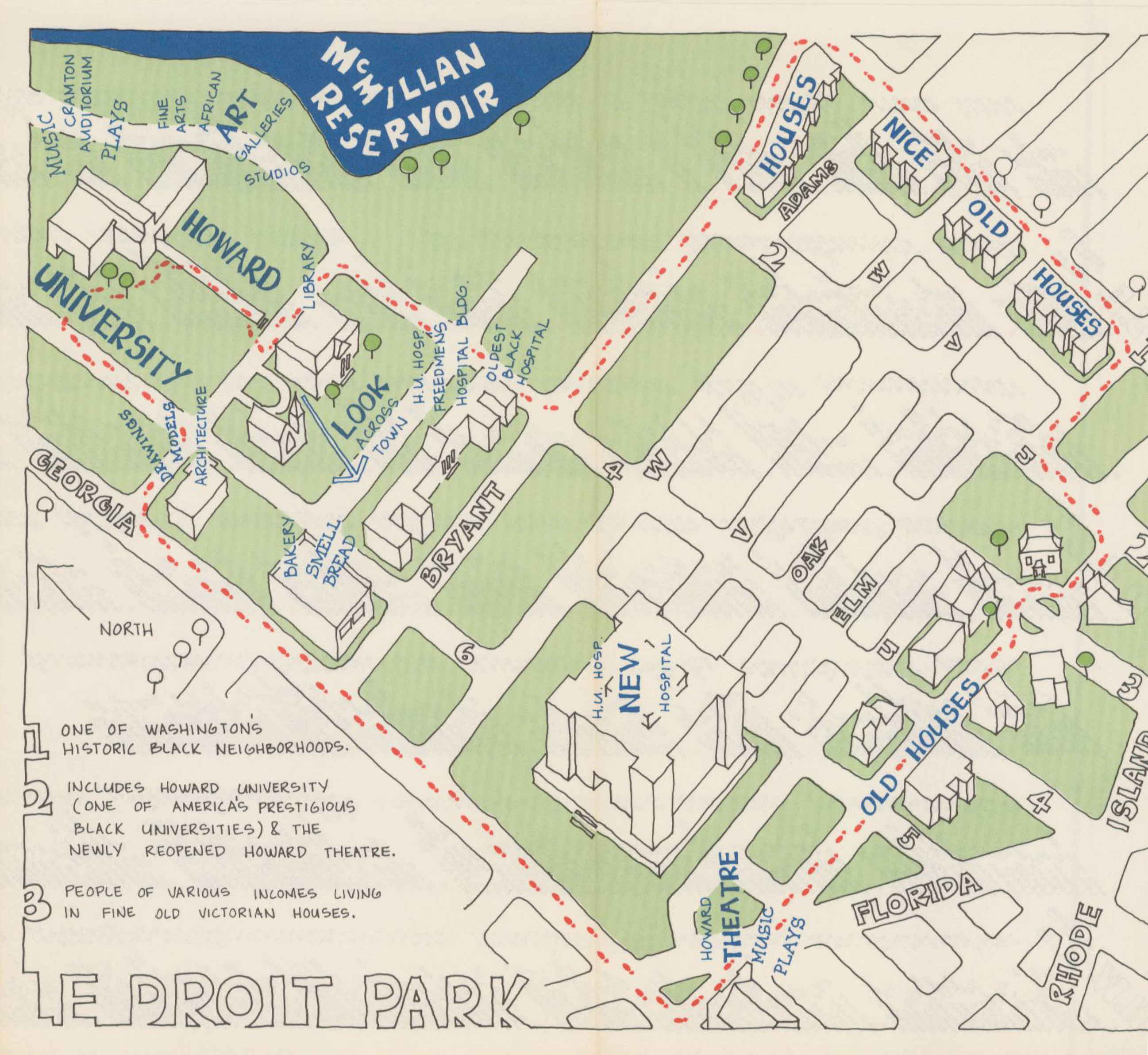
DDOT posted this map of DC published in 1975 to celebrate the bicentennial. The map includes a section on LeDroit Park. Notice the groovy font, the “new” Howard University Hospital, the “nice old houses”, the long-gone bakery, and the “newly reopened Howard Theatre.” The Howard Theatre had briefly reopened from 1975 to 1980.
Howard opens new buildings, reduces staff
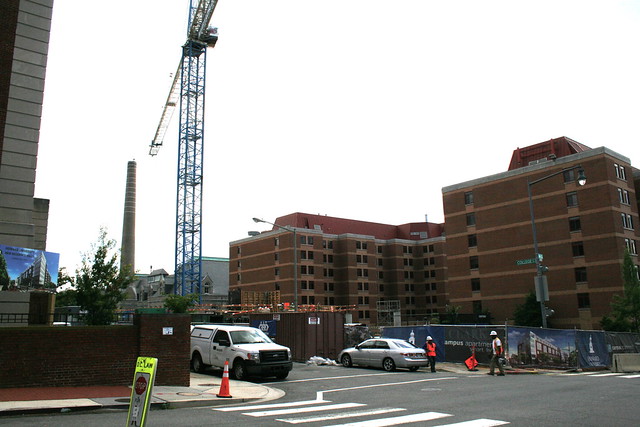
Howard University is reforming its hospital while its rank as DC’s largest employer slips. These changes come as the university looks to improve its academic program and its finances.
Financial difficulty is nothing new for Howard. In 2013 we reported that sequestration had cut its annual appropriate from Congress, enrollment had dropped, and one of its Trustees publicly warned of the university’s financial straits. Later that year, Moody’s downgraded the university’s bond rating from A3 to Baa1 as the hospital ran a $21-million loss.
The university furloughed staff and cut positions, but last year Moody’s downgraded the university further from Baa1 to Baa3, citing the hospital’s losses, which had increased to $37 million.
Since then the university has hired Paladin, a healthcare management consultancy, to reverse the hospital’s losses. University President Wayne Frederick recently told the Washington Business Journal that the hospital has made progress, particularly in billing more efficiently. (The fee-for-service model may be lucrative for healthcare providers, but the Obama Administration is trying to move the country away from it.)
Last week the hospital announced it would lay off 25 management positions and look to reduce staff further.
Meanwhile the university and its hospital have slipped in their rankings as DC’s largest employers. Over the past ten years, the university fell from first to seventh while the hospital fell from seventh to fifteenth.
| Employer | 2004 Rank | 2014 Rank |
|---|---|---|
| Georgetown University | 3 | 1 |
| Washington Hospital Center | 4 | 2 |
| George Washington University | 2 | 3 |
| Children’s Hospital | 5 | 4 |
| American University | 8 | 5 |
| Georgetown University Hospital | 9 | 6 |
| Howard University | 1 | 7 |
| Fannie Mae | 6 | 8 |
| Booz Allen Hamilton Inc. | 113 | 9 |
| Allied Barton Security Services LLC | – | 10 |
| Red Coats | 40 | 11 |
| Providence Hospital | 10 | 12 |
| George Washington University Hospital | 18 | 13 |
| Sibley Memorial Hospital | 13 | 14 |
| Howard University Hospital | 7 | 15 |
But the outlook isn’t all gloomy. The university recently completed two new dorms on 4th Street just north of the neighborhood and is nearing completion of its top-notch Interdisciplinary Research Building at Georgia Avenue and W Street.
Restaurant Costa Brava and Howard Univ. present tonight
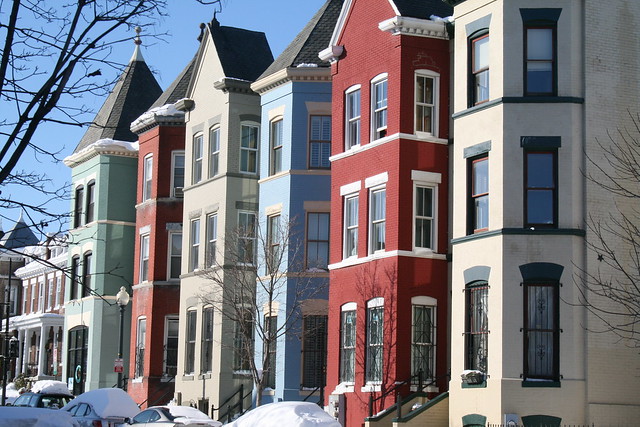
The January meeting of the LeDroit Park Civic Association is tonight at 7 pm in the basement of the Florida Avenue Baptist Church (enter at U Street and Bohrer Street).
The owner of Costa Brava (1837 First St NW) will introduce the neighborhood to his new Catalonian restaurant. I had dinner at the restaurant late last year and I highly recommend it.
Howard University representatives will propose changes to university policy regarding student conduct and public safety:
- Expanding the area around the campus deemed subject to the reporting of crime statistics.
- Giving universities broader authority to address student misconduct that takes place off-campus.
- Giving the Mayor or a university President the ability to request the assistance of other campus police personnel in cases of emergency, thus allowing the Metropolitan Police Department to focus their resources elsewhere.
The meeting will also include the usual committee reports and a community open forum. Everyone is welcome to attend.
New movie theaters are planned near LeDroit Park
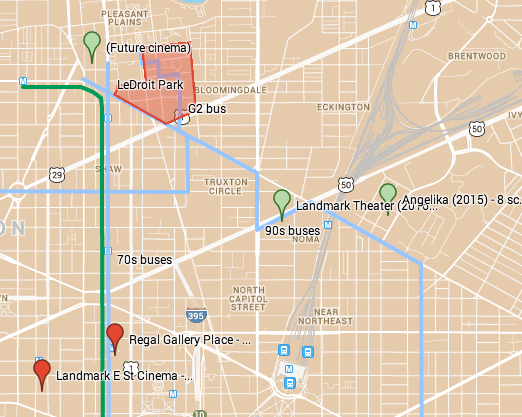
Two— possibly three— new movie theaters are set to open within a mile of LeDroit Park by 2016. All will be located within a block or two of Florida Avenue and are easily accessible by foot, bike, and 90s bus.
Atlantic Plumbing site – 800 V Street NW- unknown screens
Prolific developer JBG is starting construction on its Atlantic Plumbing project by the 9:30 Club. The project includes two mixed-use buildings on 8th Street NW, each on opposing sides of V Street. The northern building was supposed to include an 11,000-square-foot movie theater, but a September article in the WBJ makes no mention of a theater. The building will probably open in 2015.
Landmark Theater – New York Avenue & N Street NE- 10 screens
Capitol Point, another JBG mixed-use project, is located on New York Avenue NE near the maddening intersection with Florida Avenue NE. The mixed-use project is slated to receive a 10-screen Landmark Theater showing foreign and independent films. The chain currently has a location downtown on E Street and one in Bethesda. This new theater is scheduled to open in 2016.
Angelika Film Center – Union Market (5th Street & Neal Place NE) – 8 screens
Soon after you pass under the railroad tracks on Florida Avenue NE, Union Market appears embedded in the background on the left. These blocks constitute a wholesale food market that is slowly being redeveloped. The new Union Market building has met great success, featuring produce, prepared foods, oysters, meats, and dairy products along with chairs and tables for the impatient. The market fare is definitely upscale and vendors never shy from the word ‘artisanal’.
The market building’s developer announced it will open an 8-screen Angelika movie theater on an adjacent lot. Angelika theaters feature foreign and independent films and, as the Post described it, “culinary offerings from former Food Network executives.” The developer expects the theater to open in 2015.
Are we over-theatered?
Another movie theater is coming to different part of the District. In the Navy Yard, developer Forest City is planning an upscale 16-screen theater near Nationals Stadium and the Navy Yard Metro. The theater, at N Place and the future 1½ Street SE (a terrible name for a street), may not open until 2016 or later.
Can’t wait until 2015? There are four existing theaters within a 2.5-mile radius of LeDroit Park as the crow flies. The Landmark E Street Cinema (1100 block of E Street NW) and the Regal Gallery Place (7th & G Streets NW) are easily accessible from the Green Line, Yellow Line, and 70s buses. To the west of us, the West End Cinema (23rd & M Streets NW) and the AMC Loews Georgetown (3111 K Street NW) are easily accessible from the G2 bus, whose eastern terminus is LeDroit Park.
| Theater | Screens | Location | Opening | Distance |
|---|---|---|---|---|
| Atlantic Plumbing (??) | ? | 8th & V Sts NW | 2015? | 0.5 mi |
| Landmark – Capitol Point | 10 | New York Ave & N St NE | 2016 | 0.8 mi |
| Angelika Film Ctr. – Union Mkt. | 8 | 5th St & Neal Pl NE | 2015 | 1.3 mi |
| Regal Gallery Place | 14 | 7th & G Sts NW | open | 1.4 mi |
| Landmark E Street Cinema | 8 | 1100 b/o E St NW | open | 1.8 mi |
| West End Cinema | 3 | 23rd & M Sts NW | open | 2.1 mi |
| AMC Loews Georgetown | 14 | 3111 K St NW | open | 2.9 mi |
| Showplace Icon Theater | 16 | 1½ St & N Pl SE | 2016 | 3.3 mi |
Shaw Giant reopens Nov. 22
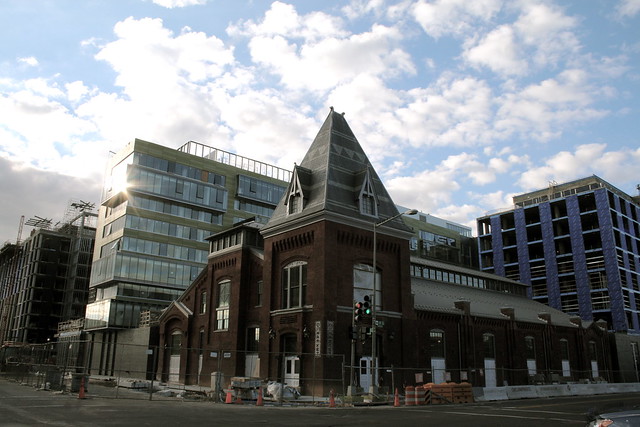
In 16 days the Giant at 7th & O Streets in Shaw will reopen after closing for redevelopment in 2011. The new store occupies 78,000 square feet, making it the largest grocery store in the District, and the closest grocery store to LeDroit Park.
Unlike the previous Giant, which was situated with its back to 9th Street, the new Giant will occupy the former historic market building along 7th Street. LeDroit residents can easily access the Giant by foot, bike, or the G2 bus, which runs along the north side of the store along P Street on its way between Georgetown and LeDroit Park.
The store is part of a larger development, City Market at O, which includes 182 hotel rooms, 407 market-rate apartments, and 90 affordable apartments for seniors.
Giant isn’t the only store opening soon. The new Trader Joe’s at 14th & U Streets is set to open early next year.
| Store | Location | Distance (mi) |
|---|---|---|
| Giant (opens Nov. 22, 2013) | 7th & O Streets NW | 0.6 |
| Trader Joe’s (opens early 2014) | 14th & U Streets NW | 0.9 |
| Safeway | 5th & L Streets NW | 0.9 |
| Harris Teeter | 1st & M Streets NE | 1.0 |
| Whole Foods | 1400 blk. P Street NW | 1.1 |
Three new restaurants and one beer garden open in Shaw
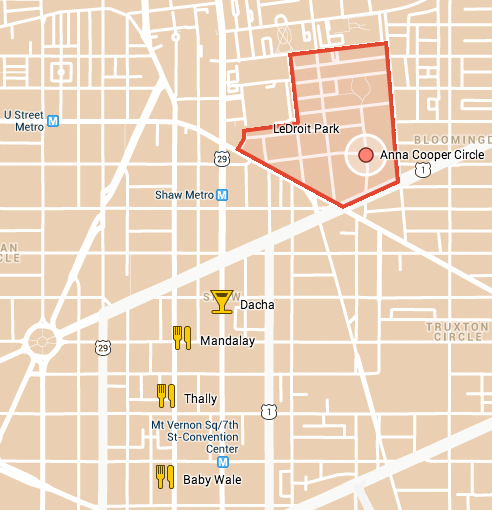
The opening of new restaurants on 14th Street has been prolific enough to merit attention from the New York Times and Wall Street Journal. These papers might want to turn their attention to Shaw, which is seeing three new restaurants and one beer garden open within a two-week period. All of these new places are within a mile of LeDroit Park.
Dacha
In time for Oktoberfest, Dacha beer garden opened Wednesday at 1600 7th Street to serve a variety of American, German, and Belgian beers. Dacha, like the Garden District beer garden (née Standard) on 14th Street, will close for the winter. After Dacha closes for the season, the owners will start construction on a permanent building to house the kitchen and bar.
Dacha is open weekdays from 4 pm to 10:30 pm and on weekends from noon to midnight.
Tomorrow from 2 pm to 3 pm, Mayor Gray is cutting the ribbon for three other restaurants, Mandalay, Thally, and Baby Wale.
Mandalay
After you finish your beer at Dacha, walk two blocks to Mandalay at 1501 9th Street, a site that has been in the works for several years. Though the building has been finished for some time, the restaurant, which sits on the ground floor, will open Sunday night for dinner.
Mandalay serves Burmese food, including many vegetarian options. The restaurant will serve eight family-style dishes at seatings at 5:30 pm and 7:30 pm Tuesdays through Sundays. Bring your wallet, though, as the prix-fixe menu is $40 on weekdays and $50 on weekends.
Thally
If you’re not in the mood for Burmese food, walk two blocks south on 9th Street to Thally (1316 9th Street), which opened last week. The restaurant, pronounced like ‘tally’, serves “modern American” food. First course items range from $8 to $10 and include peach and prosciutto soup, fancy BLTs, and crab roulette. Main course items range from $17 to $28 and include roasted duck, delmonico steak, and rockfish.
Thally is open from 5 pm to 11:30 pm Tuesdays through Sundays.
Baby Wale (I hope that’s not a menu item!)
If you’re more in the mood for wine and snacks, continue walking two blocks south to Baby Wale (1124 9th Street), a project of the Tom Power, who started Corduroy next door. Baby Wale, which opened last week, is far more casual than its upscale neighbor and serves soups, salads, sandwiches and “upscale bar food”. As for alcohol, the place serves specialty cocktails, 80 different bottles of wine, and six draft beers.
Baby Wale opens at 5 pm Mondays through Saturdays.
It’s amazing how quickly new restaurants are opening on Shaw’s primary main streets. Even more food options are on the way as Progression Place’s storefronts continue to fill and as the new Giant opens in November at 7th and O Streets.
| Name | Address | Distance | Cuisine |
|---|---|---|---|
| Dacha | 1600 7th St | 0.6 mi | beer garden |
| Mandalay | 1501 9th St | 0.7 mi | Burmese |
| Thally | 1316 9th St | 0.8 mi | Modern American |
| Baby Wale | 1124 9th St | 1.0 mi | wine and bar food |
The Lincoln Theater is back in business
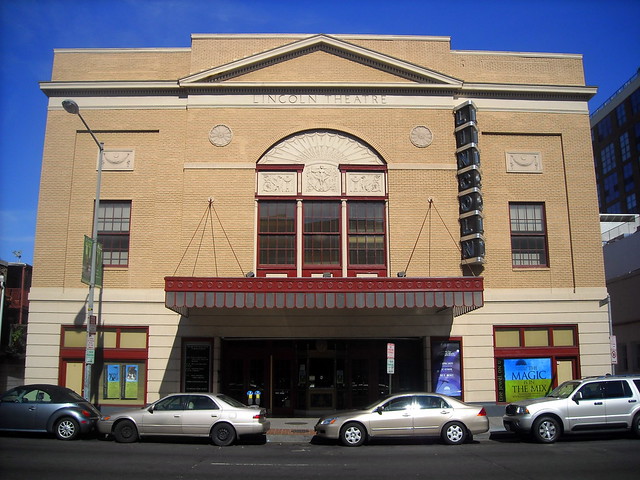
Photo by NCinDC on Flickr
The Post reports that music venue owner IMP, which operates the 9:30 Club and Merriweather Post Pavilion, is now managing the District-owned Lincoln Theater.
As we noted before, the Lincoln Theater’s revival in the 1990s failed to measure up to the Howard Theatre’s recent rebirth. Last year we compared the number of scheduled events at both theaters from May 11 to June 30, 2012. The contrast was stunning as the Howard had announced 51 scheduled events compared to the Lincoln’s paltry five.
The District’s new operator for the Lincoln has already booked comedians Ira Glass and Cheech and Chong, as well as musical performers Janelle Monae, Soundgarden’s Chris Cornell, and KT Tunstall for next month.
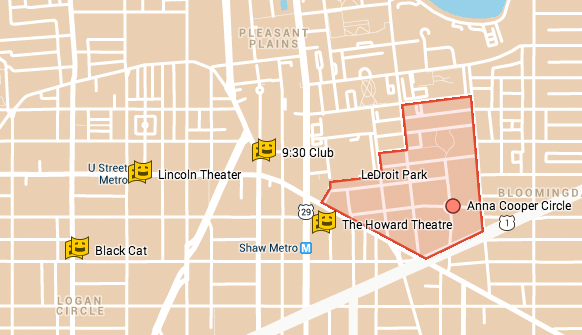
The Lincoln is just one of four big venues within a mile of LeDroit Park:
| Theater | Distance | Capacity |
|---|---|---|
| Howard Theatre | 0.3 mi | 600 if seated; 1,000 if standing |
| 9:30 Club | 0.6 mi | 1,200 standing |
| Lincoln Theater | 0.8 mi | 1,225 seated |
| Black Cat | 1.0 mi | 700 standing and 200 in the backstage |
The Lincoln Theater’s 1,225 fixed seats set the venue apart. Though this configuration limits the types of acts that will perform, it also guarantees each patron a reserved space.
Check out the Post’s handy comparison chart, including typical headliners and food options for each venue.
More retailers on board for Progression Place
Progression Place’s retail spaces are nearly leased out. Here is a list of what’s coming:
- Wanda’s—The hair salon that existed before construction started.
- SiTea— The second location for this Takoma-based tea shop.
- Bank of America
- Mockingbird Hill (already open)— Bar specializing in sherry and ham. [Read an earlier post on it]
- Eat the Rich— Oyster house from the owners of Mockingbird Hill.
- Sprint— Cell phone store
- (vacant retail bay)
- Fishnet— The second location for this Berwyn Heights-based, Mediterranean seafood and sandwich shop.
- Uprising Muffins

Don’t forget that Right Proper Brewing Company will open around the corner on T Street.
Here is the official leasing prospectus from Streetsense, the project’s retail broker.







Recent Comments